


Lee Tsai-chien (李再鈐) expected to expand his knowledge of Chinese sculpture when he set out for Europe’s galleries and museums in the early 1970s. What he didn’t expect to investigate, however, was the long tradition of Western sculpture dating back thousands of years.
“Traveling to China at the time was out of the question,” the 80-year-old sculptor said. “And when I traveled through Europe, I discovered for myself the ancient Greeks.”
What began as a search for Chinese sculpture ended with a book on Greek art and an enduring interest in the geometric forms that the ancient Greeks were obsessed with — an obsession that permeates the 16 abstract sculptures made from steel that are currently on display at the National Taiwan University of the Arts’ campus until March of next year.
The exhibition literature states that it is the largest outdoor exhibition of sculpture ever in Taiwan, and the lush grounds of Aigrette Down (鷺鷥草原) — a series of rolling hills to the left of the university’s front gate with stunning views of Taipei — serve as an ideal space for Lee’s large sculptures. Each sculpture can be seen as a meditation on an Eastern philosophical concept — whether Buddhism or Taoism — or Greek geometrical forms.
Jiang Yen-chou (江衍疇), the exhibit’s curator, breaks Lee’s abstract sculptures down into four periods both thematically and chronologically. “Finite and Infinite” dates to Lee’s earliest period — a time when he was establishing his personal style working with geometric shapes and surfaces. Using the symbol for infinity (∞) as inspiration, Unlimited Extension fuses three pyramids together in a way that resembles a closed ring. The surfaces proceed inward and outward and form an “unlimited extension” that goes on to infinity.
Lee’s “Decomposition and Composition” period reveals an interest in the five Platonic solids. It seems natural that the mathematics underpinning ancient metaphysical ideas would give way to an aesthetic of geometric forms. Cubed (元) is made up of three separate but linked cubes and demonstrates a mathematical theory through the combination of geometrical shapes.
A close reading of Buddhist and Taoist philosophy marks a transition to “Substance and Formlessness,” Lee’s third period, though still remains true to the geometric forms of the earlier works. Two for One (二而不二) incorporates the ideas of substance and formlessness, the physical and the imagination by juxtaposing two towers of stainless steel, the center of which is polished so as to provide a reflection of one with the other.
Lee shifts ideas inward in the final period, “Abstraction and Sense of Poetry,” and translates his personal experience into monumental sculptures. Dew (露), which stands in front of the university’s Administration Building, is a tall, slightly askew sculpture cross-sectioned with small bead shapes, which symbolize drops of dew and reveal Lee’s increasing interest in the natural world, “the most talented artist,” he said.
Like much abstract art, the works are somewhat difficult to penetrate unless given a clear guide as to what the artist is attempting. Fortunately, the title of each piece gives a hint as to the works’ multiple meanings.
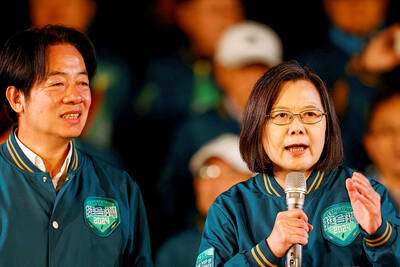
Last week Joseph Nye, the well-known China scholar, wrote on the Australian Strategic Policy Institute’s website about how war over Taiwan might be averted. He noted that years ago he was on a team that met with then-president Chen Shui-bian (陳水扁), “whose previous ‘unofficial’ visit to the US had caused a crisis in which China fired missiles into the sea and the US deployed carriers off the coast of Taiwan.” Yes, that’s right, mighty Chen caused that crisis all by himself. Neither the US nor the People’s Republic of China (PRC) exercised any agency. Nye then nostalgically invoked the comical specter
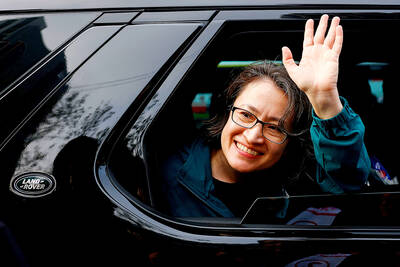
Relations between Taiwan and the Czech Republic have flourished in recent years. However, not everyone is pleased about the growing friendship between the two countries. Last month, an incident involving a Chinese diplomat tailing the car of vice president-elect Hsiao Bi-khim (蕭美琴) in Prague, drew public attention to the People’s Republic of China’s (PRC) operations to undermine Taiwan overseas. The trip was not Hsiao’s first visit to the Central European country. It was meant to be low-key, a chance to meet with local academics and politicians, until her police escort noticed a car was tailing her through the Czech capital. The
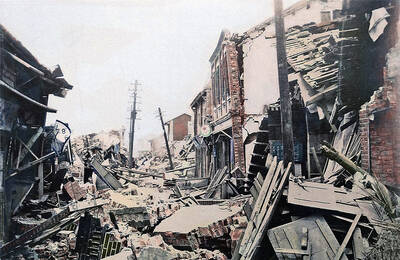
April 15 to April 21 Yang Kui (楊逵) was horrified as he drove past trucks, oxcarts and trolleys loaded with coffins on his way to Tuntzechiao (屯子腳), which he heard had been completely destroyed. The friend he came to check on was safe, but most residents were suffering in the town hit the hardest by the 7.1-magnitude Hsinchu-Taichung Earthquake on April 21, 1935. It remains the deadliest in Taiwan’s recorded history, claiming around 3,300 lives and injuring nearly 12,000. The disaster completely flattened roughly 18,000 houses and damaged countless more. The social activist and

Over the course of former President Ma Ying-jeou’s (馬英九) 11-day trip to China that included a meeting with Chinese Communist Party (CCP) leader Xi Jinping (習近平) a surprising number of people commented that the former president was now “irrelevant.” Upon reflection, it became apparent that these comments were coming from pro-Taiwan, pan-green supporters and they were expressing what they hoped was the case, rather than the reality. Ma’s ideology is so pro-China (read: deep blue) and controversial that many in his own Chinese Nationalist Party (KMT) hope he retires quickly, or at least refrains from speaking on some subjects. Regardless


 RSS
RSS