


Images of Parisian buildings and streets hover, falter, are superimposed on each other and multiply. Sometimes they spiral into an unrecognizable swirl; other times, they stutter at an almost imperceptible speed. Resurrection (甦醒), the solo exhibition by experimental filmmaker and academic Tony Chun-hui Wu (吳俊輝) currently on display at Galerie Grand Siecle (新苑藝術), is the artist’s latest attempt in his ongoing exploration of images in states of metamorphosis as they move through different formats and technologies.
Wu, an assistant professor at the department of radio, television and film in Shih Hsin University (世新大學), has shown his works shown at some of the world’s foremost art institutes, including the Museum of Modern Art in New York City, Centre Pompidou in Paris and San Francisco Cinematheque. His videos from before 2003 are generally made from collages and footage from 8mm and 16mm film and explore the aesthetic possibilities of various film formats. In 2005 he turned to digital filmmaking with Taipei 4-Way — exTAIPEIit (台北四非—遠離台北), which was exhibited at the Taipei Biennial at the Taipei Fine Arts Museum (台北市立美術館). His 2006 exhibition Europe Resurrection saw Wu expanding into multimedia with a study that combined still photography, film and digital imaging.
A natural progression from Europe Resurrection, Resurrection comprises four new filmic works building on color sides that Wu photographed last summer in Paris during his residency at the Cite Internationale des Arts. Still images are cut, split, reconstructed and reprinted on 35mm film, which is then digitally edited. The result is infinite combinations of images that seem almost desperate to return to the original medium in which they were captured, an impossible task as segments and details are lost and omitted in the process of conversion from format to format. “The stills are animated and transformed by the filmic time and then (re)frozen in digital imaging. But such freezing can only be possible in a state of ambiguity, as the images are engraved with the sense of time inherent in still photography and film,” Wu said.
Resurrection can be divided into two themes, according to content. Paris Resurrection shows 15 famous locations in Paris that disintegrate, fuse, accelerate and freeze in a visual experience that mimics the perspective of a traveler passing through the city.
But I Couldn’t See Her Face focuses on the perception created by shifting the relationship between the artist and the places he films. “Say I took one photo of the Notre Dame de Paris every 10 steps as I walked toward it. When translated into film, the architecture would appear to oscillate because the relation between us changed,” Wu explained.
Standing in contrast with the above two, Bonne Paris and Last Night, I Had a Dream About Our Mother are made from images of empty streets the artist took in Paris’ 20 arrondissements, or districts. The inspiration came from Wu’s perception of Paris in the summer as a ghost town haunted by ghostly tourists.
Hoping to show not only the end result but also the creative process, Wu will use the gallery as a studio from time to time, starting new projects in a dimly lit room at the end of the gallery. Visitors are welcome to sit with the artist and ask lots of questions.
Wu believes an artist should have the courage to challenge prevailing ideas. Recalling the raised eyebrows and general disapproval when Europe Resurrection was first staged, he noted that experimental cinema isn’t well received by the contemporary art scene in Taiwan, though the artistic form has long been part of the fine-arts tradition in the West. In Taiwan, he said, the Golden Harvest Awards (金穗獎) and Urban Nomad Film Festival are the only remaining venues that support experimental filmmaking.
“I see an incredible amount of creativity and energy in my students’ works, but there are no venues to show them,” Wu said. “I am planning to organize a showcase for experimental films with my students. It will begin with the campus, of course, but may grow into an international venue someday.”

Last week Joseph Nye, the well-known China scholar, wrote on the Australian Strategic Policy Institute’s website about how war over Taiwan might be averted. He noted that years ago he was on a team that met with then-president Chen Shui-bian (陳水扁), “whose previous ‘unofficial’ visit to the US had caused a crisis in which China fired missiles into the sea and the US deployed carriers off the coast of Taiwan.” Yes, that’s right, mighty Chen caused that crisis all by himself. Neither the US nor the People’s Republic of China (PRC) exercised any agency. Nye then nostalgically invoked the comical specter
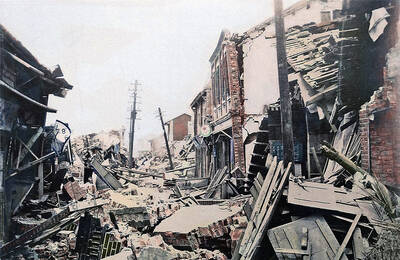
April 15 to April 21 Yang Kui (楊逵) was horrified as he drove past trucks, oxcarts and trolleys loaded with coffins on his way to Tuntzechiao (屯子腳), which he heard had been completely destroyed. The friend he came to check on was safe, but most residents were suffering in the town hit the hardest by the 7.1-magnitude Hsinchu-Taichung Earthquake on April 21, 1935. It remains the deadliest in Taiwan’s recorded history, claiming around 3,300 lives and injuring nearly 12,000. The disaster completely flattened roughly 18,000 houses and damaged countless more. The social activist and

Over the course of former President Ma Ying-jeou’s (馬英九) 11-day trip to China that included a meeting with Chinese Communist Party (CCP) leader Xi Jinping (習近平) a surprising number of people commented that the former president was now “irrelevant.” Upon reflection, it became apparent that these comments were coming from pro-Taiwan, pan-green supporters and they were expressing what they hoped was the case, rather than the reality. Ma’s ideology is so pro-China (read: deep blue) and controversial that many in his own Chinese Nationalist Party (KMT) hope he retires quickly, or at least refrains from speaking on some subjects. Regardless

Approaching her mid-30s, Xiong Yidan reckons that most of her friends are on to their second or even third babies. But Xiong has more than a dozen. There is Lucky, the street dog from Bangkok who jumped into a taxi with her and never left. There is Sophie and Ben, sibling geese, who honk from morning to night. Boop and Pan, both goats, are romantically involved. Dumpling the hedgehog enjoys a belly rub from time to time. The list goes on. Xiong nurtures her brood from her 8,000 square meter farm in Chiang Dao, a mountainous district in northern Thailand’s


 RSS
RSS