


Wednesday’s concert by the National Symphony Orchestra under Gunther Herbig had had its heart torn out before it even started. The young Russian pianist Alex Kobrin, scheduled to play Mozart’s Piano Concerto in D Minor, K.466 — perhaps his most ambitious exercise in the medium — was unable to fit the concert’s revised date into his schedule (it was to have taken place on Sunday afternoon but was moved to Wednesday because of the typhoon). Beethoven’s two violin romances, and another for two violins by Pablo Sarasate, were substituted, giving Taipei the same program Kaohsiung was due to hear the following Saturday [20 Sept.].
The result was an airing of exclusively 19th-century works, all of them extremely well-known. Is this really what the NSO, currently experiencing low ticket sales, really should be offering? Next July’s Carmen will also be something no one will be hearing for the first time, replacing Debussy’s Pelleas et Melisande, an opera by a composer young Taiwanese instrumentalists I know are often enthusiastic about.
I admit my limited receptivity to these three charming but slight violin works, Wagner’s Meistersinger Prelude and Brahms’ First Symphony was influenced by having spent the earlier part of the day listening to Janacek’s dynamic and highly original opera From the House of the Dead, vital music that has probably never been heard live here in Taiwan.
But I was prompted to wonder, nonetheless, whether this kind of extremely cautious programming was the right fare to offer Taiwan’s generally open-minded, well-educated and well-informed concertgoers. But at least November’s homegrown opera premier, The Black Bearded Bible Man, remains in the NSO program to challenge audiences with the promise of novelty.
U-Theater (優人神鼓) began its performance of The Walk at the National Theater with a short documentary of their 12,000km walk around Taiwan. One memorable shot was of an exhausted walker laying on a children’s slide, his head at the foot and his legs resting on the slope, red cap over his face. Given the quick pace at which was the company traveled, such exhaustion was merited.
The Walk moves for the most part at a much slower pace, but proved to be a very rewarding journey. Though there are some fast-paced segments, the image that lingers is of walkers moving single file, lifting each foot and putting it down ever so slowly, each muscle contraction and release a meditation in itself.
It’s always hard to describe U-Theater to someone who has not seen them. “A Zen drumming group” is the usual definition, but it is so much more. Each of the group’s productions is built around drumming, but company founder and director Liu Ruo-yu (劉若瑀) started off as an actress and her sense of showmanship helps keep audiences riveted, even during set changes.
Abstract images of the ocean, leaves and forests were projected on the backdrop and a small drop scrim was artfully used both to conceal and to highlight the performers. In section four (晚風紅日), a bright sun blazed on the screen, while the sound of the small drums carried by the performers epitomized the sun beating down on your head on a hot day. The sun was replaced in section five (山谷流泉) with shifting ocean waves of teal blue, turquoise and sky blue, while the incredible voice of Aboriginal singer Inka Mbing helped carry some of the women on their journey, much as Iki Tadaw’s singing began the show.
A few blocks south at the Taipei Guiling Street Avant-Garde Theater on Saturday afternoon there was a journey on a much smaller scale, as Sun Chuo-tai’s (孫梲泰) 8213 Physical Dance Theater (8213肢體舞蹈劇場) explored cross-cultural differences and identity in Boundless: My Bliss (無國界∣我的天堂).
Sun allowed each performer to showcase their talent, even though at other times they were competing for attention — from one another and from the audience, physically and verbally. Mimi Cave’s dialogue on global warming and how practicing yoga and being a vegetarian made her a better person (so why should she have to worry about turning off lights and turning down the air-conditioner?) was spot-on.
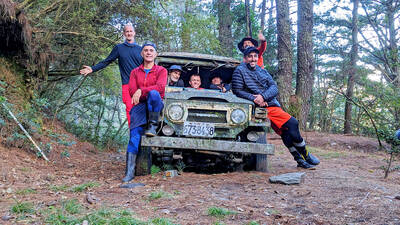
The year was 1991. A Toyota Land Cruiser set out on a 67km journey up the Junda Forest Road (郡大林道) toward an old loggers’ camp, at which point the hikers inside would get out and begin their ascent of Jade Mountain (玉山). Little did they know, they would be the last group of hikers to ever enjoy this shortcut into the mountains. An approaching typhoon soon wiped out the road behind them, trapping the vehicle on the mountain and forever changing the approach to Jade Mountain. THE CONTEMPORARY ROUTE Nowadays, the approach to Jade Mountain from the north side takes an

Last week Joseph Nye, the well-known China scholar, wrote on the Australian Strategic Policy Institute’s website about how war over Taiwan might be averted. He noted that years ago he was on a team that met with then-president Chen Shui-bian (陳水扁), “whose previous ‘unofficial’ visit to the US had caused a crisis in which China fired missiles into the sea and the US deployed carriers off the coast of Taiwan.” Yes, that’s right, mighty Chen caused that crisis all by himself. Neither the US nor the People’s Republic of China (PRC) exercised any agency. Nye then nostalgically invoked the comical specter

Relations between Taiwan and the Czech Republic have flourished in recent years. However, not everyone is pleased about the growing friendship between the two countries. Last month, an incident involving a Chinese diplomat tailing the car of vice president-elect Hsiao Bi-khim (蕭美琴) in Prague, drew public attention to the People’s Republic of China’s (PRC) operations to undermine Taiwan overseas. The trip was not Hsiao’s first visit to the Central European country. It was meant to be low-key, a chance to meet with local academics and politicians, until her police escort noticed a car was tailing her through the Czech capital. The
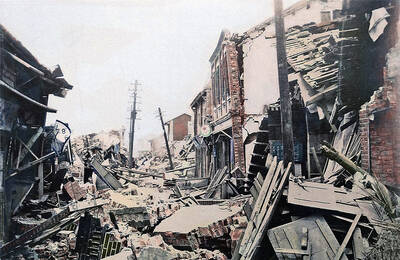
April 15 to April 21 Yang Kui (楊逵) was horrified as he drove past trucks, oxcarts and trolleys loaded with coffins on his way to Tuntzechiao (屯子腳), which he heard had been completely destroyed. The friend he came to check on was safe, but most residents were suffering in the town hit the hardest by the 7.1-magnitude Hsinchu-Taichung Earthquake on April 21, 1935. It remains the deadliest in Taiwan’s recorded history, claiming around 3,300 lives and injuring nearly 12,000. The disaster completely flattened roughly 18,000 houses and damaged countless more. The social activist and


 RSS
RSS