


In 2003, the same year that he unveiled The Weather Project, his now legendary giant artificial sun that lit up the Turbine Hall at London’s Tate Modern, Olafur Eliasson also created a much more intimately dramatic work of art. In a makeshift gallery at the Venice Biennale, he installed a white plastic drum that protruded from a wall with a red button on it that said “PRESS.” Anyone who was brave or curious enough to press the button was startled seconds later by an intense flash of light from within the drum. For several minutes afterwards, each time the viewer blinked, the word “UTOPIA” was imprinted on their retina. It was a work of art that literally made you see the world differently, and as such was both an illustration of and a metaphor for the Icelandic-born artist’s methodology. Perhaps more than any other artist working today, Eliasson involves the viewer directly in the artworks he creates. “My work is not about me,” he once said, “it’s about you.”
The Weather Project was the most successful single work of contemporary art exhibited in Britain in recent years, attracting an astonishing 2 million viewers to Tate Modern. More interesting still was the way in which the audience interacted with the piece. Many visitors wandered slowly through the Turbine Hall as if determined to take it all in, while others lounged on the floor for hours like sunbathers. Some days the atmosphere turned celebratory as crowds of strangers interacted by arranging their bodies to spell out giant words that were reflected on the mirrored ceiling. When Tim Neuger, Eliasson’s gallerist in Berlin, visited Tate Modern, a group of young people had spelt out the words “Fuck Bush” on the ceiling. He rang Eliasson in Berlin and let him listen to the cheers of the crowd echoing though the Turbine Hall.
You could say that Eliasson has reinvented the way in which conceptual art is received by the public, replacing the usual hushed reverence — or sighs of exasperation — with a mood of playful and anarchic mischief. “I do not see my work as any kind of statement or a manifesto,” he says. “It’s a dialogue. Always.”
Right now, that dialogue is continuing apace in New York, and with equally dramatic results, where Eliasson has created a series of giant self-propelling waterfalls on the East River. Situated at four different points between Manhattan and Brooklyn, the New York City Waterfalls range in height from 27m to 36m, each pumping up to more than one million liters of water a minute up and over their giant frames. At night, they are illuminated, adding another level of surrealism to an otherwise drab stretch of the river. Eliasson’s art attempts to make us see the everyday in a different light. “In a way,” says Eliasson, “I like to think that I have given New Yorkers back their river.”
And they, in their turn, have responded in kind. On the online photograph site, Flickr, visitors have posted more than 5,000 snapshots of the waterfalls, a mass response that pleases Eliasson much more than the chorus of excited approval that greeted the project’s unveiling in the US media. “On Flickr, the photographs have been taken mainly on mobile phones, and often there are people in the photographs with the waterfalls,” he says. “It’s a highly subjective way of documenting the work. I see the waterfalls as a co-producer of the time and place in which they take place. I suppose, in that way, the work filters into questions about society and democracy.”
This may indeed be the case, but it strikes me later, while perusing the images on Flickr, that the New York City Waterfalls may also function as a kind of temporary tourist attraction that visitors pose in front of in much the same way that they pose in front of the iconic skyline or the Statue of Liberty further out in the harbor. In this way, Eliasson’s artwork may well have slipped, like artworks have a tendency to do, out of the artist’s control.
And for Olafur Eliasson, art does seem in a very real way to be about control. He frets a lot about how his work is interpreted to the point where he often tries to undercut the media’s tendency to report what he does as mere spectacle. Or, as he puts it, “I have a team that includes lawyers, copyright specialists, press officers, all making sure that the values I think the work represents are navigated into the communication of the project throughout the process. In my practice, I try my best to avoid the experience of my work being formalized, standardized, generalized and rationalized. My work is about the opposite.”
For someone who makes epic works of such sublime beauty — in itself quite a feat in an age when notions of the sublime in art sometimes seem as passe as pastels and watercolors — Eliasson is a doggedly serious, even earnest, young man. Talking to him about his art can be oddly exhausting. His mind, as his ambitious projects suggest, is in constant motion, one thought spiraling into another in ever-evolving circles of conceptual complexity. Like many installation artists, he has a tendency to theorize and his speech is littered with terms like “duality” and “collectivity,” not to mention “experiential.” He is the contemporary artist-as-boffin as well as architect, designer, philosopher and scientist.
“If one were to look for precedents as to the way Olafur works,” says Hans Ulrich Obrist of the Serpentine Gallery in London, where the artist created a pavilion last summer, “it would have to be Buckminster Fuller, the artist-as-inventor. He has that kind of enquiring approach where the art emerges out of collective studio operation that is essentially a laboratory of ideas.”
To this end, Eliasson currently employs around 40 people in his Berlin studio, including architects and scientists as well as craftsmen and designers. It’s all very Scandinavian, the notion of the unified aesthetic taken to conceptual extremes in the pursuit of art that is so ambitious in both its form and content that it engages the audience almost as much as it has engaged the minds of its creators. Before he installed his giant sun in Tate Modern, Eliasson’s team constructed a small-scale version of the Turbine Hall, about 12m long, in his studio so that they could wander through it and observe the effects.
I meet Eliasson in Copenhagen, where he has a big, bright, airy harbor-side office. He lives in the Danish capital with his wife and two adopted children when he is not working in Berlin, or flying around the world to oversee the various high-concept art projects he seems to be juggling at any given time. (In 1998, he had more than 60 artworks on show across the world.) Both his adopted son and daughter are Ethiopian, and he and his wife, the art historian Marianne Krogh Jensen, run a charity for Ethiopian orphans called 121Ethiopia.org. Recently, he designed a kind of mini art installation in the form of a light projection that will greet visitors to every Louis Vuitton shop on the planet — there are more than 300. All the money earned from the commission went directly to his charity fund.
Currently, Eliasson is involved in an ambitious urban renewal project in Manhattan called the High Line, and earlier this summer he had a big retrospective of his work at MoMA. Alongside the architects Diller Scofidio+Renfro, he will help transform a 2.4km stretch of disused elevated railway track into an elongated shopping mall with a park. Or, as the DS+R Web site puts it, “a post-industrial instrument of leisure reflection.” You can see why Olafur gets along with them.
For the past two-and-a-half years, he has also been working on what he calls his “academy.” The vast new office-cum-studio space he has purchased in Berlin was formerly a school and, when it is converted, will house up to 20 student-apprentices who, Bauhaus-style, will learn how to be artists by being on-site and contributing to the Eliasson laboratory of ideas.
“Though all this is not related directly to making art, it is exciting and therapeutic,” he says, sounding genuinely enthused by the challenge. “When you move studio, you can also optimize the values of the workplace. I can now give more space to the things that have turned out to be important and shed the less interesting things. A studio is not just a workspace but a little psychographic universe of the brain.”
At 40, Eliasson still has the air of the brainiest boy at school about him, and his chic wardrobe and designer spectacles somehow accentuate his palpable sense of studiousness. He was born in Denmark though both his parents are from Iceland, where his father worked as a cook on a fishing boat and a part-time artist, and his mother as a dressmaker. Interestingly, both his grandparents were bohemians: his grandfather published avant-garde writing, while his grandmother was a photographer of some local repute, and hosted a salon where Reykjavik’s scattered artistic community gathered to argue and swap ideas. “I am not avant-garde at all,” says Eliasson. “I do not want to be a spokesman or lead a movement. I am essentially a traditionalist.”
Eliasson was four when his parents split up. A few years later, after his father moved back to Iceland, he began spending his summer holidays there with him. You sense that the country’s elemental landscapes, strange sunlight and long shadows have had some deep and lasting effect on his creative psyche. As a teenager, he was a prolific drawer, specializing in anatomical sketches. By 14, he had also discovered breakdancing, which he seems to have embraced with the same fervor as he later pursued conceptual art. With his teenage posse, The Harlem Gun Crew, he toured Scandinavia, and even won the national break-dancing championship. Today, he is resolutely tight-lipped regarding his personal life, but recently he told the New Yorker that break-dancing “really gave me a quite particular idea of space, and an obsession with how the body moves within that space.”
The same article had also revealed that, in 1987, his grandfather had committed suicide and that afterwards, as part of his university application, Eliasson had submitted a piece of sculpture in the form of a black gravestone.
He looks genuinely perturbed when I mention the New Yorker piece in passing. “Why on earth would anyone want to write a piece like that? I mean, what was it about? The media do not know exactly how to verbalize something that does not anchor in the personal life of an artist. The music and fashion industry have promoted that idea for so long that it has become a model for how the media wants to address art.” He shrugs his shoulders and sighs. “Also, I’m just not interesting enough to do that kind of profile on.”
This is a refrain that echoes throughout our conversation, and suggests that the incredible success of The Weather Project and New York City Waterfalls has brought in its wake a level of exposure that Eliasson is utterly uncomfortable with. Earlier, when the subject of the Young British Artists, and Tracey Emin in particular, had come up, he had said, “Emin is the opposite of me. Merging her life and her artwork completely is her greatest success, but I do not have those social skills. I am much more mainstream and boring. I am an uninteresting person really. I try to let the work go out there and not to require me to be in front of it.”
When I ask him who his formative influences were, he thinks for a moment, as if weighing up whether he should reveal them or not. Finally, he says, “I started out being interested in the American west coast movement — Sol LeWitt, Donald Judd, Dan Flavin. Then, I came across the so-called land artists — Richard Long, Hamish Fulton.”
Eliasson’s willingness to make epic artworks in the open air, though, recalls the work of Christo, who, back in the 1970s and 1980s, famously wrapped huge public buildings in fabric. Initially, though, after graduating from the Royal Danish Academy of Fine Arts, Eliasson expressed himself though photography: big Icelandic landscapes whose horizons and dimensions seemed askew. Soon, though, he moved into more ephemeral territory, using water, ice, steam and light in installations. In Venice, he also created the Yellow Room, which was lit by the kind of high-definition sodium lights that are used in Swiss motorway tunnels. He described, in his inimitable way, the experience of walking through it as “hyper-seeing.”
More dramatic still was his now legendary act of interventionist or guerrilla art, the Green River project, which consisted of dyeing rivers in various cities bright green. Using industrial amounts of the same vegetable dye that Irish-American bars use to color the beer on St Patrick’s Day, Eliasson managed to change the color — at least for a brief moment — of rivers in Tokyo, Los Angeles and Stockholm. The impulse, he says, was the same one that drove the Waterfalls project. “It makes the water explicit. You see the river differently. It shows that the river is a bloody river and not a postcard.”
Eliasson is quick to point out that, while the Green River was “an activist project,” the New York City Waterfalls is not. Does his work have an ecological agenda, as some have suggested? He sighs, but then concedes that this is an interesting question.
“With The Weather Project, I ask myself that question all the time. I did not anticipate the global warming issue as it is today, it was more an attempt to set up ideas that would constitute a platform for collectivity. But the weather has become politicized. So, interestingly, the world has changed and the reading of my work has changed with it, but the work itself hasn’t changed.”
He stares at my tape recorder for a long moment, as if lost in thought, then he says, “One should be careful about only amplifying the ecological aspects of the waterfalls. I certainly don’t consider myself an eco-warrior. Not at all. Talking about green power, that is for the brain. I’m not an intellectual artist, as you can see from my art. I make my work and then I talk about it. My work does not illustrate my ideas; my ideas try and support my work.”
Nevertheless, this is a man who initially wanted the Turbine Hall in Tate Modern to accommodate a tropical rainstorm as well as a giant sun. For once, though, the mechanics could not support the idea. The New York City Waterfalls, it strikes me, may well be that idea transformed. Indeed, one could view Eliasson’s entire output as one unified work-in-progress.
“Olafur’s process has to do with producing reality,” says Hans Ulrich Oberst, “and that has taken him way beyond the exhibition space. He has an incredible sense of determination and a commitment to pursuing his ideas to see where they lead. With him, it’s not so much about the destination but the journey itself.”
Towards the end of our meeting, I ask Eliassson, who has grown visibly restless, if he ever finds the time to daydream or be bored? He looks momentarily startled. “When I am bored, I start doubting whether I exist,” he replies, without irony. “When I don’t do anything, I feel I might disappear.”
I ask him, in conclusion, if there might come a point when the bigness starts getting in the way of the art. “Generally speaking, you are surely right,” he says, frowning and looking even more fretful, “but one needs to challenge oneself and look deeper and ask oneself what role art has in society. To answer that question, one must take certain risks in order to reinvent what art can do. For me, the question is not how big or how small, but does the work succeed.”

Last week Joseph Nye, the well-known China scholar, wrote on the Australian Strategic Policy Institute’s website about how war over Taiwan might be averted. He noted that years ago he was on a team that met with then-president Chen Shui-bian (陳水扁), “whose previous ‘unofficial’ visit to the US had caused a crisis in which China fired missiles into the sea and the US deployed carriers off the coast of Taiwan.” Yes, that’s right, mighty Chen caused that crisis all by himself. Neither the US nor the People’s Republic of China (PRC) exercised any agency. Nye then nostalgically invoked the comical specter

Relations between Taiwan and the Czech Republic have flourished in recent years. However, not everyone is pleased about the growing friendship between the two countries. Last month, an incident involving a Chinese diplomat tailing the car of vice president-elect Hsiao Bi-khim (蕭美琴) in Prague, drew public attention to the People’s Republic of China’s (PRC) operations to undermine Taiwan overseas. The trip was not Hsiao’s first visit to the Central European country. It was meant to be low-key, a chance to meet with local academics and politicians, until her police escort noticed a car was tailing her through the Czech capital. The
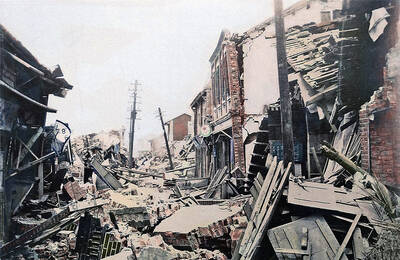
April 15 to April 21 Yang Kui (楊逵) was horrified as he drove past trucks, oxcarts and trolleys loaded with coffins on his way to Tuntzechiao (屯子腳), which he heard had been completely destroyed. The friend he came to check on was safe, but most residents were suffering in the town hit the hardest by the 7.1-magnitude Hsinchu-Taichung Earthquake on April 21, 1935. It remains the deadliest in Taiwan’s recorded history, claiming around 3,300 lives and injuring nearly 12,000. The disaster completely flattened roughly 18,000 houses and damaged countless more. The social activist and

Over the course of former President Ma Ying-jeou’s (馬英九) 11-day trip to China that included a meeting with Chinese Communist Party (CCP) leader Xi Jinping (習近平) a surprising number of people commented that the former president was now “irrelevant.” Upon reflection, it became apparent that these comments were coming from pro-Taiwan, pan-green supporters and they were expressing what they hoped was the case, rather than the reality. Ma’s ideology is so pro-China (read: deep blue) and controversial that many in his own Chinese Nationalist Party (KMT) hope he retires quickly, or at least refrains from speaking on some subjects. Regardless


 RSS
RSS