


The Boat, the first book of Vietnamese-born Nam Le, has taken the English-speaking literary world by storm, certainly in Australia and the US. The author left Vietnam when very young and eventually arrived in Australia. He subsequently began work as a lawyer but gave that up to enroll in creative-writing courses in the US. He now divides his time between these two countries.
The book consists of seven short stories (itself unusual for a first publication) and each of them is entirely different — in setting, style, and the point of view of the narrator or principal character. Only the first and last stories, both immensely strong, feature Vietnam, though neither has it as its principal location. Others are set in Colombia, Iran, Japan, Australia and the US.
Every story is a tour de force of imaginative sympathy and thoughtfulness. The one set in Japan, for example, is entirely phrased in the words of a small girl in Hiroshima in the days before the unleashing of the atomic bomb — she talks with gentle innocence of butterflies, flowers, the revered emperor, the war effort, and the lack of danger posed by single American aircraft — they only drop leaflets that it’s forbidden to read, she muses as she plays in the dust.
The Colombia story is set in the drug capital of Medellin and is narrated by a teenager with orders from his gangland boss to kill his best friend. Grenades, pistols and machine guns are part of his everyday life, but by an extraordinary effort of empathy he’s presented by the author as the adolescent he is, and with an adolescent’s attitudes and loyalties, but forced into a terrifyingly adult predicament.
The story set in Teheran features an American woman who’s visiting an Iranian friend she got to know in the US. She labors under multiple levels of incomprehension, and yet Iranian society is displayed in extraordinary detail — the food, the furnishings, the views from the city, the religious and other customs. I found it the least satisfying of the stories because I didn’t understand why it ended as it did, but even so overall this is a quite exceptional book.
Nam Le is something of an intellectual writer — his vocabulary is extensive and even occasionally abstruse, and one of his greater strengths is giving characters the ability to look deep into themselves and ponder on why they’re thinking as they are. But there’s nothing whatsoever pale or abstract about these stories, none of Colm Toibin’s willingness to leave stories without a traditional ending or of Kazuo Ishiguro’s trademark understatement. Instead, violence is everywhere in this book, sometimes on the surface but, if not, then just beneath it.
The opening and closing stories featuring recent Vietnamese history are terrifying. In the first a student of Vietnamese extraction is studying on a creative-writing course in Iowa (exactly as Nam Le did — and this ability to be quasi-autobiographical in one story, and then write about a country he’s never even been to in another, is part of his enviable strength as a writer). His father is visiting Iowa, and he’s made to be a survivor of the My Lai massacre. This enables Nam Le to juxtapose young American GIs then — one in a bead necklace and baseball cap who taps his grandfather on the top of his head with his rifle butt, then twirls round and slides his bayonet into his throat — with his contemporaries at Iowa, making jokes about his “ethnic” stories and how much money he can make from them.
The last item features 200 Vietnamese emigrants in the 1980s on a fishing boat built for a crew of 15. Horror is piled on horror — storms, excrement, suicides, disease, broken-down engines, no drinking water (let alone food) and sharks. Yet curiously there’s nothing intrinsically sensational about Nam Le’s writing. These things happened, and they’re part of our world, he implies, as are seagulls with their stomachs torn out by fishermen’s hooks, child soldiers, and raped and then executed children.
In place of sensationalism, Nam Le looks inside his characters. His refugees, for instance, aren’t simply anonymous figures but lonely and jealous husbands, women with secrets, individuals with war-torn minds who set out together on a leaky wooden ship into mountainous seas, with worse to follow.
Nevertheless, this book doesn’t really have any political ax to grind. Instead, Nam Le is saying, “Just look! These victims, from all over the world and often very young, were all partway through their real and only lives, yet were subjected to laceration and death for reasons wholly beyond their control or comprehension. And this could be you, or me, and one day it may be.”
But even that is too specific. Each of these seven stories is different, but they do share the results of thinking unflinchingly on the harsh conditions of human existence. There are some discernible themes — difficult relations between parent and child is one of them, present in four of the seven stories. But there’s also the serious writer’s technical desire to create things that are coherent in themselves, but are also distinct from anything that he’s imagined and written before.
That this book is the debut of a major writer is unquestionable. It isn’t only that Nam Le often writes with immense power. He’s also uncompromising (and hence occasionally difficult to follow), in deadly earnest, and writes about the age-old concerns of the greatest artists — love, death, fear, hope, and the profoundest human dilemmas.
When asked in an interview what the strongest fiction was that he’d read that year, Nam Le replied “Cormac McCarthy’s The Road”. Coming from such an impeccable source, I for one won’t need any stronger recommendation.

Last week Joseph Nye, the well-known China scholar, wrote on the Australian Strategic Policy Institute’s website about how war over Taiwan might be averted. He noted that years ago he was on a team that met with then-president Chen Shui-bian (陳水扁), “whose previous ‘unofficial’ visit to the US had caused a crisis in which China fired missiles into the sea and the US deployed carriers off the coast of Taiwan.” Yes, that’s right, mighty Chen caused that crisis all by himself. Neither the US nor the People’s Republic of China (PRC) exercised any agency. Nye then nostalgically invoked the comical specter

Relations between Taiwan and the Czech Republic have flourished in recent years. However, not everyone is pleased about the growing friendship between the two countries. Last month, an incident involving a Chinese diplomat tailing the car of vice president-elect Hsiao Bi-khim (蕭美琴) in Prague, drew public attention to the People’s Republic of China’s (PRC) operations to undermine Taiwan overseas. The trip was not Hsiao’s first visit to the Central European country. It was meant to be low-key, a chance to meet with local academics and politicians, until her police escort noticed a car was tailing her through the Czech capital. The
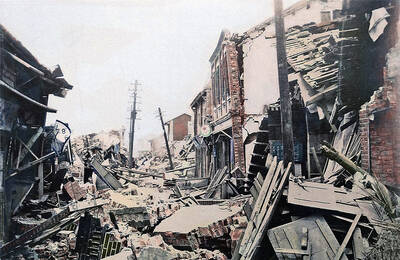
April 15 to April 21 Yang Kui (楊逵) was horrified as he drove past trucks, oxcarts and trolleys loaded with coffins on his way to Tuntzechiao (屯子腳), which he heard had been completely destroyed. The friend he came to check on was safe, but most residents were suffering in the town hit the hardest by the 7.1-magnitude Hsinchu-Taichung Earthquake on April 21, 1935. It remains the deadliest in Taiwan’s recorded history, claiming around 3,300 lives and injuring nearly 12,000. The disaster completely flattened roughly 18,000 houses and damaged countless more. The social activist and

Over the course of former President Ma Ying-jeou’s (馬英九) 11-day trip to China that included a meeting with Chinese Communist Party (CCP) leader Xi Jinping (習近平) a surprising number of people commented that the former president was now “irrelevant.” Upon reflection, it became apparent that these comments were coming from pro-Taiwan, pan-green supporters and they were expressing what they hoped was the case, rather than the reality. Ma’s ideology is so pro-China (read: deep blue) and controversial that many in his own Chinese Nationalist Party (KMT) hope he retires quickly, or at least refrains from speaking on some subjects. Regardless


 RSS
RSS