


“In the immortal words of Noel Gallagher, I’m gonna live for ever,” says Lars Ulrich. Sitting in Metallica’s backstage complex at the Reading festival in southern England, which they call “the Barrio,” the drummer is considering how long his band — one of the biggest live draws in the world, the group that reinvented metal and made it credible — can continue. The question of the famously combustible group’s lifespan, is Ulrich admits, “the US$64,000 question. The Rolling Stones are setting a great precedent, but Charlie Watts doesn’t play drums on songs like Fight Fire With Fire every night, no disrespect. “Will we be able to play the shit we do when we’re 65? I don’t know. When it becomes a joke, we’ll stop.”
Some people feared Metallica had reached that point a few years ago — certainly their new release, Death Magnetic, is being promoted as the “return to form” album, and there is a sense they need to prove both their mettle and their metal all over again. Their last album, 2003’s St Anger, topped the charts around the world, but sold just 1.8 million copies in the US, a fraction of what Metallica’s previous few offerings had sold. Instead of being the back-to-basics exercise the band had intended after a decade spent meandering away from their thrash-metal origins, it captured a band in crisis, a period recorded in the group-sanctioned documentary of the sessions, Some Kind of Monster. Bassist Jason Newsted had left after 14 years of being undermined as “the new boy” (he had replaced Cliff Burton, who died in a road accident in 1986). Singer/guitarist James Hetfield — Ulrich’s co-leader — had gone into rehab. The band hired a therapist to try to hold everything together, only for him to try to offer creative input to the band. The documentary played like a tragi-comic hybrid of This Is Spinal Tap and The Larry Sanders Show.
“St Anger happened because it had to happen,” says Hetfield. “It sounds very disjointed to me when I listen to it now. One-dimensional. Relentless. And that’s exactly how we felt at the time: We were disjointed, and I think the resentment we felt towards each other was relentless.”
St Anger was, Ulrich contends, “an isolated, one-off experience. Things aren’t like that now.” Their new album, is something of a make-or-break then, where the world will see whether Metallica is still creatively vital, whether their future holds more than living well off their legacy and back catalogue. Bob Rock — who became Metallica’s producer with 1991’s eponymously titled release, which has come to be known as the “Black album” — is no longer at the helm in the studio, and gone is the more polished, accessible sound that he brought. The hope is that his replacement, Rick Rubin, will achieve what he did for Johnny Cash and Slayer: in the first case, rejuvenate a drifting career; in the second, focus an aggressive, fast metal band to produce their best work.
“Rick’s initial seed for motivation, his mission statement, was ‘essence of Metallica,’” says Hetfield, meaning he wanted to return to the sound of the albums that made the group’s name: 1986’s Master of Puppets and 1988’s ... And Justice for All.
“We had stayed clear of the sound of those records for so many years,” says Ulrich. “We were scared of going near them, because if we tried to repeat them again, there was a chance we could dilute them, or ruin them. We basically ran screaming in 28 other directions for the next 20 years, almost.”
Hetfield describes the process as “getting back to the skeleton of Metallica,” which promises much: the group’s 1980s purple patch remains an apex for heavy metal, their ambition a match for the landmarks of any genre. But in the years that have passed, everything surrounding that skeleton has changed, not least the members of Metallica themselves.
Ulrich is an unlikely American metal star. For a start, he’s Danish. His father was a professional tennis player, who also played jazz and ran Copenhagen’s Blue Note club. Ulrich Jr moved to California in his teens, to perfect his own tennis, but any sporting ambitions were derailed by a trip to England in the summer of 1981 to see the band Diamond Head play at Woolwich Odeon in east London. Ulrich was besotted with Diamond Head and ended up staying with them for several weeks. On his return to California he placed an ad in a Los Angeles paper, which read: “Drummer looking for other metal musicians to jam with Tygers of Pan Tang, Diamond Head and Iron Maiden.” And so began a career that, among top-flight metal bands, has been surpassed in longevity only by that of Iron Maiden.
Metallica released two albums on independent labels before Elektra signed them for Master of Puppets, which became the first thrash metal album to break the US Top 30. The death of Burton during the subsequent tour threatened to derail them, but they soldiered on with the recruitment of Newsted, who made his debut on ... And Justice for All. (As part of the hazing of the new member, his bass playing was mixed to inaudible levels on the album.) The moment at which they broke through into the mainstream came at the 1989 Grammy awards ceremony. Though ageing prog-rockers Jethro Tull were the unlikely winners of that year’s Best Hard Rock/Metal Performance award, Metallica gave their first nationally televised performance.
“All I remember of that night was seeing Michael Jackson sat in the front row, and thinking, ‘Don’t fuck up,’” says Ulrich. On a stage set strewn with battleground props, the group played their new single, One. It opened like a ballad, but Hetfield wasn’t singing about love. The song, One, was written from the perspective of a soldier so imprisoned by his war-damaged body that he could not even commit suicide. The song crackled with the angst that was Metallica’s forte, its tender acoustic strums segueing into a brutal, ballistic thrash, drumrolls blasting like artillery as lead guitarist Kirk Hammett fired off haywire solos, doubtless terrorizing some members of the awards audience.
Two years later, the “Black album” translated that impact into commercial success. It sold 15 million copies worldwide (though if you asked most rock critics to name the most significant hard rock album of 1991, they’d probably offer Nevermind by Nirvana). They had become one of the world’s biggest bands without any significant compromise, by appealing — as Rolling Stone writer Michael Azerrad put it — “to the dark underside of the white-suburban-male psyche.”
“We were stubborn,” grins Hetfield, laconically explaining Metallica’s mindset of the time. “We’re not going to come to you, we’re not going to meet you halfway — you have to come to us.”
Despite what some detractors have suggested, the deer-hunting Hetfield is no redneck, though he is unabashedly blue collar. “I didn’t grow up around people who had therapy,” he says. “But my dad was extremely religious, up reading the Bible at five every morning for an hour. Maybe that was his therapy, his pill for the day.” Hetfield was raised as a Christian Scientist, and his family adhered to the religion’s avoidance of modern medicine, even as his mother died slowly of cancer. The anguish of his adolescence would later find voice in Hetfield’s lyrics, fuelling songs that railed against religion and authoritarianism.
His anger proved to be a gift — as Ulrich says in Some Kind of Monster, “Twenty years of hatred sold 100 million records,” and Hetfield was anxious that entering therapy and rehab at the time of the St Anger sessions might quiet his muse. “That is probably the biggest cliche of walking out of recovery” — he pauses, corrects himself — “sorry, walking out of the recovery building, and into recovery itself: the fear of ‘I can’t do this without alcohol, without the anxieties.’ My dichotomy is, I don’t like people, but I have a never-ending quest to feel like I belong. So, there’s still stuff to work out, for ever.”
Hetfield hit a lyrical peak with Puppets and Justice — Azerrad wrote that Metallica were “as political as any band out there.” Hetfield’s songs eschewed sloganeering for something more potent, reflecting the rage of an undereducated, underemployed, alienated fanbase — best reflected in the song Disposable Heroes, which he wrote in 1985 about those sent off to war to become cannon fodder. The “disposable heroes” of American suburbia could sense that Hetfield was one of them. More than 20 years later, that sense of identification remains: the soldier-cum-author Colby Buzzell has posted on his blog — since turned into a book, My War — of Metallica’s heavy rotation on his iPod while he was fighting out in Iraq.
Hetfield shifts uncomfortably at the subject, and says he hadn’t heard about Buzzell’s blog. “Metallica has really tried to be non-political, as much as possible,” he continues, carefully. “I write about the human side of it all. I really dislike it when celebrities get up on a soapbox and start giving their opinion. It shouldn’t be more valid, because you’re popular. It gets in the way of the music. I like to just live, and think, and feel. Politics bore me. Politics separate people, especially where we’re from. Politics rarely bring people together.” Hetfield’s answer is earnest, honest and polite — much like the man himself — but it does highlight one of the frustrations of Death Magnetic. His lyrics are introspective and intensely personal — Unforgiven III, he explains, concerns how you “can’t forgive anyone until you’ve forgiven yourself” — but they lack the fiery conviction of the likes of Disposable Heroes, written when he was just some ratty San Francisco headbanger. And there’s a generation at war in the Middle East sorely wanting a group like Metallica to write their song.
But Metallica are not the same people as they were when they recorded Disposable Heroes. “I’m 44 years old, I’ve got three kids, I flew in a helicopter on Friday,” laughs Ulrich. “It’s a little difficult to revisit the vibe of 20 years ago when you’re living in a two-bedroom suite at in one of the most expensive hotels in the world. I live a very different life to how I lived then.”
The one thing that hasn’t changed is the level of expectation Metallica still command. “I was thinking the other day,” Ulrich says, “about how everyone expects us to continue to release albums that define the genre, to ‘save’ metal. And that’s a lot of fucking pressure, really. Why hasn’t anyone dethroned us yet? We support all the great new metal bands, take them under our wing, but people still want us to carry the whole genre on our backs.”
But Metallica are the pioneers and figureheads of modern metal, the genre’s Beatles; they did it first and on the biggest scale, they won this music its mainstream acceptance. Theirs is the standard by which newcomers will always be measured, and while they might be faster and louder than Metallica, no one else will ever be Metallica.
Although Death Magnetic is plagued by a couple of sub-grunge grunters and something suspiciously like a power ballad, when it’s good — which is at least half the time — it’s great, the group playing painstakingly composed riffs with all the violent precision of their golden era.
As they play One on stage at Reading tonight, preceded by a barrage of pyrotechnics and special effects that would rival a Hollywood blockbuster, it’s clear that age hasn’t impaired their ability to play up their sturm und drang, for all the effort it must demand. But it feels odd to hear the song’s visceral horror played out as pulpy stadium-rock bombast tonight, while Metallica fans in Iraq and Afghanistan are coming home in wheelchairs and coffins from a controversial war they had no say in. I wonder if the James Hetfield of 1986 might have found it odd too.

Last week Joseph Nye, the well-known China scholar, wrote on the Australian Strategic Policy Institute’s website about how war over Taiwan might be averted. He noted that years ago he was on a team that met with then-president Chen Shui-bian (陳水扁), “whose previous ‘unofficial’ visit to the US had caused a crisis in which China fired missiles into the sea and the US deployed carriers off the coast of Taiwan.” Yes, that’s right, mighty Chen caused that crisis all by himself. Neither the US nor the People’s Republic of China (PRC) exercised any agency. Nye then nostalgically invoked the comical specter

Relations between Taiwan and the Czech Republic have flourished in recent years. However, not everyone is pleased about the growing friendship between the two countries. Last month, an incident involving a Chinese diplomat tailing the car of vice president-elect Hsiao Bi-khim (蕭美琴) in Prague, drew public attention to the People’s Republic of China’s (PRC) operations to undermine Taiwan overseas. The trip was not Hsiao’s first visit to the Central European country. It was meant to be low-key, a chance to meet with local academics and politicians, until her police escort noticed a car was tailing her through the Czech capital. The
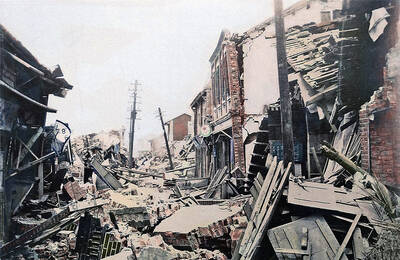
April 15 to April 21 Yang Kui (楊逵) was horrified as he drove past trucks, oxcarts and trolleys loaded with coffins on his way to Tuntzechiao (屯子腳), which he heard had been completely destroyed. The friend he came to check on was safe, but most residents were suffering in the town hit the hardest by the 7.1-magnitude Hsinchu-Taichung Earthquake on April 21, 1935. It remains the deadliest in Taiwan’s recorded history, claiming around 3,300 lives and injuring nearly 12,000. The disaster completely flattened roughly 18,000 houses and damaged countless more. The social activist and

Over the course of former President Ma Ying-jeou’s (馬英九) 11-day trip to China that included a meeting with Chinese Communist Party (CCP) leader Xi Jinping (習近平) a surprising number of people commented that the former president was now “irrelevant.” Upon reflection, it became apparent that these comments were coming from pro-Taiwan, pan-green supporters and they were expressing what they hoped was the case, rather than the reality. Ma’s ideology is so pro-China (read: deep blue) and controversial that many in his own Chinese Nationalist Party (KMT) hope he retires quickly, or at least refrains from speaking on some subjects. Regardless


 RSS
RSS