


If you take a plane, it’s possible to breakfast in the UK and have dinner in Taiwan. But have you ever wondered what you miss in between? After a cup of tea in London, how about moules et frites in Brussels, followed by a weissbier in Cologne, then solyanka in Moscow, a vodka in Siberia, teppanyaki in Japan and finally a bubble tea in Taipei?
Of course, this can’t be done on the same day, but it’s easy if you travel from the UK to Taipei by train and boat. The journey is naturally much longer than flying — the 14,000km trip takes about three weeks — but it’s an experience you will never forget. And the food is only a part of the fun.
Adventure was my main motivation when I began planning my trip. I wanted to visit Taiwan but I dislike the sterile confinement of airplanes. So, inspired by the writings of other flight-free travelers — particularly Paul Theroux and Michael Palin — I decided to investigate the possibilities.
It was not as difficult as I’d imagined. In Europe public concern about the environmental impact of airplanes has made international travel by train and boat increasingly popular. This is evident from numerous newspaper articles and Web sites, such as www.seat61.com, which describe how to travel to just about anywhere without leaving the planet’s surface.
Traveling from the UK to continental Europe could not be easier. The Eurostar train whisked me from London to Brussels in a little over two hours. After a day in the Belgian capital, I took a fast train to Cologne in Germany and, following dinner in the shadow of the famous cathedral, a sleeper train to Moscow.
This train was not as modern as the previous two, but there was ample compensation for the lack of facilities on the 36-hour journey. And it was somewhere in Poland that I began to appreciate the uniqueness of train travel: the unpredictable joy of meeting new people.
I shared a sleeping compartment with, Eddie, an 11-year-old boy from Moscow. He was returning home from a holiday in Paris with his mother and grandmother who were in the compartment next door.
I was particularly pleased to meet Eddie’s mother, Natalia. Soon after the train crossed the border into Belarus, a green-uniformed and heavily armed immigration officer thrust a form into my hand. I was horrified to see that it was printed in Cyrillic script only. One wrong answer, I thought, and I could be in prison before nightfall. Thankfully, Natalia miraculously appeared at the door and helped me complete the form.
In Moscow I stayed the night with an old friend, and the next day he showed me some of the tourist sites. Although the buildings surrounding Red Square are impressive, they pale into insignificance when compared to the next stage of my trip: the Trans-Siberian Railway.
Arguably the most famous train journey in the world, the Trans-Siberian connects Moscow with Vladivostok, some 9,300km — and seven days’ travel — to the east. In the hundred years or so since it was completed, the railway has been Russia’s central artery.
During World War II the railway played a crucial role in supplying food, armaments and soldiers to the Red Army in the west. These days the traffic is commercial freight and a huge diversity of passengers.
As I waited in the evening sunlight at Moscow’s Yaroslavsky station, I was joined by Russian families — from babies to great-grandmothers — gathered around stacks of belongings; a squad of 20 teenage gymnasts dressed in red-and-blue tracksuits; lone, cropped-haired soldiers nervously smoking cigarettes; and small bands of Western tourists standing by their bulging backpacks.
Although the passengers were from disparate backgrounds, friendships were quickly formed. I shared a four-berth compartment with Elizabeth, an estate agent from London who was also traveling to Vladivostok. For the first three days, the other two berths were unoccupied, but in Omsk we were joined by Viktor, a Russian naval officer, and his partner, Olga.
Our train, the Rossiya, is generally regarded as one of the best on the Trans-Siberian route, and although the decor is somber (pale green and brown are the dominant colors) and the facilities rather utilitarian, it’s comfortable.
The compartments are approximately 2m long by 2m wide, there is plenty of storage room, and getting a good night’s sleep is surprisingly easy. Mattresses, pillows and sheets are provided, and the motion of the train acts as a sedative. As long as you take some earplugs, the sound of the tracks (and your roommates’ snoring) will not keep you awake.
Breakfast can be taken in the restaurant car that is open until 11pm. The menu includes filling and tasty Russian soups (solyanka and borscht), grilled fish, steaks, chicken and huge omelettes. Prices are reasonable, around 200 rubles (NT$330) for a main course.
The train made several stops every day. Some passengers left the train, others joined, and those who were traveling further had an opportunity to stretch their legs, get some fresh air and buy supplies. At many of the stations, particularly in the western part of the trip, groups of local women greeted the train as it pulled into the station.
Some had trays of home-cooked food (meatballs, dumplings, roast chicken and bread were the most common offerings) and others brought shopping carts direct from the supermarket and sold the contents to the passengers.
The regular stops were a welcome respite from the perpetual clickety-clack of the wheels on the track and the view from the window. Although I was never bored for the whole seven days on the Trans-Siberian, the sight of dense birch forests, endless prairies and massive skies did become mundane.
Buying food from the entrepreneurs was one of the highlights of the trip. But, like the previous train journeys, the real thrill was making new friends. As well as bonding with my roommates, I met a group of Irish accountants, a retired couple from Australia, an IT consultant from New York, a father and son from Germany and numerous Russia soldiers who were returning to their bases after leave.
Irrespective of nationality, ethnicity, background, age or education, every person I met on the train was welcoming, friendly, generous and engaging. Surprisingly, language was not a barrier. So long as you can say the basics in Russian — “hello,” “thank you,” “beer” and “water” are a good start — and you greet people with a smile, you will be amazed by the warmth of your fellow travelers.
Warmth was in short supply, however, when the train arrived at Vladivostok station. In the harbor a rank of Russian navy ships brooded under a blanket of gray mist and, in the near distance, I saw the MV Rus, the ferry that would take me across the Sea of Japan.
After a day and night in Vladivostok, I made my way to the ferry passenger terminal. In the waiting room I recognized four people from the train — William and Anne-Marie from Holland; Dominic from the UK; and Rosalind from Switzerland — and we quickly became travel buddies.
As with the train the accommodation on the ship was hardly luxurious. The voyage to Fushiki, on the west coast of Japan, took 36 hours, which meant two nights on board. But with good conversation and a calm sea, the time passed very pleasantly.
In Japan I took a Shinkansen, or bullet train, to Tokyo and, after two nights in the capital, another to Osaka. On the evening of day 19 of my journey, I boarded the Hiryu and set sail for Keelung, via Okinawa and Ishigaki. Again the sea was placid, the weather was benign, and the cabin was comfortable.
The only downside was that this was one of the last voyages the ship would make. In early June the company — Arimura Line — went into liquidation, and there is no sign that the service will recommence.
Even so, it’s still possible to travel from Europe to Taiwan (or vice versa) without flying. Public appetite for low-carbon travel — as it’s commonly known — has spawned a new generation of travel agencies in Europe who can arrange international train travel, visas and even cabins on the mammoth container ships that circumnavigate the globe.
If you only have a few weeks’ vacation and you desperately want to hit the beach or see the tourist sites, then slow-motion travel is probably not for you. But if you have the time and the inclination, traveling by rail and water will give you a unique perspective on the world that you will never get from 10,000m above the ground.
Read the complete account of Gary’s journey at sixtrainstwoboats.blogspot.com, and see his travel photography at www.fishdragon.com

Last week Joseph Nye, the well-known China scholar, wrote on the Australian Strategic Policy Institute’s website about how war over Taiwan might be averted. He noted that years ago he was on a team that met with then-president Chen Shui-bian (陳水扁), “whose previous ‘unofficial’ visit to the US had caused a crisis in which China fired missiles into the sea and the US deployed carriers off the coast of Taiwan.” Yes, that’s right, mighty Chen caused that crisis all by himself. Neither the US nor the People’s Republic of China (PRC) exercised any agency. Nye then nostalgically invoked the comical specter
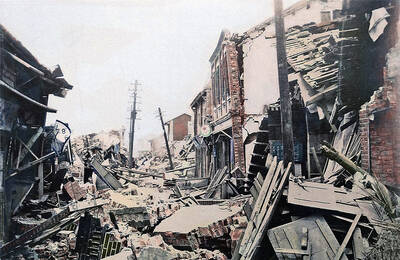
April 15 to April 21 Yang Kui (楊逵) was horrified as he drove past trucks, oxcarts and trolleys loaded with coffins on his way to Tuntzechiao (屯子腳), which he heard had been completely destroyed. The friend he came to check on was safe, but most residents were suffering in the town hit the hardest by the 7.1-magnitude Hsinchu-Taichung Earthquake on April 21, 1935. It remains the deadliest in Taiwan’s recorded history, claiming around 3,300 lives and injuring nearly 12,000. The disaster completely flattened roughly 18,000 houses and damaged countless more. The social activist and

Over the course of former President Ma Ying-jeou’s (馬英九) 11-day trip to China that included a meeting with Chinese Communist Party (CCP) leader Xi Jinping (習近平) a surprising number of people commented that the former president was now “irrelevant.” Upon reflection, it became apparent that these comments were coming from pro-Taiwan, pan-green supporters and they were expressing what they hoped was the case, rather than the reality. Ma’s ideology is so pro-China (read: deep blue) and controversial that many in his own Chinese Nationalist Party (KMT) hope he retires quickly, or at least refrains from speaking on some subjects. Regardless

Approaching her mid-30s, Xiong Yidan reckons that most of her friends are on to their second or even third babies. But Xiong has more than a dozen. There is Lucky, the street dog from Bangkok who jumped into a taxi with her and never left. There is Sophie and Ben, sibling geese, who honk from morning to night. Boop and Pan, both goats, are romantically involved. Dumpling the hedgehog enjoys a belly rub from time to time. The list goes on. Xiong nurtures her brood from her 8,000 square meter farm in Chiang Dao, a mountainous district in northern Thailand’s


 RSS
RSS