


A lot can happen in nine seconds. It’s the time it took Bayern Munich’s Roy Makaay to score a goal against Real Madrid in the 2007 UEFA Champion’s League. It’s the time it took Usain Bolt to run 100m in New York in May. It’s the time it took Harris Chan to break the world record for doing the Rubik’s cube earlier this year. It’s also the time that a student named Rich took to unclasp the bra straps of seven women (thank you, YouTube) and, if you are a quick reader, it’s the time you have taken to read to this point.
More importantly, it’s the time it takes the fabric roof to fold neatly into the trunk of Audi’s sporty new compact cabriolet. That’s quite a jump in the record stakes. It takes the BMW 1 Series convertible, the A3’s only realistic competitor, a gasping and red-faced 22 seconds to convert — if that’s the right word. The Astra Twin Top limps in at 30 seconds, while the Ford Focus CC takes a semi-comatose 35. You could open and shut the roof of the A3 almost four times in the eon of finger-drumming boredom the Ford takes. The latter two are folding hard tops rather than cloth tops, which give you the flexibility of an all-weather saloon and a convertible, but I’ve always found the lack of trunk space, the swollen rear end, the cramped back seats and the complexity of the opening mechanisms give you all the flexibility of a sergeant major at a passing-out ceremony.
The A3 can also cleverly open and shut its roof at speeds of up to 29kph. Many convertibles can do it at a crawl; plenty can only do it at a standstill. It may seem an unnecessary perk, but it’s surprising how useful it is, especially in the city. On the basic model, the roof is only semi-automatic: you have to clamp and unclamp it yourself, which is only really a problem if you have just had a set of 8cm false nails stuck on. But the model I drove was fully automatic, so all you have to do is concentrate on not decapitating the kids. Or maybe that would be another bonus.
In the UK, Audi is on a mission to become the country’s biggest-selling premium brand. Last year it sold 30,936 models compared to BMW’s 33,326 and Mercedes-Benz’s 23,003. And this new A3 will only confirm Audi’s status. The build quality is outstanding. Week in, week out I am lucky enough to find myself behind the wheels of some very posh cars, but slipping into the A3, you immediately sense that the benchmark has been raised. From the lush interior’s tactile surfaces to the emotive, sophisticated design and the exhilarating drive, Audi ensures you feel you are in the poshest of company.
There are four engine options — two variants of the FSi gasoline and two direct-injection turbo diesels — and they all drive the front wheels. The Sport version with the 2-liter, 200bhp engine will do zero to 100kph in 7.3 seconds and has a top speed of 230kph.
So is the A3 cab for you? It is, Audi believes, if you are middle-aged, have children under 18, are more than likely a woman, and have a high level of education and income and other cars within the household.

“Taiwan’s Opposition Leader Comes to US With a Message Straight Out of Beijing” read a May 31 headline in the Wall Street Journal. Top US administration officials and members of Congress almost certainly read the WSJ, and if there was a bullet point takeaway that people in Washington should absorb ahead of Chinese Nationalist Party (KMT) Chair Cheng Li-wun’s (鄭麗文) arrival in DC on June 9, that headline is it. The last few columns have discussed this very topic, and the timing is not coincidental. While those top officials likely do not read the Taipei Times, judging by the number

With weighty, anxiety-inducing geopolitical topics dominating the headlines, checking in on the wild and weird state of local politics can take some of the edge off. This November’s elections will determine who will be in charge of fixing potholes in your neighborhood, not the potholes in Taiwan’s complicated geopolitical space. Recently, after an online interview with a Taipei-based journalist, I commented that Taipei journalists never go further than the MRT can take them. He laughed and agreed. Naturally, the Taipei mayoral race is eating up much of the press attention. TAIPEI CITY Democratic Progressive Party (DPP) candidate Puma Shen (沈伯洋) has
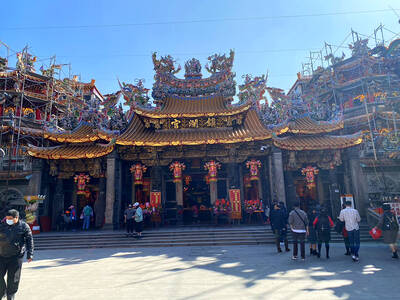
In December of 2008 Lee E-tin (李乙廷), a Miaoli county legislative hopeful, was convicted of vote-buying. Rather than buy votes retail, voter by voter, in the usual manner, Lee had done it wholesale, in a commendably efficient manner: he had visited local temples and made donations to gain their support. Because he did not normally make donations to temples, the court ruled he was attempting to improperly influence voter behavior. The case indicates how important temples are in influencing political life. Both judge and politician appeared to see them in the same way. Beijing sees them that way as well. Democratic Progressive

Audiences in Leicester, Cardiff, London and Sheffield will this month gather to watch a series of black-and-white Taiwanese-language films made more than 70 years ago. On the surface, these screenings commemorate the seventieth anniversary of taiyupian (台語片) — Taiwanese-language cinema. Yet the significance of these events extends far beyond nostalgia or film history. They represent a remarkable chapter in Taiwan’s ongoing effort to recover, preserve and reinterpret a cultural heritage that was once thought to have largely disappeared. The centerpiece of the program is the Ho Chi-ming (何基明) directed Xue Pinggui and Wang Baochuan (薛平貴與王寶釧), a film produced in 1955 and


 RSS
RSS