


Outstanding kun opera productions are far from unusual these days, but there was a good turnout, if somewhat short of a full house, for the opening night of Lanting Kun Opera Troupe’s (蘭庭崑劇團) Six Legends of Lan Ting (蘭庭六記) on Friday at Novel Hall for Performing Arts (新舞臺).
Six Legends was a showcase of the sheng (生), or young male lead role, featuring US-based kun star Wen Yuhang (溫宇航), formerly a leading performer with The Northern Kunqu Opera Theater (北方崑曲劇院) in China.
Ably supporting him was a lineup drawn largely from Taiwan’s National Guoguang Opera Company (國立國光劇團). The production’s director, Zhang Shizheng (張世錚), a leading performer with the Zhejiang Kun Opera Company (浙江崑劇團), put in an especially adept performance in an excerpt from The Tale of the Embroidered Jacket (繡襦記), the second of three opera excerpts that made up the opening night’s program.
Zhang, who played the role of a father who is torn between joy at discovering his long-lost son and anger that this son was now a pauper frequenting the town’s red light district, was a model of the nuances that can be injected into even the heavily stylized forms of Chinese opera.
One highlight was the Tale of the White Rabbit (白兔記), two scenes from which made up the second half of the program. This opera from the Yuan Dynasty is rarely staged, and the moral attitudes it embraces can seem alien and even unpalatable to a modern audience. Nevertheless, Chen Ching-he (陳清河) was delightfully humorous as the evil mother-in-law.
Unfortunately technical problems bedeviled the latter half of White Rabbit, with mic hiss and pops all but drowning out the performers, who soldiered bravely through nevertheless.
One of the best aspects of the show was the costumes, which had a very elegant cut, made bold use of color and included a number of clever design flourishes. Given that the Lanting Kun Opera Troupe had opted to be very traditional with the sets — nothing more than a chair and table and a red rug covering the stage — all attention could focus on the characters themselves.
The fact that elaborate props were dispensed with and the only multimedia element was the projection of scans from the original opera libretti onto the background (a device used to highlight the literary roots of kun opera), was very gratifying, as it put attention back where it belongs.
At the Experimental Theater on Saturday afternoon, the first half of the New Productions of Emerging Taiwanese Choreographers program provided a new look for some favorite choreographers and tantalizing taste of a relative newcomer.
The show opened with Lien Ho’s (賀連華) solo Coming Home, an interesting juxtaposition of Aboriginal and Spanish cultures. Lien used her flamenco training to express her longing for a lost world as Aboriginal singers Panai and Nabu stood stage center to sing Panai’s Perhaps One Day. While the music was powerful and Lien’s performance was heartfelt, the piece was the weakest on the program.
Chen Wu-kang (陳武康) and girlfriend Yeh Ming-hwa’s (葉名樺) Dimmer was a more light-hearted romp, as Wang and his three Kewpie doll-looking colleagues scuttled around to four songs by Leon Redbone, often in a full plie position, which made my knees hurt just to watch.
Having never seen the work of Sun Chuo-tai (孫梲泰), his Sho-jing left me eager to see what he has in store with his 8213 Physical Dance Theater performances next month. Shirtless, clad in wide-bodied tie-dyed skirt and white body power, Shu was mesmerizing — and sometimes spooky — as he moved within a video-projected circle while scenes of temple roofs, kaleidoscope images and a bulldozer at work were projected on the back wall, all part of his modern take on the ancient ritual of purifying the souls of scared children.
Lin Hsiang-hsiu’s (林向秀) Shouting, set on five women and one man, was an interesting departure from the work I have seen with her Lin HH Dance Company (林向秀舞團), starting from the pounding rock ’n’ roll beat of the opening segment. While Lin was upset that sound problems led to Lo Si-rong’s (羅思容) songs being almost unintelligible, the technical glitches didn’t detract from the strength of the piece, especially the lengthy pas de trois in the second part.
The show left me eagerly anticipating the second half of the Emerging Choreographers program next weekend, which will include works by Huang Huai-de (黃懷德), Wei Kuang-ching (魏光慶), Su Shih-jian (蘇詩堅), Lai Wei-chun (賴韋君) and Tien Hsiao-tzu (田孝慈).
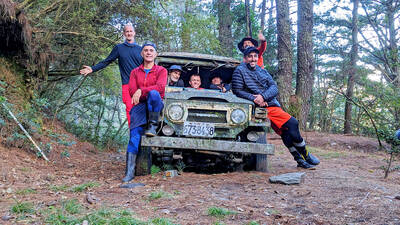
The year was 1991. A Toyota Land Cruiser set out on a 67km journey up the Junda Forest Road (郡大林道) toward an old loggers’ camp, at which point the hikers inside would get out and begin their ascent of Jade Mountain (玉山). Little did they know, they would be the last group of hikers to ever enjoy this shortcut into the mountains. An approaching typhoon soon wiped out the road behind them, trapping the vehicle on the mountain and forever changing the approach to Jade Mountain. THE CONTEMPORARY ROUTE Nowadays, the approach to Jade Mountain from the north side takes an

Relations between Taiwan and the Czech Republic have flourished in recent years. However, not everyone is pleased about the growing friendship between the two countries. Last month, an incident involving a Chinese diplomat tailing the car of vice president-elect Hsiao Bi-khim (蕭美琴) in Prague, drew public attention to the People’s Republic of China’s (PRC) operations to undermine Taiwan overseas. The trip was not Hsiao’s first visit to the Central European country. It was meant to be low-key, a chance to meet with local academics and politicians, until her police escort noticed a car was tailing her through the Czech capital. The

Last week Joseph Nye, the well-known China scholar, wrote on the Australian Strategic Policy Institute’s website about how war over Taiwan might be averted. He noted that years ago he was on a team that met with then-president Chen Shui-bian (陳水扁), “whose previous ‘unofficial’ visit to the US had caused a crisis in which China fired missiles into the sea and the US deployed carriers off the coast of Taiwan.” Yes, that’s right, mighty Chen caused that crisis all by himself. Neither the US nor the People’s Republic of China (PRC) exercised any agency. Nye then nostalgically invoked the comical specter
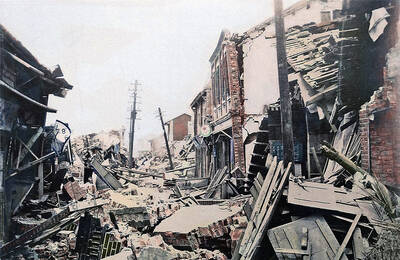
April 15 to April 21 Yang Kui (楊逵) was horrified as he drove past trucks, oxcarts and trolleys loaded with coffins on his way to Tuntzechiao (屯子腳), which he heard had been completely destroyed. The friend he came to check on was safe, but most residents were suffering in the town hit the hardest by the 7.1-magnitude Hsinchu-Taichung Earthquake on April 21, 1935. It remains the deadliest in Taiwan’s recorded history, claiming around 3,300 lives and injuring nearly 12,000. The disaster completely flattened roughly 18,000 houses and damaged countless more. The social activist and


 RSS
RSS