


Though Lanting Kun Opera Troupe (蘭庭崑劇團) is a relative newcomer to Taiwan’s traditional art scene, it has already done much to promote kun opera (崑劇) to a younger generation and has won recognition for its innovative work.
The troupe’s director, Wang Chih-ping (王志萍), earlier this year won a Golden Melody Award for producing Quest for the Garden Saunter and the Interrupted Dream (尋找遊園驚夢), which is no small achievement for a group that was only re-established in 2005.
In the case of Quest, Wang said the production succeeded because the troupe experimented with non-conventional performances spaces — the original production was designed for the cavernous spaces of Huashan Culture Park’s Rice Wine Factory building (台北華山文化園區米酒作業場) — and this gave the show a cutting-edge appeal that traditional opera lacks.
Six Legends of Lan Ting (蘭庭六記), Lanting Kun Opera Troupe’s production for this year, is wholly dissimilar to Quest: the former is a simple presentation of scenes excerpted from six well-known operas while the latter is a multi-day opera of 55 scenes rolled into one story performed in a single sitting.
Each segment of Six Legends highlights an aspect of the sheng (生) male character. “There are many divisions and subdivisions within the sheng character type,” said Wang. “We wanted to show off the huge variety of performance styles encompassed within this character type.”
Quest focuses on Du Liniang (杜麗娘), one of the defining female roles of Chinese theater.
In addition to Lanting’s own
talented performers, Six Legends stars Wen Yuhang (溫宇航), who is best-known in the West for his performance in the 19-hour 1999 Lincoln Center production of The Peony Pavilion (牡丹亭). It is performances like these that give substance to talk of a kun opera revival, especially as an international performance medium similar to Italian opera.
Wen, who is currently based in the US, said in an interview before rehearsals last week that he has “seen audiences change from people with white hair to people with black hair. [Kun opera] is very classical, and the classical is now fashionable. Not to have seen a production, or at least know about The Peony Pavilion, is for a modern person the same as missing something [in their repertoire of cultural references]. “
Six Legends brings together excerpts from five Ming Dynasty operas and one rarely performed Yuan Dynasty opera, including an excerpt from The Peony Pavilion, which will be part of tomorrow’s program. While the production attempts to make these segments stand alone, audiences will benefit from knowing the often complex backstories; nevertheless, the focus is less on the narrative than on Wen’s star turn.
While English subtitles won’t be available, Wang said that the troupe has prepared a comprehensive publication about Six Legends’ re-interpretation opera (to be sold separately from the program), which will contain abstracts of the operas in English.
“We have put considerable effort in extending the reach of kun opera through publication and merchandising,” Wang said. In addition to these detailed show notes, Lanting will also be releasing notebooks with cute sketches of the characters, book marks and other merchandise. “We want to have things people can take away with them,” she said. “Something to make these stories part of people’s lives.”

In late October of 1873 the government of Japan decided against sending a military expedition to Korea to force that nation to open trade relations. Across the government supporters of the expedition resigned immediately. The spectacle of revolt by disaffected samurai began to loom over Japanese politics. In January of 1874 disaffected samurai attacked a senior minister in Tokyo. A month later, a group of pro-Korea expedition and anti-foreign elements from Saga prefecture in Kyushu revolted, driven in part by high food prices stemming from poor harvests. Their leader, according to Edward Drea’s classic Japan’s Imperial Army, was a samurai
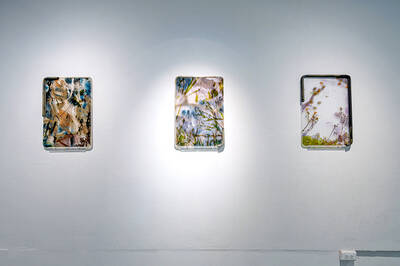
Located down a sideroad in old Wanhua District (萬華區), Waley Art (水谷藝術) has an established reputation for curating some of the more provocative indie art exhibitions in Taipei. And this month is no exception. Beyond the innocuous facade of a shophouse, the full three stories of the gallery space (including the basement) have been taken over by photographs, installation videos and abstract images courtesy of two creatives who hail from the opposite ends of the earth, Taiwan’s Hsu Yi-ting (許懿婷) and Germany’s Benjamin Janzen. “In 2019, I had an art residency in Europe,” Hsu says. “I met Benjamin in the lobby
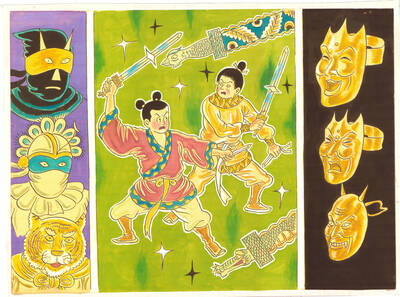
April 22 to April 28 The true identity of the mastermind behind the Demon Gang (魔鬼黨) was undoubtedly on the minds of countless schoolchildren in late 1958. In the days leading up to the big reveal, more than 10,000 guesses were sent to Ta Hwa Publishing Co (大華文化社) for a chance to win prizes. The smash success of the comic series Great Battle Against the Demon Gang (大戰魔鬼黨) came as a surprise to author Yeh Hung-chia (葉宏甲), who had long given up on his dream after being jailed for 10 months in 1947 over political cartoons. Protagonist

Peter Brighton was amazed when he found the giant jackfruit. He had been watching it grow on his farm in far north Queensland, and when it came time to pick it from the tree, it was so heavy it needed two people to do the job. “I was surprised when we cut it off and felt how heavy it was,” he says. “I grabbed it and my wife cut it — couldn’t do it by myself, it took two of us.” Weighing in at 45 kilograms, it is the heaviest jackfruit that Brighton has ever grown on his tropical fruit farm, located


 RSS
RSS