


Lin Tien-jen (林天人), one of the researchers behind the National Palace Museum’s (國立故宮博物院) new exhibition Outlining Geographical Expanse With a Brush (筆畫千里 — 院藏古輿圖特展), is excited by maps. "Maps represent the physical horizons of those in power," he said, as he led a group of journalists around the small display chamber filled with maps of various sizes and styles. "They are symbols of power. I like to emphasize that maps are not just documents that provide information, they also represent the way people in past times viewed the world."
The exhibition, which runs until Dec. 31, puts on display a small portion of the Museum’s huge collection of maps, including maps used for civil engineering projects, coastal defense and in reports from governors to the Chinese emperor. “These maps are extremely precious, for in most cases they are unique. Unlike Western maps, which often employed etching or other technology [which allowed accurate mass reproduction], most of these maps were hand drawn. In many cases they use the techniques of landscape painting, and can be very beautiful,” said Lin, drawing attention to Memorial to the Throne With Map of Wu-li-ya-su-tai (烏里雅蘇臺籌防圖), a map composed by a military inspector stationed in modern day Xinjiang Autonomous Region to outline the defensive posture of the Qing government against the restive local nomads. Its use of semi-abstract water color techniques makes it enormously attractive to look at. It is fascinating to speculate on the man behind the map and appreciate that this picture, along with an accompanying report, where a means of providing classified military data.
Unfortunately the lack of detailed notes in the exhibition, either in English or Chinese, is a major obstacle to non-specialists who without the assistance of a guide will find appreciation of the full impact of this and other fascinating documents on display difficult. The excellent catalog, however, available for NT$450, provides detailed Chinese notes and invaluable closeups of sections of various maps. An effort has been made in this volume to provide short introductions to the four sections of the exhibition in English, but these do little more than whet the appetite for more specific information.
One of the show’s highlights is the Map of Taiwan and the Pescadores (臺灣圖附澎湖群島圖) from the Yungcheng period (1678-1735) of the Qing Dynasty. This detailed map, which among many other fascinating features shows the Taipei basin as a lake, provides endless interest for anyone familiar with Taiwan’s geography. “We had written accounts of how there was a lake in this area,” Lin said, “but this was invaluable corroborative evidence.”
According to the Museum’s deputy director, many of these maps are on display for the first time, and given the fragility of many of these documents, the exhibition will be divided into two sections, with the current exhibits being rotated out in October.
Over at the Taipei Fine Arts Museum (台北市立美術館), an exhibition by Taiwan-born artist Hsu Pang-chieh (徐邦傑), the first in his hometown, opened last week. Titled Neglected Existence (被遺忘的存在), the show consists of works from 2002 to 2008 and comprises two series, one of oil paintings of ghost money, often in such extreme closeup so as to blur the line between representation and abstraction, and the other of charcoal drawings of enormous refinement, whose subjects are spaces and textures rather than the objects that are depicted.
In this first series of works, Hsu takes stock of his own cultural heritage in the symbolic value of the spirit money he represents on canvass. He obviously delights in the painstaking realism of the representation of a very ordinary object, but the closer he gets to the object, the more abstract it becomes. He calls this “abstract realism,” and in works such as Full House, a stack of ghost money painted in extreme closeup and meticulous detail becomes an imaginative space for the viewer to contemplate lines, textures and light, the representative subject having been pushed into the background. In other works such as Palace, Hsu pulls back slightly and uses stacks of money to create an architectural space that evokes and comments on the Chinese priorities of family and home, as well as the inevitability of death and decay.
In a second room, Hsu presents a series of charcoal drawings that come across as somewhat conventional academic exercises in representations of space. Closer inspection reveals that Hsu is once again more interested in something that lies beyond the object depicted. The Lonely Loo (2003) is a study of surfaces, light and textures that makes the image of a public lavatory something supremely nuanced and faintly mysterious. His three-part series Lady’s Room (2006) takes this focus on space and texture one step further. The first panel depicts a rather decrepit lavatory in the same kind of painstaking care as can be found in The Lonely Loo, but then the second panel zooms into a section of wall around the lavatory window, and the third becomes an abstract of peeling paint, mold and damp as seen under a microscope.
Hsu writes in his introduction to the show that, “The existence of objects is forgotten because we tend to functionalize everything.” The paintings presented in Neglected Existence undermine this functional aspect of things, and reveal an underlying skein of being that is both banal and sublime.

In late October of 1873 the government of Japan decided against sending a military expedition to Korea to force that nation to open trade relations. Across the government supporters of the expedition resigned immediately. The spectacle of revolt by disaffected samurai began to loom over Japanese politics. In January of 1874 disaffected samurai attacked a senior minister in Tokyo. A month later, a group of pro-Korea expedition and anti-foreign elements from Saga prefecture in Kyushu revolted, driven in part by high food prices stemming from poor harvests. Their leader, according to Edward Drea’s classic Japan’s Imperial Army, was a samurai

The following three paragraphs are just some of what the local Chinese-language press is reporting on breathlessly and following every twist and turn with the eagerness of a soap opera fan. For many English-language readers, it probably comes across as incomprehensibly opaque, so bear with me briefly dear reader: To the surprise of many, former pop singer and Democratic Progressive Party (DPP) ex-lawmaker Yu Tien (余天) of the Taiwan Normal Country Promotion Association (TNCPA) at the last minute dropped out of the running for committee chair of the DPP’s New Taipei City chapter, paving the way for DPP legislator Su

Located down a sideroad in old Wanhua District (萬華區), Waley Art (水谷藝術) has an established reputation for curating some of the more provocative indie art exhibitions in Taipei. And this month is no exception. Beyond the innocuous facade of a shophouse, the full three stories of the gallery space (including the basement) have been taken over by photographs, installation videos and abstract images courtesy of two creatives who hail from the opposite ends of the earth, Taiwan’s Hsu Yi-ting (許懿婷) and Germany’s Benjamin Janzen. “In 2019, I had an art residency in Europe,” Hsu says. “I met Benjamin in the lobby
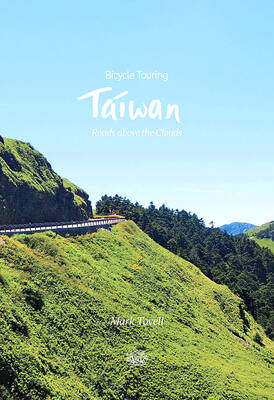
It’s hard to know where to begin with Mark Tovell’s Taiwan: Roads Above the Clouds. Having published a travelogue myself, as well as having contributed to several guidebooks, at first glance Tovell’s book appears to inhabit a middle ground — the kind of hard-to-sell nowheresville publishers detest. Leaf through the pages and you’ll find them suffuse with the purple prose best associated with travel literature: “When the sun is low on a warm, clear morning, and with the heat already rising, we stand at the riverside bike path leading south from Sanxia’s old cobble streets.” Hardly the stuff of your


 RSS
RSS