


In the musty back room of the collectibles shop he owns here, stocked with a copy of the Declaration of Independence and Ernest Hemingway’s briefcase typewriter, John Reznikoff held up a gold case that contained his most prized possession.
Behind the glass, the curly black clumps looked like a worthless old Brillo pad. But Reznikoff, 48, said the US$500,000 piece de resistance was something far more precious: a strand of hair from Abraham Lincoln, taken from the US’ 16th president on his deathbed.

PHOTO: NY TIMES NEWS SERVICE
Reznikoff said the pieces of detritus stuck to the hair, which looked like egg bits found on a frying pan, is dried brain matter.
He has hair strands from numerous historical figures like George Washington, John F. Kennedy, Napoleon, Beethoven and Chopin. While he enthusiastically advertises his US$10 million annual business in stamps, autographs, and Americana in trade catalogs and newspapers, Reznikoff keeps a low profile when it comes to his beloved hair collection. He doesn’t advertise, sell to the public or buy clippings of living people.
“I’m concerned clients might not take me seriously if they see me selling a lock of Charles Dickens’ hair,” Reznikoff said.
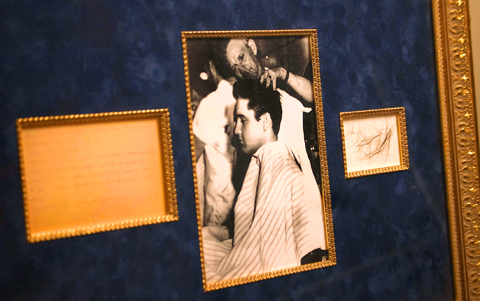
PHOTO: NY TIMES NEWS SERVICE
What was once a gentleman’s hobby among a few dozen enthusiasts at the turn of the 20th century has evolved into a multimillion-dollar industry, complete with professional dealers and serious quacks. As hair collecting has endured to the modern day, it brings with it the air of august creepiness that surrounds any celebrity-chasing pastime, not to mention its own peculiar set of boundary-issue controversies.
Hair collecting took hold during the Victorian era, when notables were asked by their admirers for locks rather than their signatures. “More so than an autograph, it was a sign of affection,” said Harry Rubenstein, a curator at the Smithsonian National Museum of American History.
Today, thousands of small-time collectors jostle along with Sotheby’s and Christie’s for snippets of Marilyn Monroe’s curls (rare), Katharine Hepburn’s tresses (rarer) and Elvis Presley’s locks (rarest).

PHOTO: NY TIMES NEWS SERVICE
The demand has been insatiable, said Brian Marren, vice president for acquisitions at Mastro Auctions, whose company sells about US$100,000 in hair a year. “It’s a celebrity-driven culture,” Marren said, “so almost anything attached to a celebrity is sellable.”
In October, one collector paid US$119,500 for a tuft of hair from Che Guevara. Auction wars erupted around the same time for the hair of Babe Ruth (sold for US$38,000) and John Lennon (US$48,000).
Beyond the initial yuck factor, hair collecting can facilitate lurid prying into private affairs, as collectors use DNA taken from strands of hair to investigate the lives of celebrities past and present. Did Lincoln have syphilis? Was Beethoven hooked on prostitutes?
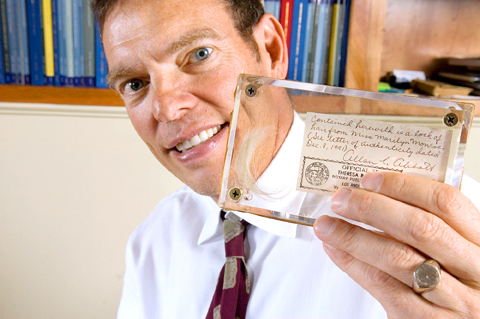
PHOTO: NY TIMES NEWS SERVICE
To solve such mysteries, star-struck fans and conspiracy-obsessed historians alike have visited Reznikoff’s company, University Archives, which occupies a renovated thread mill. Here they’ve found bits and pieces of Reznikoff’s follicular mementos.
There’s the framed photo of Elvis, after getting his famous GI haircut, accompanying a hunk of his hair glued onto blue suede. Another frame on the wall holds the portrait of Charles I (before he lost his head), juxtaposed with a few strands of hair taken from his tomb (after he was beheaded).
“Nobody likes just a clump of hair, which is why you need to illustrate the history,” Reznikoff said, using the same dispassionate tone Martha Stewart would use to explain how macrame is made.
His mother lode is kept in a storage room filing cabinet. There is a folder for each celebrity, usually overflowing with yellowed news clippings and torn pages from diaries that attest to the hair’s authenticity through a verifiable chain of ownership. He uses sophisticated imaging equipment like a video spectral comparator, a device used to verify passports and bank notes, to analyze handwriting and other documentation. Meanwhile, the actual hair is usually stuffed in a plain first-class envelope.
Reznikoff’s knowledge of historical documents has made him a valuable expert witness for the Justice Department, which has called on him in appraisal and fraud cases and sets him apart from other small-time hair collectors.
“John is the most diligent, most research-oriented type of person you will meet,” said Louis Mushro, a fellow collector. “He’s not going to buy something unless he knows it’s absolutely real.”
As Reznikoff casually flipped through his collection, he breezed through them like they were Christmas cards from family friends. “This is John Wilkes Booth’s,” he said, pointing to a brown tuft snatched off the assassin moments after his death. “And here’s John Dillinger’s. Oh, I forgot. I just got Eva Braun’s.”
As an undergraduate at Fordham University in New York, Reznikoff became so obsessed with stamp collecting that he found himself attending stamp shows instead of his pre-law classes. He dropped out in 1981, to the shock of his father, a psychology professor, and founded a stamp business, naming it University Archives as a jab at his dropout status.
Selling celebrity locks to other memorabilia dealers, Reznikoff says, nets him almost enough to cover the salaries of his 10 employees. Each year, he buys three or four additional strands from auction houses, a network of small-time dealers and the occasional grandmother who just cleaned out her attic.
Most of Reznikoff’s hair archive came from Margaretta Pierrepont, the wife of Edwards Pierrepont, the attorney general under President Ulysses S. Grant. For US$100,000, Reznikoff purchased the set of about 60 famous locks from Robert White, a cleaning-supply salesman who also hoarded shrunken heads, and who had acquired the Pierrepont collection in the 1970s.
“He had the world’s greatest collection of hair,” Reznikoff said. “But nobody knew about it.” (It was in Baltimore, tucked away in the basement of White’s mother.)
Today, almost anyone can become a hair collector through Web sites like eBay. While the locks of US Civil War figures are popular acquisitions, the hair of living celebrities is also frequently sought. In February of 2007, when Britney Spears had her head shaved at a Los Angeles salon, Esther Tognozzi, the hairdresser, put the hair up for sale in an online auction for US$1 million. (No one bought it; Reznikoff appraised the hair at US$3,500.)
Though Reznikoff says he collects mainly for personal enjoyment, his hobby has occasionally gotten him into trouble. In 2005, he paid US$3,000 to Neil Armstrong’s barber for some of the astronaut’s hair. A furious Armstrong threatened to sue. “I don’t do living celebrities anymore,” Reznikoff said. “That has the connotations of a stalker running around with scissors, and that’s not me.”
Other critics of hair collecting say that the pastime could be fertile ground for fraud. The organization International Crusade for Holy Relics is lobbying for legislation in the US to prevent the trade of hair and other human artifacts on eBay, arguing that canon law forbids their sale.
Likewise, many families of contemporary celebrities oppose such sales. Others contend that the hobby is a violation of a basic right to privacy. Historians have used DNA tests on hair obtained from collectors to determine, for instance, that Thomas Jefferson had fathered a child with one of his slaves, and that Beethoven suffered from lead poisoning.
Some memorabilia dealers have stopped collecting hair. “It’s basically a credibility issue,” said Bob Eaton, who auctions celebrity autographs. “Anybody can snip a piece of hair and, say, call it Einstein’s.”
Though some people don’t take this hobby seriously, others see dollar signs. In September, Reznikoff sold a few strands of George Washington’s hair to Topps, the company known for baseball cards, setting off a frenzy when Topps hid the hair in three special cards as part of a promotional contest. That same month, Reznikoff sold a wisp of Beethoven’s hair to a company that incorporated it into a synthetic diamond and listed it for US$1 million on eBay. (The diamond attracted 62 bids and was finally sold for US$202,000.)
Despite the controversy that hair collecting has generated, Reznikoff regards the hobby as natural and as innocent as his childhood days spent hoarding toy cars and comic books.
“I’ve always been a collector,” he said. “I really believe that’s something genetic. You’re either a collector or you’re not.”
As Reznikoff left the storage room at his shop, he said, “I’m thinking about getting into wine.” He casually pointed to a few dusty bottles of a dark black vintage, sitting on a shelf, that were courtesy of the wine cellars of Edward VIII.

In late October of 1873 the government of Japan decided against sending a military expedition to Korea to force that nation to open trade relations. Across the government supporters of the expedition resigned immediately. The spectacle of revolt by disaffected samurai began to loom over Japanese politics. In January of 1874 disaffected samurai attacked a senior minister in Tokyo. A month later, a group of pro-Korea expedition and anti-foreign elements from Saga prefecture in Kyushu revolted, driven in part by high food prices stemming from poor harvests. Their leader, according to Edward Drea’s classic Japan’s Imperial Army, was a samurai

The following three paragraphs are just some of what the local Chinese-language press is reporting on breathlessly and following every twist and turn with the eagerness of a soap opera fan. For many English-language readers, it probably comes across as incomprehensibly opaque, so bear with me briefly dear reader: To the surprise of many, former pop singer and Democratic Progressive Party (DPP) ex-lawmaker Yu Tien (余天) of the Taiwan Normal Country Promotion Association (TNCPA) at the last minute dropped out of the running for committee chair of the DPP’s New Taipei City chapter, paving the way for DPP legislator Su

Located down a sideroad in old Wanhua District (萬華區), Waley Art (水谷藝術) has an established reputation for curating some of the more provocative indie art exhibitions in Taipei. And this month is no exception. Beyond the innocuous facade of a shophouse, the full three stories of the gallery space (including the basement) have been taken over by photographs, installation videos and abstract images courtesy of two creatives who hail from the opposite ends of the earth, Taiwan’s Hsu Yi-ting (許懿婷) and Germany’s Benjamin Janzen. “In 2019, I had an art residency in Europe,” Hsu says. “I met Benjamin in the lobby
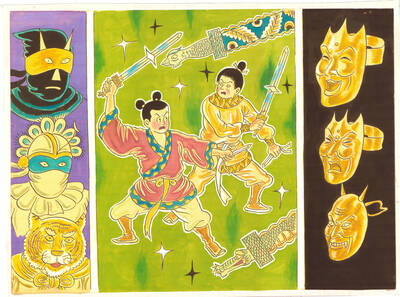
April 22 to April 28 The true identity of the mastermind behind the Demon Gang (魔鬼黨) was undoubtedly on the minds of countless schoolchildren in late 1958. In the days leading up to the big reveal, more than 10,000 guesses were sent to Ta Hwa Publishing Co (大華文化社) for a chance to win prizes. The smash success of the comic series Great Battle Against the Demon Gang (大戰魔鬼黨) came as a surprise to author Yeh Hung-chia (葉宏甲), who had long given up on his dream after being jailed for 10 months in 1947 over political cartoons. Protagonist


 RSS
RSS