


December 1980. America’s premier black music show, Soul Train, is being filmed in Hollywood. The crowd is dancing to the soul hits of the day — Stevie Wonder’s Master Blaster, Kool and the Gang’s Celebration, Donna Summer’s The Wanderer — and singing along with the ballad Ooh Baby by Tower of Power crooner Lenny Williams.
Then veteran host Don Cornelius introduces three rather nerdy Japanese men called YMO — or Yellow Magic Orchestra. “It was the turn of the crazy Japanese guys,” laughs Haruomi “Harry” Hosono, YMO’s bassist. “We performed our song Computer Games, and everyone went mad.”
“They were breakdancing and bodypopping,” says the band’s drummer and lead singer, Yukihiro Takahashi. “We’d never seen anything like it.”
“It was quite intimidating,” says keyboardist Ryuichi Sakamoto. “Everyone else on the show was black. The audience was black. The crew and the presenters were black. There were no white or Asian faces there. Suddenly, it was the oriental guys who were being asked to make the dance music, which defied every stereotype!”
Between 1978 and 1984, they went on to confound stereotypes. Hip-hop pioneer Afrika Bambaataa, who sampled their music, was only half-joking when he said that Yellow Magic Orchestra invented hip-hop. Their singles Firecracker and Tighten Up were both big R ’n’ B hits in the US, while Computer Games became a top 20 UK hit, earning them the adoration of synth pop acts such as Ultravox, John Foxx, Gary Numan and Duran Duran. Over the next three decades, their influence cropped up in odd areas: producer Todd Rundgren had a YMO album on the wall of his studio for inspiration; Eric Clapton’s unlikely cover version of YMO’s Behind the Mask was a huge international hit; while the arcade-game bleeps and Asian scales in their music went on to influence 21st-century electronica acts such as Dizzee Rascal and Kieran Hebden, who weren’t even born when YMO was formed. Meanwhile, in Japan, they were bigger than the Beatles.
“We were very big,” sighs Sakamoto, “that’s why I hated it. We were always followed by paparazzi.”
“Yes, and teenage girls,” says Hosono. “They would literally chase us down the street and rip our clothes to shreds.”
“I quite enjoyed that,” says Takahashi.
In Europe, however, the audience response was often rather more cerebral.
“In Italy, the audience would start arguing during our concert,” says Hosono. “You had these very serious-looking men with beards and long hair, having a symposium about our music while we were playing.”
“They looked like Greek or Roman philosophers,” says Sakamoto. “It was so funny.”
It’s a few days before their historic reunion show at London’s Royal Festival Hall — their first UK date since 1980 — where they have been asked to play by Meltdown curators Massive Attack. The three YMO members — grey-haired and astonishingly dapper — are sitting in the bar of their London hotel, and all of them seem to conform to stereotype: Hosono (61) is the amusingly grumpy, de facto band leader; Takahashi (56) is the rakish design student, wearing an immaculately tailored mod suit and a pork-pie hat; while Sakamoto (56) is the handsome, floppy-fringed intellectual, wearing sharp, modernist, designer threads.
They have long been heralded as godfathers of techno, part of a pioneering wave of musicians who brought synthesizer technology into the charts. However these weren’t untutored, one-fingered soloists, but experienced musicians. In the early 1970s, Hosono led an exotica band called Happy End, which explored country and western and Hawaiian music; Takahashi played in a glam rock outfit called the Sadistic Mika Band, who’d toured the UK with Roxy Music (and even appeared on TV), while Sakamoto was a classically trained session musician.
Furthermore, while their peers in Dusseldorf and Detroit were using synthesizer technology to create a bleak, dystopian vision of the future — a world of faceless robots and brutal post-industrial landscapes — the YMO saw technology as something joyous and liberating. In their hands, the synthesizer was a cuddly, slightly whimsical instrument.
“I think that’s a Japanese thing,” says Sakamoto. “Japan used to be an animistic society before Shinto imperialism was established. But most of us still have an animistic sense. And you can see it in the way in which we use tools. For us, those tools are not just objects. Japanese people can feel some attachment in what they are making, whether it is a car or a TV or a computer. It’s like when Sony made that pet robotic dog. From the beginning, nobody in Japan had any fear or apprehension about that. Even old people thought it was cute.”
Hosono and Sakamoto in particular were always obsessed with Japanese cultural identity. The band’s name is a sly joke at Japan’s obsession with black magic (“Yellow magic was halfway between white magic and black magic,” says Hosono. “Actually, it’s a stupid name, isn’t it?”), and the band constantly explored notions of Asianness, exoticization and orientalism. Their first single, for instance, was a version of Martin Denny’s “oriental” anthem Firecracker from a defiantly Japanese perspective.
‘The thing was to take these Western ideas of the exotic, but to subvert them,” says Hosono. “With Martin Denny, the exotica is kind of fake. But I am real! I am the target of that Western exotica. So what I wanted to make was exotica from an oriental perspective.”
What were your respective roles in the group?
“I was the ideas man,” says Hosono.
“I was the popularizer, the communicator,” says Takahashi.
“And I did the theory,” says Sakamoto.
“Yes,” says Takahashi. “We called Ryuichi ‘professor.’”
When asked why they split up in 1984, there is an awkward pause.
“We hated each other,” says Hosono.
“Yes,” says Takahashi. “I was always trying to stop Harry and Ryuichi from fighting.”
All three maintained solo careers even during YMO’s peak. “By that last year, I think we started pursuing our solo careers rather more vigorously,” laughs Yukihuro.
Sakamoto, always the heartthrob of the band, had the highest international profile, collaborating first with David Sylvian and XTC’s Andy Partridge, before going on to work with artists as diverse as David Byrne, Iggy Pop and Talvin Singh. He wrote operas, soundtracks for Hollywood movies (The Last Emperor), and even starred in one (Merry Christmas Mr Lawrence). Hosono and Yukihuro continued to make music in Japan, and to collaborate as a duo called Sketch Show. After a chance meeting with Sakamoto at Barcelona’s Sonar festival in 2004, they tentatively started collaborating as a trio. They played at Tokyo’s Live Earth festival in 2007, and began writing and recording material.
“Now we are too old and weary to fight,” laughs Sakamoto. “And it is fun to work together again.”
“And it is so much easier now,” says Hosono. “In the old days, our synthesizers had no memory function. When we played live, it was a nightmare. As we were playing one song, we had a computer programmer backstage, tapping out the computer code for the next song.”
“And, if it was taking him longer than usual,” says Takahashi, “we’d have to take longer solos.”
“Now we can just press a few buttons, and everything is set up for the next song,” says Sakamoto. “Japanese technology is very good, isn’t it?”

Last week Joseph Nye, the well-known China scholar, wrote on the Australian Strategic Policy Institute’s website about how war over Taiwan might be averted. He noted that years ago he was on a team that met with then-president Chen Shui-bian (陳水扁), “whose previous ‘unofficial’ visit to the US had caused a crisis in which China fired missiles into the sea and the US deployed carriers off the coast of Taiwan.” Yes, that’s right, mighty Chen caused that crisis all by himself. Neither the US nor the People’s Republic of China (PRC) exercised any agency. Nye then nostalgically invoked the comical specter

Relations between Taiwan and the Czech Republic have flourished in recent years. However, not everyone is pleased about the growing friendship between the two countries. Last month, an incident involving a Chinese diplomat tailing the car of vice president-elect Hsiao Bi-khim (蕭美琴) in Prague, drew public attention to the People’s Republic of China’s (PRC) operations to undermine Taiwan overseas. The trip was not Hsiao’s first visit to the Central European country. It was meant to be low-key, a chance to meet with local academics and politicians, until her police escort noticed a car was tailing her through the Czech capital. The
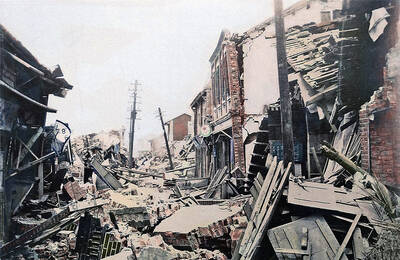
April 15 to April 21 Yang Kui (楊逵) was horrified as he drove past trucks, oxcarts and trolleys loaded with coffins on his way to Tuntzechiao (屯子腳), which he heard had been completely destroyed. The friend he came to check on was safe, but most residents were suffering in the town hit the hardest by the 7.1-magnitude Hsinchu-Taichung Earthquake on April 21, 1935. It remains the deadliest in Taiwan’s recorded history, claiming around 3,300 lives and injuring nearly 12,000. The disaster completely flattened roughly 18,000 houses and damaged countless more. The social activist and

Over the course of former President Ma Ying-jeou’s (馬英九) 11-day trip to China that included a meeting with Chinese Communist Party (CCP) leader Xi Jinping (習近平) a surprising number of people commented that the former president was now “irrelevant.” Upon reflection, it became apparent that these comments were coming from pro-Taiwan, pan-green supporters and they were expressing what they hoped was the case, rather than the reality. Ma’s ideology is so pro-China (read: deep blue) and controversial that many in his own Chinese Nationalist Party (KMT) hope he retires quickly, or at least refrains from speaking on some subjects. Regardless


 RSS
RSS