


He is rusty, lipless, subliterate and keeps company with garbage. Worse, he's a Hello, Dolly! fan. This little robot, who goes by the name Wall-E - for Waste Allocation Load Lifter Earth-Class - is also the newest face (not that he has one) of Pixar.
Last year's offering, Ratatouille, about a cartoon rat with Cordon Bleu aspirations, seemed like a hard sell. But Pixar may have outdone itself in the weird-premises department with Wall-E, a US$180 million post-apocalyptic, near-silent robot love story inspired by Charlie Chaplin.
Andrew Stanton, who wrote and directed the film, doesn't care if the kiddies want to hug Wall-E or not. "I never think about the audience," he said. "If someone gives me a marketing report, I throw it away."
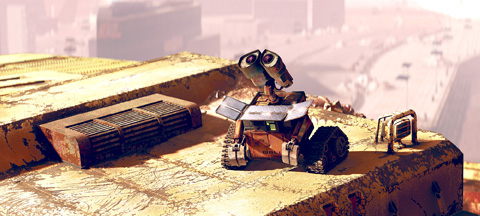
PHOTO: NY TIMES NEWS SERVICE
Stanton, 42, sat in a Toronto hotel room this month, shaggy-haired and bearded, bouncing in his chair with a tween's frenzied energy. In this way he seemed to embody the anti-corporate posture that is part of the Pixar mythology. When John Lasseter, Pixar's chief creative executive, announced the company's US$7.4 billion acquisition by the Walt Disney Co in 2006, he did so in a Hawaiian shirt and jeans. Employees at the Pixar "campus" in Emeryville, California, ride scooters and play foosball. "It's like a film school with no teachers," Stanton said. "Everyone actually wants you to take risks."
Such is the Pixar brand, or anti-brand: a multibillion US dollar company that acts like a nerd hobbyist in a basement. But that balancing act is even tougher to pull off as a subsidiary of Disney, a company whose very name has been turned into a neologism - Disneyfication - for a kind of bland commercial aesthetic.
Perhaps to assure the public that nothing has changed under new ownership, an early trailer for Wall-E - which opens in Taiwan late next month - plays up Pixar's carefree mystique. The teaser, narrated by Stanton, describes a 1994 lunch, when the central Pixar players were finishing Toy Story, the first feature-length CG animated film. Over lunch they sketched on napkins characters that would end up in A Bug's Life, Monsters, Inc and Finding Nemo.

PHOTO: NY TIMES NEWS SERVICE
On one napkin a lonely robot emerged. "We said: 'What if humanity left and some little robot got left on and kept doing the same thing forever?'" said Stanton, who joined Pixar in 1990 as its second animator and ninth employee. "That was the saddest character I'd ever heard of."
Wall-E took a back seat to another project, a film Stanton wrote and directed about a fish father looking for his son: Finding Nemo (2003). It went on to earn US$340 million domestically and US$865 million worldwide. The day after the 2004 Academy Awards, in which Stanton won the Oscar for best animated feature, he went to work on Wall-E, forgoing a planned six-month vacation.
"We were always frustrated that people saw CG as a genre as opposed to just a medium that could tell any kind of story," he said. "We felt like we widened the palette with Toy Story, but then people unconsciously put CG back in a different box: 'Well, it's got to be irreverent, it's got to have A-list actors, it's got to have talking animals.'"
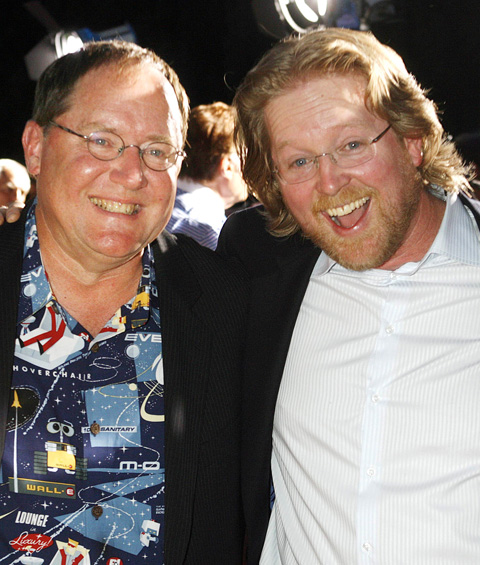
PHOTO: NY TIMES NEWS SERVICE
So Stanton took Wall-E to a more somber, less sassy place (though there is some sass of course). The film is set in 2700 on an uninhabitable Earth, a dystopia covered in towers of garbage. Stanton drew on films from science fiction's golden age: "1968 to 1981," he said, with a film geek's specificity. Software imitated the film - mostly Panavision 70mm - that gave movies like 2001 and Blade Runner their visual sweep. Casting Sigourney Weaver in one of a handful of speaking parts is a nod to Alien. Wall-E, a generic robo-janitor, contentedly compacts trash into perfect cubes, until he's shaken up by the appearance of an egg-shaped search robot named Eve. This high-tech, piano-key-smooth egg-bot has dropped from the sky, seeking a sign of life on Earth. Wall-E, who knows about love from a video of Hello, Dolly!, falls hard.
"Technically there have been romances in animation," Stanton said, but does anyone care about them? Stanton loves a rhetorical question: "Why can't you have a love story that just completely sweeps you up? It happens in other movies, why not animation?"
In Wall-E, a mega-corporation called Buy n' Large has transported Earth's populace to luxury space ships, where the obese human race moves around in robotic loungers, drinking super-size soft drinks, placated by television and robot servants. Environmental disaster; corporate takeover; a global psychological coma: Wall-E starts to seem like An Inconvenient Cartoon. Yet Stanton dismisses talk of an allegory.
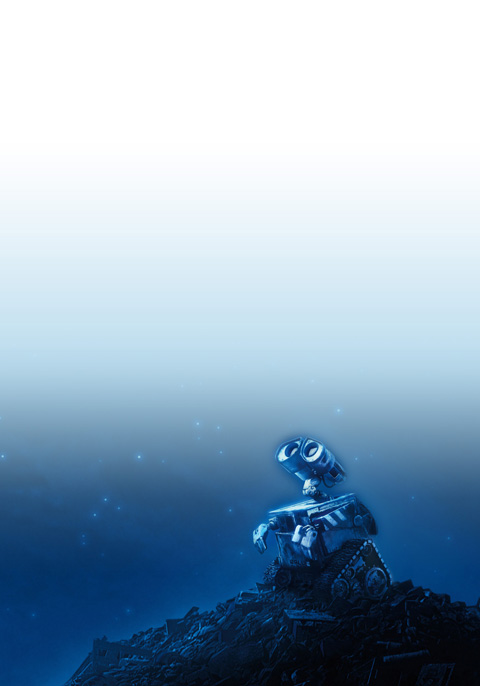
PHOTO: NY TIMES NEWS SERVICE
"I was writing this thing so long ago, how could I have known what's going on now?" he said. "As it was getting finished, the environment talk started to freak me out. I don't have much of a political bent, and the last thing I want to do is preach. I just went with things that I felt were logical for a possible future and supported the point of my story, which was the premise that irrational love defeats life's programming, and that the most robotic beings I've met are us."
And is the ubiquitous, all-powerful Buy n' Large a sly dig at Disney Pixar's new corporate bedfellow? With a fervent head shake no, Stanton turns company man.
"Part of the contract was: 'You can't touch us, you can't change what we do,' and that's actually gained them such a level of respect and trust they wouldn't have gotten if they'd tried to be Draconian."
David Price, author of a company history called The Pixar Touch, doesn't see the dark tone of Wall-E as a radical departure. "Pixar films reach whole audiences because they know how to make characters that are appealing to children and then give them adult problems," he said. Both Nemo and Wall-E are small, lost and vulnerable. But unlike Finding Nemo, with its chatterbox characters, Wall-E feels almost like a silent film. The first 25 to 30 minutes introduce Wall-E as a Buster Keaton-meets-ET figure, comically rocking and shuffling. Stanton found the key to the robot's infant-sweet appearance at a baseball game. While he played with binoculars, Wall-E sprang into his head: binoculars on a box with treads.
"I want you to project a face on it," he said. "I wanted to evoke the audience's participation. You need to actually see it as a machine. I kept saying, I'm trying to make R2D2: The Movie. "
To that end Stanton enlisted the man who created the grammar of the Star Wars robot R2D2, the veteran sound designer Ben Burtt. Stanton wrote a conventional script - "Hi, I'm Wall-E" - and Burtt essentially translated the dialogue into robot, something he calls "audio puppeteering."
"If you take sounds from the real world, we have a subconscious association with them that gives credibility to an otherwise fantastic concept," Burtt said in a telephone interview.
The result is a film where the sound is as significant as the visual. One hears echoes of ET's throat-singing (ET is another Burtt film), and when Wall-E moves, the sound comes from a hand-cranked, World War II Army generator that Burtt saw in a John Wayne movie, then found on eBay.
"We all thought about Charlie Chaplin and Buster Keaton," Burtt said, "this energetic, sympathetic character who doesn't say a whole lot. Most animation is very dialogue heavy. There's dance, constant talking, punch lines. We used to wonder: How will we prepare the audience?"
Whether or not viewers give in to Wall-E is a billion-dollar question. "The box office from Pixar films hasn't been growing since Finding Nemo," Price said, speaking of the domestic box office. "Certainly Cars and Ratatouille were not as strong as the predecessor films." (Even The Incredibles, the best performer since Finding Nemo, trailed it in the US.) "If that trend were to continue with Wall-E, there would be questions raised about the soundness of the deal. Though of course there's always money to be made in merchandising." The Wall-E robots, sheets and Crocs may turn a profit, but the alpha success still has to be the film about a mute robot.
But Stanton is measuring the film's success in different terms.
"I'm not naive about what's at stake," he said. "But I almost feel like it's an obligation to not further the status quo if you become somebody with influence and exposure. I don't want to paint the same painting again. I don't want to make the same sculpture again. Why shouldn't a big movie studio be able to make those small independent kinds of pictures? Why not change it up?"

Last week Joseph Nye, the well-known China scholar, wrote on the Australian Strategic Policy Institute’s website about how war over Taiwan might be averted. He noted that years ago he was on a team that met with then-president Chen Shui-bian (陳水扁), “whose previous ‘unofficial’ visit to the US had caused a crisis in which China fired missiles into the sea and the US deployed carriers off the coast of Taiwan.” Yes, that’s right, mighty Chen caused that crisis all by himself. Neither the US nor the People’s Republic of China (PRC) exercised any agency. Nye then nostalgically invoked the comical specter
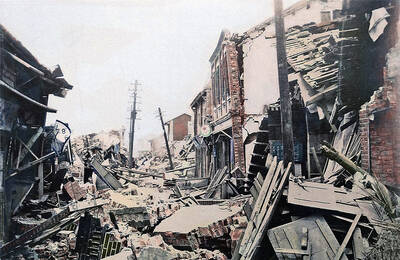
April 15 to April 21 Yang Kui (楊逵) was horrified as he drove past trucks, oxcarts and trolleys loaded with coffins on his way to Tuntzechiao (屯子腳), which he heard had been completely destroyed. The friend he came to check on was safe, but most residents were suffering in the town hit the hardest by the 7.1-magnitude Hsinchu-Taichung Earthquake on April 21, 1935. It remains the deadliest in Taiwan’s recorded history, claiming around 3,300 lives and injuring nearly 12,000. The disaster completely flattened roughly 18,000 houses and damaged countless more. The social activist and

Over the course of former President Ma Ying-jeou’s (馬英九) 11-day trip to China that included a meeting with Chinese Communist Party (CCP) leader Xi Jinping (習近平) a surprising number of people commented that the former president was now “irrelevant.” Upon reflection, it became apparent that these comments were coming from pro-Taiwan, pan-green supporters and they were expressing what they hoped was the case, rather than the reality. Ma’s ideology is so pro-China (read: deep blue) and controversial that many in his own Chinese Nationalist Party (KMT) hope he retires quickly, or at least refrains from speaking on some subjects. Regardless

Approaching her mid-30s, Xiong Yidan reckons that most of her friends are on to their second or even third babies. But Xiong has more than a dozen. There is Lucky, the street dog from Bangkok who jumped into a taxi with her and never left. There is Sophie and Ben, sibling geese, who honk from morning to night. Boop and Pan, both goats, are romantically involved. Dumpling the hedgehog enjoys a belly rub from time to time. The list goes on. Xiong nurtures her brood from her 8,000 square meter farm in Chiang Dao, a mountainous district in northern Thailand’s


 RSS
RSS