


When the Shanghai Dramatic Arts Center (上海話劇藝術中心) visited in January, it was part of the hugely disappointing The Last Night of Taipan Chin (金大班的最後一夜), which was clearly little more than a star vehicle for actress and celebrity Liu Xiaoqing (劉曉慶). With the presentation of the multi-award-winning play The Scholar and the Executioner (秀才與劊子手) by the highly respected contemporary playwright and theorist Huang Wei-ruo (黃維若), the company proved it’s capable of much more.
The range of theatrical theories and styles that Huang sought to combine in The Scholar is daunting in its ambition and remarkable in its success. Puppet theater, and the theoretical issues that underpin the use of puppets — or in this case masks — is raised in the very first moments of the play. The idea that these were “meat puppets” — the US punk/grunge band scene came to mind, one of many contemporary references that the play throws up — set one of the play’s themes; then there was the Brechtian declamatory diction and elements taken from the Theater of the Absurd. Added to that were the formal poses and use of language taken both from Beijing opera and from the tradition of Chinese vernacular storytelling. Some of this was given straight, some ironically, and at other times refracted through the lens of Chinese Communist Model Plays.
While the presentation of the play draws heavily on Chinese traditional culture, the theoretical underpinnings are very contemporary, and one can conceive of the whole as an ironic take on ideologically-driven drama of the Left, with nods to people as diverse as George Bernard Shaw and Pirandello. On top of that, the masked cast serves also as a kind of Greek chorus, commenting on the action and moving the story along.

PHOTO COURTESY OF TAIPEI ARTS INTERNATIONAL ASSOCIATION
What makes the whole thing even more remarkable, is that despite this heavy academic baggage, the story of the scholar and the executioner, both finding themselves unemployed after an edict abolishing the more elaborate forms of torture and the other uniquely Chinese torture of the civil service examinations, is really fun and interesting. There is plenty of humor, both verbal and physical, and in the way that Huang wears his considerable learning lightly, he bears some similarities to a playwright like Tom Stoppard, who has also done well with his ability to create theater that appeals both at an intellectual and a visceral level. This is all stuff from which Taiwan’s theater community could learn, for scripts have always been the traditional weakness of Taiwan’s drama, and this is a wonderful example of what can be achieved in the ubiquitous concept of fusion. It certainly sets the bar very high, but Taiwan has proved that it can make the grade if the commitment is there.
There are a number of minor complaints about the performance. It was unfortunate that subtitles were displayed only for the more difficult sections of text, such as when the scholar character recites verses from the Confucian Analects, as the text is so dense and the delivery so rapid that sometimes written text may have been of some assistance even to local Chinese-speaking members of the audience. That the English subtitles were only provided for these sections made them virtually useless, quite apart from the fact that even these subtitles were often utterly cryptic, and could not have assisted a non-Chinese speaker to understand the play.
Sound quality yet again was a major issue, something which this reviewer has commented on more than once. With actors speaking lines behind masks, sound quality on the microphones was often distorted. This made the task of following the play that much more difficult, and is clearly an issue that the technicians of the National Theater ought to be able to overcome.
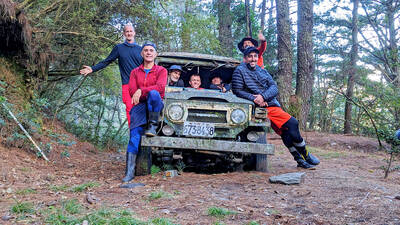
The year was 1991. A Toyota Land Cruiser set out on a 67km journey up the Junda Forest Road (郡大林道) toward an old loggers’ camp, at which point the hikers inside would get out and begin their ascent of Jade Mountain (玉山). Little did they know, they would be the last group of hikers to ever enjoy this shortcut into the mountains. An approaching typhoon soon wiped out the road behind them, trapping the vehicle on the mountain and forever changing the approach to Jade Mountain. THE CONTEMPORARY ROUTE Nowadays, the approach to Jade Mountain from the north side takes an

Last week Joseph Nye, the well-known China scholar, wrote on the Australian Strategic Policy Institute’s website about how war over Taiwan might be averted. He noted that years ago he was on a team that met with then-president Chen Shui-bian (陳水扁), “whose previous ‘unofficial’ visit to the US had caused a crisis in which China fired missiles into the sea and the US deployed carriers off the coast of Taiwan.” Yes, that’s right, mighty Chen caused that crisis all by himself. Neither the US nor the People’s Republic of China (PRC) exercised any agency. Nye then nostalgically invoked the comical specter

Relations between Taiwan and the Czech Republic have flourished in recent years. However, not everyone is pleased about the growing friendship between the two countries. Last month, an incident involving a Chinese diplomat tailing the car of vice president-elect Hsiao Bi-khim (蕭美琴) in Prague, drew public attention to the People’s Republic of China’s (PRC) operations to undermine Taiwan overseas. The trip was not Hsiao’s first visit to the Central European country. It was meant to be low-key, a chance to meet with local academics and politicians, until her police escort noticed a car was tailing her through the Czech capital. The
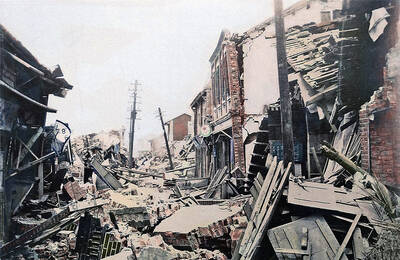
April 15 to April 21 Yang Kui (楊逵) was horrified as he drove past trucks, oxcarts and trolleys loaded with coffins on his way to Tuntzechiao (屯子腳), which he heard had been completely destroyed. The friend he came to check on was safe, but most residents were suffering in the town hit the hardest by the 7.1-magnitude Hsinchu-Taichung Earthquake on April 21, 1935. It remains the deadliest in Taiwan’s recorded history, claiming around 3,300 lives and injuring nearly 12,000. The disaster completely flattened roughly 18,000 houses and damaged countless more. The social activist and


 RSS
RSS