


The Harry Potter series of books had the inestimable advantage of being an enormously popular contemporary composition, while J.R.R. Tolkien’s The Lord of the Rings had the almost equivalent advantage of being a work of genius that had half a century to establish its fan base. The Chronicles of Narnia has neither of these advantages, and the fact that the books have dated significantly over the 60 or so years since they were first published, and are marred, by the standards of popular culture at least, by their overt Christian message, was made clear by the first installment of the series, the 2005 film The Lion, the Witch and the Wardrobe.
Despite this, the first installment gained sufficient popularity to warrant the continuation of the series under director Andrew Adamson, who made his name with the Shrek franchise. This is a mixed blessing for fans of the book, for while director Adamson shows a commendable faithfulness to the spirit of the books and a dexterous soft peddling of C.S. Lewis’ more blatant sermonizing, the result, manages to fall curiously flat — caught between a straightforward morality tale and the desire to produce the adrenaline rush that is essential to any movie that relies primarily on spectacle to draw in the audience.
Adamson has clearly decided to emphasize the darker aspects of the story, and Prince Caspian aims for a toughness that the first installment never aspired to. With the very first scene, a cry of pain as a woman gives birth in a darkened chamber, Adamson announces that he is taking the series to a new level. The promise, unfortunately, remains sadly unfulfilled, despite two big and really rather exciting battle sequences, and some outstanding acting by minor characters.
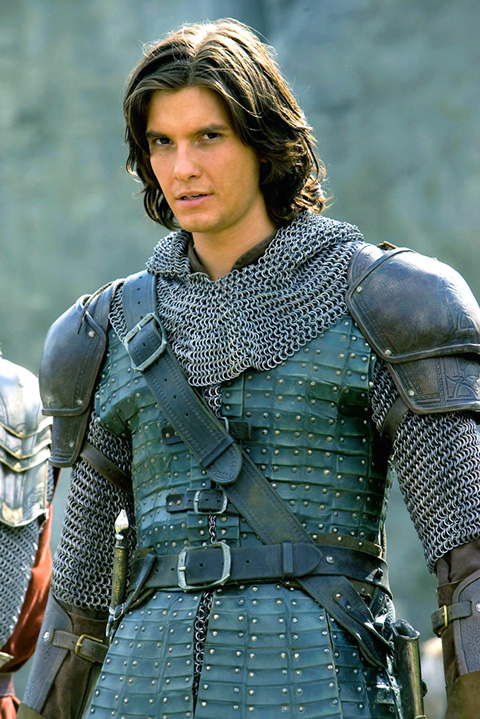
PHOTO COURTESY OF BVI/SONY
As the film opens, the land of Narnia is under the iron heel of the Telmarines. Inside the court of its rulers, a child is born to the usurper King Miraz, and the rightful heir to the throne, Prince Caspian, is forced to flee. He escapes into the hands of the Narnian people, dwarves and talking badgers among a host of other magical animals, who have been oppressed virtually out of existence. For reasons that are not ever made clear, he is regarded as the rightful king by the oppressed people of the land, despite his ethnic affiliation with the oppressors. This is only one of many issues in this complex web of religious and nationalistic allegories that are rather brushed over so that we can get to the fight sequences with the minotaurs and sword-wielding mice.
Meanwhile, the four Pevensie children are caught up in wartime London, missing the wondrous life they’d lived as kings and queens in Narnia in the first installment. The life of school children grates on them, and Peter and Edmund get into fights with other school kids as their sisters look on in despair. They know that beneath the dull exterior of their school uniforms, they are royalty. But even as the drab world of boarding school life closes in, a call is sent out, and miraculously they are drawn back to help Caspian liberate Narnia and its freedom-loving people from the Telmarine yoke.
Lewis was a subtle storyteller and packed a good deal of moral reflection into this Narnia series. Morality is at the very core of the stories, and Adamson tries his best to put a contemporary gloss on this, sometimes with considerable effect. A scene in which Narnian troops, including gorgeously rendered centaurs, are caught behind enemy lines and massacred, is heartbreaking; but the recrimination back at camp between Peter Pevensie, erstwhile high king, and Prince Caspian, the supposedly legitimate heir to the throne, is of an adolescent shallowness that would embarrass a child of 12.
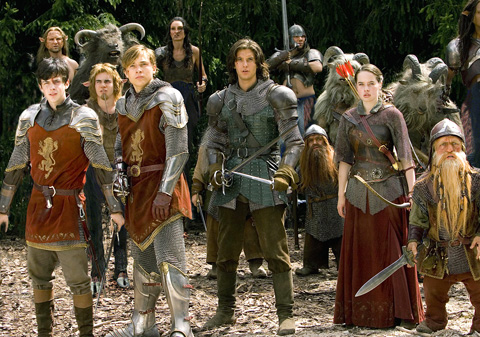
PHOTO COURTESY OF BVI/SONY
Ben Barnes, a young British stage actor, is perfectly wooden as Caspian, though more than suitable as an object of a high school crush by Susan Pevensie. Skandar Keynes, as Edmund, the most stroppy of the Pevensie children, shows some development from The Lion, but the show on the Narnian side is completely stolen by Peter Dinklage, who plays the cynical dwarf Trumpkin. The fact that the accent of the curmudgeonly but good-hearted Trumpkin is clearly from the north of England, and much of the Narnian army sound like they are from the British Midlands, while the Telmarines have accents that are clearly southern or eastern European in inspiration, gives rise to some interesting reflections on the pertinacity of ethnocentric stereotyping in fantasy fiction.
As with The Lion, Prince Caspian is not a bad film. For those who know the books, it is in fact a remarkable feat of fidelity to the original work — for better or for worse. The Narnian series of books is, for all its talking beasts and knights in shining armor, a story about finding redemption in the love of a Christian god. Adamson, to his credit, has not discarded this aspect of the story totally, but in an age when the moral certitudes that Lewis lived with have long been thrown out the window, he fails in this interpretation to engage with the core of the story, and is content to remain faithful to the superficial details.
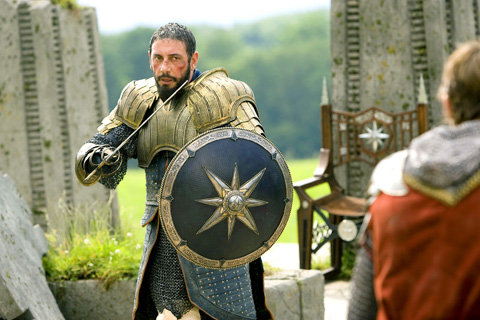
PHOTO COURTESY OF BVI/SONY

Last week Joseph Nye, the well-known China scholar, wrote on the Australian Strategic Policy Institute’s website about how war over Taiwan might be averted. He noted that years ago he was on a team that met with then-president Chen Shui-bian (陳水扁), “whose previous ‘unofficial’ visit to the US had caused a crisis in which China fired missiles into the sea and the US deployed carriers off the coast of Taiwan.” Yes, that’s right, mighty Chen caused that crisis all by himself. Neither the US nor the People’s Republic of China (PRC) exercised any agency. Nye then nostalgically invoked the comical specter

Relations between Taiwan and the Czech Republic have flourished in recent years. However, not everyone is pleased about the growing friendship between the two countries. Last month, an incident involving a Chinese diplomat tailing the car of vice president-elect Hsiao Bi-khim (蕭美琴) in Prague, drew public attention to the People’s Republic of China’s (PRC) operations to undermine Taiwan overseas. The trip was not Hsiao’s first visit to the Central European country. It was meant to be low-key, a chance to meet with local academics and politicians, until her police escort noticed a car was tailing her through the Czech capital. The
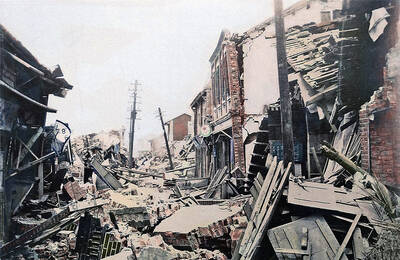
April 15 to April 21 Yang Kui (楊逵) was horrified as he drove past trucks, oxcarts and trolleys loaded with coffins on his way to Tuntzechiao (屯子腳), which he heard had been completely destroyed. The friend he came to check on was safe, but most residents were suffering in the town hit the hardest by the 7.1-magnitude Hsinchu-Taichung Earthquake on April 21, 1935. It remains the deadliest in Taiwan’s recorded history, claiming around 3,300 lives and injuring nearly 12,000. The disaster completely flattened roughly 18,000 houses and damaged countless more. The social activist and

Over the course of former President Ma Ying-jeou’s (馬英九) 11-day trip to China that included a meeting with Chinese Communist Party (CCP) leader Xi Jinping (習近平) a surprising number of people commented that the former president was now “irrelevant.” Upon reflection, it became apparent that these comments were coming from pro-Taiwan, pan-green supporters and they were expressing what they hoped was the case, rather than the reality. Ma’s ideology is so pro-China (read: deep blue) and controversial that many in his own Chinese Nationalist Party (KMT) hope he retires quickly, or at least refrains from speaking on some subjects. Regardless


 RSS
RSS