


The symphony of Manhattan Island, composed and performed fortissimo daily by garbage trucks, car speakers, I-beam bolters, bus brakes, warped manhole covers, knocking radiators, people yelling from high windows and the blaring television that now greets you in the back of a taxi, is the kind of music people would pay good money to be able to silence, if only there were a switch.
The other day, in a paint-peeling hangar of a room at the foot of the island, David Byrne, the artist and musician, placed his finger on a switch that did exactly the opposite: it made such music on purpose. The switch was a white key on the bass end of a beat-up Weaver pump organ that was practically the only thing sitting inside the old Great Hall of the Battery Maritime Building, a 99-year-old former ferry terminal at the end of Whitehall Street that has sat mostly dormant for more than a half-century.
The organ’s innards had been replaced with relays and wires and light blue air hoses. And when the key was pressed, a 110-volt motor strapped to a girder high up in the room’s ceiling began to vibrate, essentially playing the girder and producing a deafening low hum — like one of the tuba tones played by the mother ship in Close Encounters of the Third Kind. Or, if you were less charitably inclined, like a truck on Canal Street with a loose muffler. Byrne ran his fingers up the keyboard, causing more hums and whines, moans and plunks and clinks until he came to a key that seemed to do nothing.
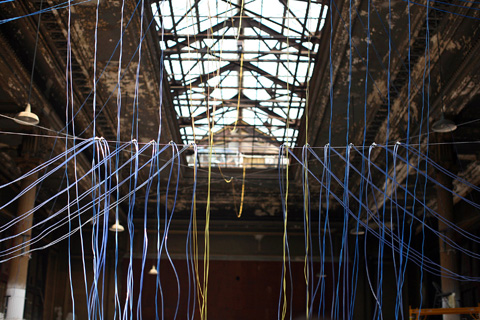
PHOTO: NY TIMES NEWS SERVICE
“We’re not getting any register on that bottom one,” he said, sending two artist-technicians up onto a scaffold to figure out why a certain magnetic knocker was not turning one of the room’s giant Corinthian columns into a kind of architectural castanet.
The project Byrne has created with support from the public-art organization Creative Time is a kind of twist on the projects Creative Time has brought into being since it started helping artists use the city as a canvas in 1974. Often the organization finds dilapidated, neglected, historically rich buildings, and artists create installations inside, as the British artist Mike Nelson did last year when he turned a wing of the Essex Street Market on the Lower East Side into a dimly lighted labyrinth. The ferry-terminal project, called, appropriately enough, Playing the Building, opened Saturday.
But in the case of Byrne — a founder of the Talking Heads who has been a visual artist as long as he has been a musician and producer — the Beaux-Arts terminal itself has become the installation, or at least a stunning, 836m² part of it that once served as a soaring waiting room for passengers who came there to board ferries bound for South Brooklyn. The building has been one of those glorious Manhattan antiques caught in a decades-long time warp, not used for major ferry service since 1938. Plans to have it house everything from a children’s museum to a dance troupe to even Creative Time’s offices have fallen through over the years, and now a developer has been chosen to rehabilitate the terminal and build a hotel atop it.
PHOTO: NY TIMES NEWS SERVICE
At least for the next two and a half months, though, the building will simply serve as a gargantuan cast-iron orchestra. Besides being fitted with several motors, which produce the bass sounds by vibrating a set of girders that once supported a stained-glass skylight in the 12m-high ceiling, the organ is attached to a pump that blows air through a tangle of hoses. These hoses snake into the huge room’s old water and heating pipes and conduits, making primitive flute sounds. And then there are more than a dozen spring-loaded solenoids, attached like woodpeckers to the columns and even to a linebacker-size radiator that emits a surprisingly sonorous tone when struck in just the right place with a metal rod.
When you get both hands busy on the keyboard — as anyone who comes to see the work will be allowed to do — the room roars and clatters to life, seeming to harbor an invisible band playing something written by Philip Glass in collaboration with the Stooges, a Japanese sho virtuoso and a kitchen full of 3-year-olds with pots and ladles.
Working on the project recently in his SoHo studio, Byrne said he had generally avoided music-related art projects because he did not want his reputation as a musician to become confused with such work.
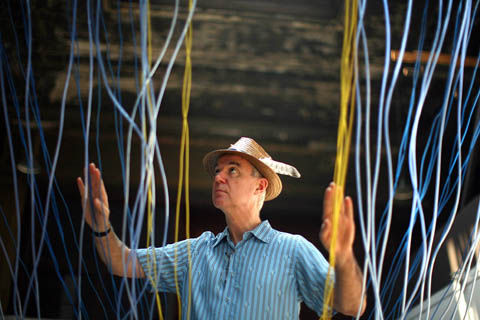
PHOTO: NY TIMES NEWS SERVICE
But when he was invited several years ago to propose a piece for Fargfabriken, a gallery space in a former factory in Stockholm, Sweden, he began thinking about how to turn a building into an instrument. (One of his ideas for the Swedish project was to build a huge microwave oven inside the hall.) He had inherited the out-of-tune pump organ from a friend who was moving out of his print studio in the meatpacking district. And so Byrne used the organ to create the first version of Playing the Building in 2005.
Because he generally likes to distance his art from his music, Byrne has not composed pieces for the building-organ and does not plan to play it publicly. But he said he hoped the project would say something about the direction of popular music.
“I’m not suggesting people abandon musical instruments and start playing their cars and apartments, but I do think the reign of music as a commodity made only by professionals might be winding down,” he said. “The imminent demise of the large record companies as gatekeepers of the world’s popular music is a good thing, for the most part.”
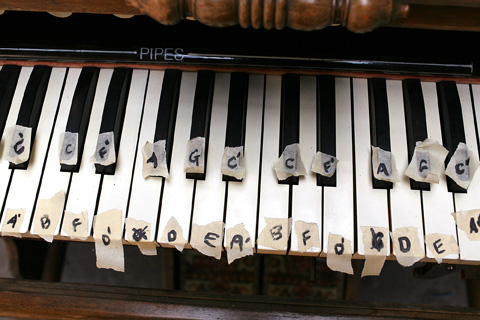
PHOTO: NY TIMES NEWS SERVICE

In late October of 1873 the government of Japan decided against sending a military expedition to Korea to force that nation to open trade relations. Across the government supporters of the expedition resigned immediately. The spectacle of revolt by disaffected samurai began to loom over Japanese politics. In January of 1874 disaffected samurai attacked a senior minister in Tokyo. A month later, a group of pro-Korea expedition and anti-foreign elements from Saga prefecture in Kyushu revolted, driven in part by high food prices stemming from poor harvests. Their leader, according to Edward Drea’s classic Japan’s Imperial Army, was a samurai

The following three paragraphs are just some of what the local Chinese-language press is reporting on breathlessly and following every twist and turn with the eagerness of a soap opera fan. For many English-language readers, it probably comes across as incomprehensibly opaque, so bear with me briefly dear reader: To the surprise of many, former pop singer and Democratic Progressive Party (DPP) ex-lawmaker Yu Tien (余天) of the Taiwan Normal Country Promotion Association (TNCPA) at the last minute dropped out of the running for committee chair of the DPP’s New Taipei City chapter, paving the way for DPP legislator Su

It’s hard to know where to begin with Mark Tovell’s Taiwan: Roads Above the Clouds. Having published a travelogue myself, as well as having contributed to several guidebooks, at first glance Tovell’s book appears to inhabit a middle ground — the kind of hard-to-sell nowheresville publishers detest. Leaf through the pages and you’ll find them suffuse with the purple prose best associated with travel literature: “When the sun is low on a warm, clear morning, and with the heat already rising, we stand at the riverside bike path leading south from Sanxia’s old cobble streets.” Hardly the stuff of your
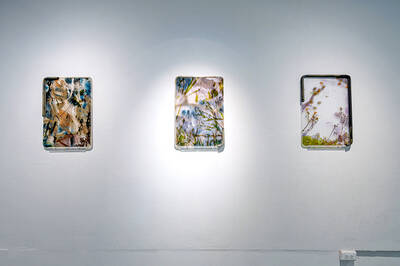
Located down a sideroad in old Wanhua District (萬華區), Waley Art (水谷藝術) has an established reputation for curating some of the more provocative indie art exhibitions in Taipei. And this month is no exception. Beyond the innocuous facade of a shophouse, the full three stories of the gallery space (including the basement) have been taken over by photographs, installation videos and abstract images courtesy of two creatives who hail from the opposite ends of the earth, Taiwan’s Hsu Yi-ting (許懿婷) and Germany’s Benjamin Janzen. “In 2019, I had an art residency in Europe,” Hsu says. “I met Benjamin in the lobby


 RSS
RSS