


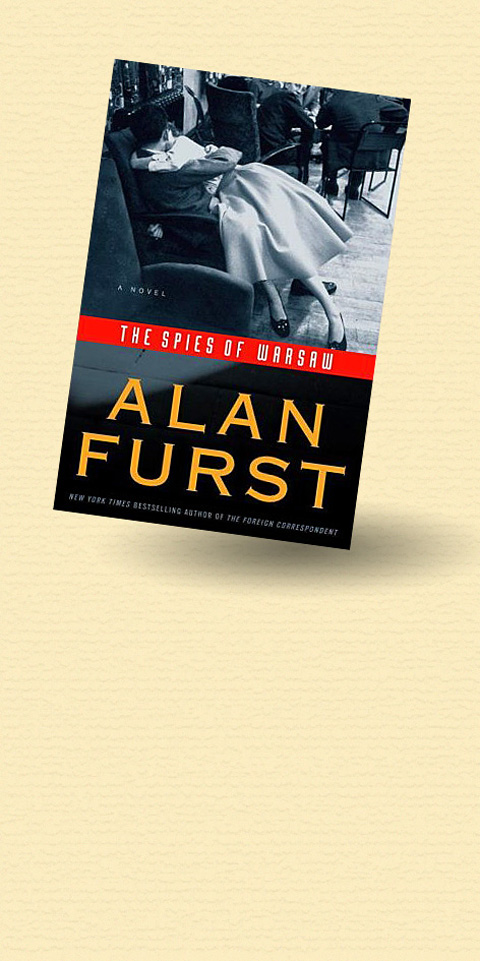
On a train bound from Warsaw to Belgrade, Colonel Jean-Francois Mercier, the immensely attractive hero of Alan Furst’s sinuous new novel, cannot decide what to read. Should it be Stendhal’s Red and the Black, which a teacher once told him was “a political novel, very nearly a spy novel, one of the first ever written”? Or should it be The Bar on the Seine, an early Georges Simenon detective story featuring Commissaire Jules Maigret?
One is a much-admired classic, the other a more forthright page-turner. Mercier winds up devouring both. And no wonder: Furst’s instant espionage classics are equally indebted to both kinds of fiction. His stories combine keen deductive precision with much deeper, more turbulent and impassioned aspects of character. Since they are also soigne and steamy, there is the inevitable woman in the dining car, with whom Mercier will have this perfectly succinct conversation:
“‘So,’ she said, ‘an adventure on a train.’
“‘No,’ he said. ‘More.’”
And, two pages and one change of venue later, in Mercier’s sleeping car: “They paused, shared a look of exquisite complicity, and she raised her hips.” This is one of those Furst one-sentence erotic marvels that truly could stop a train in its tracks.
If Furst wrote arid, mechanical spy books, such steam heat might be surprising. But he can invest even the most humdrum situation with similarly elegant acuity. In this latest brooding, sophisticated period piece, The Spies of Warsaw, winter does not simply arrive. Instead, “out in the countryside, the first paw prints of wolves were seen near the villages.” It is late 1937 in Poland, and the atmosphere is charged with peril. The wolves are both metaphorical and real.
Mercier is a French aristocrat, a contemporary of Charles de Gaulle who, after lengthy military service, has become the military attache to Poland. France and Poland are allies, and Furst observes with characteristic worldliness, that “allies were, for reasons of the heart more than the brain, supposed to trust each other.”
But as Mercier acknowledges to his Polish counterpart, Colonel Anton Vyborg (“tall and well-built and thin-lipped, with webbed lines at the corners of eyes made to squint into blizzards”), the reality is different. With a second World War looming before military men old enough to have fought in the first one, Mercier says: “You know what I think, Anton. If the worst happens, and it starts again, you must be prepared to stand alone.”
As Furst has acknowledged, the outcomes of his pre-World War II novels are never in doubt. And much of the plot of The Spies of Warsaw hinges on a question answerable in hindsight: Yes, Germany will invade France. But this book is set at a point when a knowledge of Germany’s precise plans is all-important. And so, as the book begins, Mercier meets not only with fellow dignitaries but also with a character whom he holds in slight contempt.
Mercier is cultivating Edvard Uhl, a German who can provide the particulars about how German tanks are constructed. Uhl does this gladly because his monthly trips to Warsaw allow him to conduct an affair with a woman he thinks is royalty. But the woman is deceiving him. “I rather like her, actually,” the female spy says of the countess she impersonates when Uhl comes to town.
When Uhl arouses German suspicions, Mercier starts trying to protect him. And when questions of tank traps and fortifications arise, Mercier abandons any complaints about being bored by his work. As Furst plays his usual cat-and-mouse games, he lures both Mercier and the reader into high-stakes espionage activities in which prescience about a possible tank attack is all-important. To the extent that The Spies of Warsaw has a central thread, this is it.
Furst has created this book on a broad canvas. And he succeeds in doing so without losing sight of his narrative focus. Mercier deals with an arch, international mixture of characters, all of whom share a kind of anxiety that is anything but dated. “A bad dream,” Vyborg says about tank information found in Wehrmacht journals. “They write books and articles about what they intend to do, but nobody seems to notice, or care.”
As always, but with especially great efficacy in The Spies of Warsaw, Furst asks how life can go on in the face of encroaching menace. And in the book’s uncommonly fine-tuned portrait of Mercier, it has some kind of answer.

In late October of 1873 the government of Japan decided against sending a military expedition to Korea to force that nation to open trade relations. Across the government supporters of the expedition resigned immediately. The spectacle of revolt by disaffected samurai began to loom over Japanese politics. In January of 1874 disaffected samurai attacked a senior minister in Tokyo. A month later, a group of pro-Korea expedition and anti-foreign elements from Saga prefecture in Kyushu revolted, driven in part by high food prices stemming from poor harvests. Their leader, according to Edward Drea’s classic Japan’s Imperial Army, was a samurai

Located down a sideroad in old Wanhua District (萬華區), Waley Art (水谷藝術) has an established reputation for curating some of the more provocative indie art exhibitions in Taipei. And this month is no exception. Beyond the innocuous facade of a shophouse, the full three stories of the gallery space (including the basement) have been taken over by photographs, installation videos and abstract images courtesy of two creatives who hail from the opposite ends of the earth, Taiwan’s Hsu Yi-ting (許懿婷) and Germany’s Benjamin Janzen. “In 2019, I had an art residency in Europe,” Hsu says. “I met Benjamin in the lobby

April 22 to April 28 The true identity of the mastermind behind the Demon Gang (魔鬼黨) was undoubtedly on the minds of countless schoolchildren in late 1958. In the days leading up to the big reveal, more than 10,000 guesses were sent to Ta Hwa Publishing Co (大華文化社) for a chance to win prizes. The smash success of the comic series Great Battle Against the Demon Gang (大戰魔鬼黨) came as a surprise to author Yeh Hung-chia (葉宏甲), who had long given up on his dream after being jailed for 10 months in 1947 over political cartoons. Protagonist

Peter Brighton was amazed when he found the giant jackfruit. He had been watching it grow on his farm in far north Queensland, and when it came time to pick it from the tree, it was so heavy it needed two people to do the job. “I was surprised when we cut it off and felt how heavy it was,” he says. “I grabbed it and my wife cut it — couldn’t do it by myself, it took two of us.” Weighing in at 45 kilograms, it is the heaviest jackfruit that Brighton has ever grown on his tropical fruit farm, located


 RSS
RSS