


Even if you spend a lot of time around fashion and the endearing nut jobs who create it, this question comes up every so often: Who is that person?
By that person, one is referring to an imaginary consumer, a man who designers have decided should wear skintight flood pants and a Pee-wee Herman jacket barely grazing his behind.
Who exactly is the boy/man fashion is crazy about lately, the guy wearing tennis shorts or onesies or the sort of jacket an Etonian whom I know claims was called a bum-freezer when he was at school?
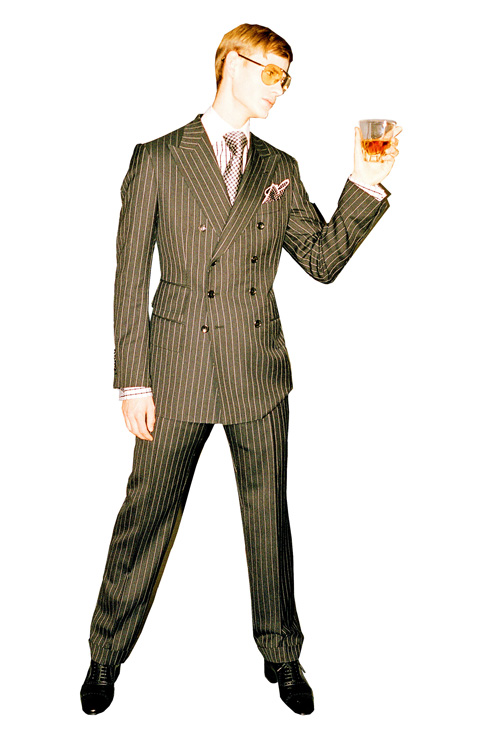
PHOTO : NY TIMES NEWS SERVICE
Who, in other words, is the Thom Browne man?
For the benefit of those who have just awakened from a lengthy disco nap, Thom Browne is a onetime actor, a former design director for Club Monaco and an award-winning designer who — distressed by the disheveled mess that was men’s wear in the aftermath of business casual — took a pronounced taste for a geek version of the 1960s “Mad Men” style, and also a pair of scissors, to the traditional suit.
Having decided that the American male uniform of jeans and a T-shirt had lapsed into a form of dreary establishment dressing, Browne set about reviving the suit, a costume that once defined the establishment.
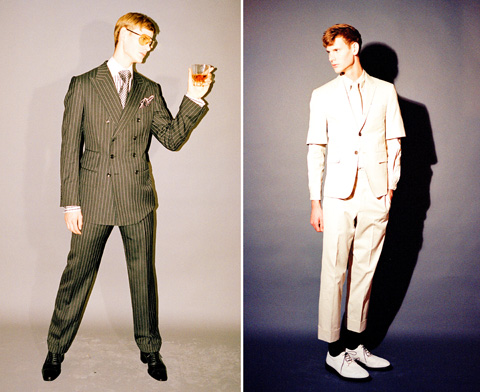
PHOTO : NY TIMES NEWS SERVICE
Slashing away with abandon, he arrived at a silhouette that was lean and shrunken, with trousers lopped off well north of the ankle, jacket skirts like peplums and sleeves snug enough to cut off the flow of blood.
In Thom Browne’s universe, trousers and suit coats and lapels and ties, and even tie clips, are skinny. In Thom Browne’s world, one can actually wear a tie clip without appearing to idolize Don Knotts. Thom Browne thinks that tie clips are cool, and so apparently did the jury of the Council of Fashion Designers of America, which two years ago named him men’s wear designer of the year.
Eternal Adolescence
It is not just the council folks who signed on to the Thom Browne cult, however. He tends to inspire excitement among department store buyers and editors, particularly Anna Wintour, who is credited with having brokered a job for Browne at Brooks Brothers when the venerable clothier went looking for someone to infuse its dowdy image with verve.
“What Thom Browne has done is make our eye adjust to a shorter, smaller silhouette,” said Tommy Fazio, the men’s fashion director at Bergdorf Goodman, where members of the Thom Browne sect go for their seasonal hit, at least those unafraid to pay US$4,000 for a suit. “Other designers followed,” Fazio said, an observation correct as far as it goes. (Viktor & Rolf; Christopher Bailey; Ennio Capasa at Costume National; and Miuccia Prada leap to mind as designers who have showed kiddie-size men’s clothes for years.)
It is certainly true that many US designers fell under the influence of Browne and his singular ideas about masculine presentation. Or most of them did, anyway. The signal exception is another talented Tom named Ford.
If Thom Browne has come to represent sartorial arrested development, the proponent of a kind of masculinity that suggests one is never sexier than when being carded, Tom Ford is a throwback to a different manliness. In one of those funny confluences that retailers like Bergdorf Goodman are seemingly built to showcase, the two designers and their variant ideas of how men should dress now find themselves cheek by jowl.
Hollywood Style
There, on the second and third floors of the Bergdorf men’s branch on Fifth Avenue in Manhattan, stand racks of Browne’s suits, all chalk stripes, peg legs and taut armholes. And there, as of May 29, in an adjacent second-floor boutique, is a new Tom Ford department, infused with the designer’s trademark form of wood-paneled testosterone swank.
One could think of the pairing as a stare-down between Tom and Thom, or an attempt to capture in clothes the essence of American manhood. Or just think of it as an accident of real estate. In any case, the pairing offers a chance to see how masculinity looks from the very different vantage points of two of the more talented designers at work.
Browne, the man Brooks Brothers hired to develop a “style for a new generation,” offers clothes that look a lot like those worn by my father four decades ago, when men aimed to look 50 at 20, rather than 20 going on 15. Ford, who in his Gucci heyday got more mileage out of crotch-hugging trousers and male decolletage than anyone since Tom Jones, offers his Anglicized gloss on Hollywood style.
Unlike more workaday designers, both men seem to start from the hoary but still sound premise, so beloved of the folks in theory-land, that masculinity is a pose, a form of drag. That their clothes in some ways reflect an adolescent’s idea of what it means to look grown up also makes sense. It is probably no accident that as technology makes age seem more mutable, people have happily lapsed into a kind of prolonged adolescence. Biologists terms this Peter Pan state neoteny. Fashion calls it the new look for fall. And why not? With scientists conspiring to make it seem as if growing up and old is anything but inevitable, it makes sense that designers would take up the challenge to cloak our cultural fantasies in new ways.
Once upon a time, people were encouraged to dress in a manner that was age-appropriate. That notion now seems incredibly quaint. How can you dress appropriately for your age when it’s difficult to recall what it is anymore? And why confine your wardrobe to one stage of manhood when it’s equally cool and plausible to dress as though Cary Grant was your grandpa or Pee-wee Herman your dad?
“I’m taking a more youthful kind of sensibility and stretching it to a not-so-youthful sensibility,” Browne said the other day. “I wanted to take the traditional suit and give it to men in a new way, so that they weren’t wearing their fathers’ suits, and hopefully making that cool for them.”
For his part, Ford, whose ready-made suits start at US$2,900, said in an interview last week at his Madison Avenue flagship that a person “can push to create newness and move a boundary and yet end up forgetting that people want something to wear.”
Peter Pan syndrome
Back in the 1980s, when the undervalued genius Paul Reubens began mining cultural anxiety about manhood, he played it mostly for laughs. But there was undoubtedly something prophetic about the adenoidal boy/man Pee-wee Herman as he giggled his way toward a future in which generational distinctions grow fuzzy and we find ourselves parading giddily toward the playhouse dressed up as our child selves in bow ties and knee socks, or else as our fathers doing impersonations of themselves.
“I don’t get hung up by the idea of masculinity,” Browne said. “An idea that is confident always looks masculine.”
To be masculine, according to Ford’s design vision, is to fuse the debonair cut of a Savile Row suit with the swagger of a star from 1970s pornography. “I’m gay, I’m masculine and I’m not at all ashamed or embarrassed at this point to say I feel confident in traditional masculine clothes,” he said. By the time a man has reached his 40s, as Ford and Browne both have, it is probably useful to accept that one is less close to the playhouse than to the grave. “You grow up,” Ford said. Or else you do not.

In late October of 1873 the government of Japan decided against sending a military expedition to Korea to force that nation to open trade relations. Across the government supporters of the expedition resigned immediately. The spectacle of revolt by disaffected samurai began to loom over Japanese politics. In January of 1874 disaffected samurai attacked a senior minister in Tokyo. A month later, a group of pro-Korea expedition and anti-foreign elements from Saga prefecture in Kyushu revolted, driven in part by high food prices stemming from poor harvests. Their leader, according to Edward Drea’s classic Japan’s Imperial Army, was a samurai
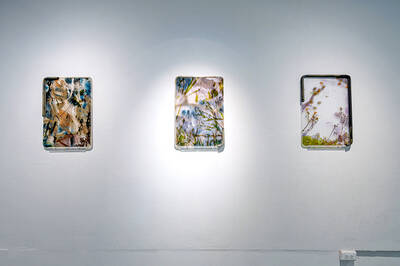
Located down a sideroad in old Wanhua District (萬華區), Waley Art (水谷藝術) has an established reputation for curating some of the more provocative indie art exhibitions in Taipei. And this month is no exception. Beyond the innocuous facade of a shophouse, the full three stories of the gallery space (including the basement) have been taken over by photographs, installation videos and abstract images courtesy of two creatives who hail from the opposite ends of the earth, Taiwan’s Hsu Yi-ting (許懿婷) and Germany’s Benjamin Janzen. “In 2019, I had an art residency in Europe,” Hsu says. “I met Benjamin in the lobby
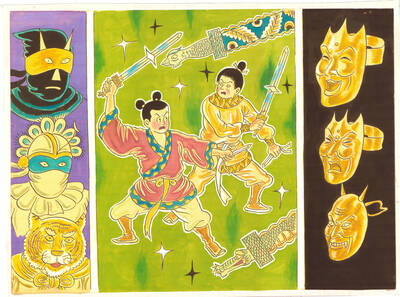
April 22 to April 28 The true identity of the mastermind behind the Demon Gang (魔鬼黨) was undoubtedly on the minds of countless schoolchildren in late 1958. In the days leading up to the big reveal, more than 10,000 guesses were sent to Ta Hwa Publishing Co (大華文化社) for a chance to win prizes. The smash success of the comic series Great Battle Against the Demon Gang (大戰魔鬼黨) came as a surprise to author Yeh Hung-chia (葉宏甲), who had long given up on his dream after being jailed for 10 months in 1947 over political cartoons. Protagonist

Peter Brighton was amazed when he found the giant jackfruit. He had been watching it grow on his farm in far north Queensland, and when it came time to pick it from the tree, it was so heavy it needed two people to do the job. “I was surprised when we cut it off and felt how heavy it was,” he says. “I grabbed it and my wife cut it — couldn’t do it by myself, it took two of us.” Weighing in at 45 kilograms, it is the heaviest jackfruit that Brighton has ever grown on his tropical fruit farm, located


 RSS
RSS