


Any writer who has struggled to “do the words” would take heart from the self-effacing assessment written for himself by Ian Fleming, the raffish Englishman born 100 years ago this month who became one of the most successful authors of his time through the creation of the world’s best-loved spy, James Bond.
Fleming died in 1964, at 56, of complications from pleurisy after playing a round of golf in Oxfordshire though he had a heavy cold. But the real culprits were years of smoking up to 80 cigarettes a day, and a fondness for drink. Perhaps because of the difficulty he found in resisting life’s indulgences, he adopted a strict writing routine in his last 12 years, the period in which he wrote more than a dozen Bond novels that spawned the multibillion-dollar film franchise.
Rising early for a swim in the aquamarine waters in the cove below his idyllic Jamaican retreat, Goldeneye, Fleming tapped away at his Remington portable typewriter with six fingers for three hours in the morning and an hour in the afternoon — 2,000 words a day, a completed novel in two months, all the while keeping up the sybaritic lifestyle that led Noel Coward, a frequent guest at Goldeneye and no puritan himself, to describe the Fleming household as “golden ear, nose and throat.”
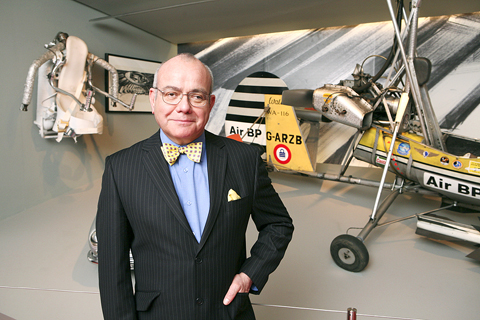
PHOTO: NY TIMES NEWS SERVICE
Fleming, who saw 40 million copies of his books sold in his lifetime but died before the Bond franchise went stratospheric, had no literary pretensions. He described his first Bond book, Casino Royale, as “an oafish opus,” and offered further disparagement in a 1963 BBC radio interview. “If I wait for the genius to come, it just doesn’t arrive,” he said. Asked if Bond had kept him from more serious writing, of the kind achieved by his older brother, Peter, a renowned explorer and travel writer, he replied: “I’m not in the Shakespeare stakes. I have no ambition.”
Fleming’s workaday approach to writing is among the revelations drawing crowds of Bond lovers to For Your Eyes Only: Ian Fleming and James Bond, an exhibition that opened at the Imperial War Museum in London last month and runs through March 2009. For the museum, founded in 1917 and guarded by two 18-inch guns from a World War I dreadnought, there is something — well, raffish — in the staging of an exhibition about the glamorous, gadget-wielding, womanizing, devil-may-care Bond and his creator, for whom the superspy was in many respects an alter ego.
The museum’s former curator, Alan Borg, whose 13-year tenure as director ended in 1995, encouraged innovative approaches by reminding his staff that “the three most off-putting words in the English language” were encompassed by the museum’s name.
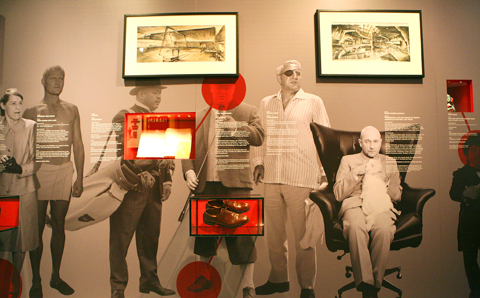
PHOTO: NY TIMES NEWS SERVICE
“And we have to fight against that,” said Terry Charman, the museum’s senior historian and curator of the Bond exhibition.
The display explores the relationship between Fleming and Bond, examining how much of the fictional spy is built on the author’s character — the degree to which Bond was his “fantasy version of himself,” as Charman put it. As well, it shows how Fleming drew on his experiences as a man about town and as a prewar foreign correspondent, in the world of banking and investment, and as a World War II aide to the head of the UK’s directorate of naval intelligence, to give what he described as “verisimilitude” to Bond’s world of spies and villains and romance.
Of his Bond plots, Fleming, ever prosaic about his talent, said, “I extracted them from my wartime memories, dolled them up, attached a hero and a villain, and there was the book.” For M, Bond’s irascible, domineering secret service overseer, he had as a model Rear Admiral John Godfrey, his wartime intelligence chief; old school friends, golfing partners and girlfriends also metamorphosed into Bond characters. Even his villains had real-life antecedents.
Bond himself, Fleming said, was “a compound of all the secret agents and commandos I met during the war,” but his tastes — in blondes, martinis “shaken, not stirred,” expensively tailored suits, scrambled eggs, short-sleeved shirts and Rolex watches — were Fleming’s own. But not all the comparisons were ones the author liked to encourage. Bond, he said, had “more guts than I have” as well as being “more handsome.” And he was eager to discourage the idea that he had been as much of a Lothario as Bond before his marriage to Ann Rothermere, whom he wed in 1952, the year he wrote Casino Royale.
But the exhibition suggests otherwise. A section of the show titled Friends and Lovers has one of a stable of prewar girlfriends, Mary Pakenham, saying of Fleming, “No one I know had sex so much on the brain as Ian.”

In late October of 1873 the government of Japan decided against sending a military expedition to Korea to force that nation to open trade relations. Across the government supporters of the expedition resigned immediately. The spectacle of revolt by disaffected samurai began to loom over Japanese politics. In January of 1874 disaffected samurai attacked a senior minister in Tokyo. A month later, a group of pro-Korea expedition and anti-foreign elements from Saga prefecture in Kyushu revolted, driven in part by high food prices stemming from poor harvests. Their leader, according to Edward Drea’s classic Japan’s Imperial Army, was a samurai

Approaching her mid-30s, Xiong Yidan reckons that most of her friends are on to their second or even third babies. But Xiong has more than a dozen. There is Lucky, the street dog from Bangkok who jumped into a taxi with her and never left. There is Sophie and Ben, sibling geese, who honk from morning to night. Boop and Pan, both goats, are romantically involved. Dumpling the hedgehog enjoys a belly rub from time to time. The list goes on. Xiong nurtures her brood from her 8,000 square meter farm in Chiang Dao, a mountainous district in northern Thailand’s

Located down a sideroad in old Wanhua District (萬華區), Waley Art (水谷藝術) has an established reputation for curating some of the more provocative indie art exhibitions in Taipei. And this month is no exception. Beyond the innocuous facade of a shophouse, the full three stories of the gallery space (including the basement) have been taken over by photographs, installation videos and abstract images courtesy of two creatives who hail from the opposite ends of the earth, Taiwan’s Hsu Yi-ting (許懿婷) and Germany’s Benjamin Janzen. “In 2019, I had an art residency in Europe,” Hsu says. “I met Benjamin in the lobby
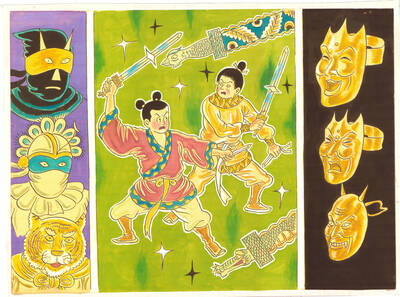
April 22 to April 28 The true identity of the mastermind behind the Demon Gang (魔鬼黨) was undoubtedly on the minds of countless schoolchildren in late 1958. In the days leading up to the big reveal, more than 10,000 guesses were sent to Ta Hwa Publishing Co (大華文化社) for a chance to win prizes. The smash success of the comic series Great Battle Against the Demon Gang (大戰魔鬼黨) came as a surprise to author Yeh Hung-chia (葉宏甲), who had long given up on his dream after being jailed for 10 months in 1947 over political cartoons. Protagonist


 RSS
RSS