


Any writer who has struggled to “do the words” would take heart from the self-effacing assessment written for himself by Ian Fleming, the raffish Englishman born 100 years ago this month who became one of the most successful authors of his time through the creation of the world’s best-loved spy, James Bond.
Fleming died in 1964, at 56, of complications from pleurisy after playing a round of golf in Oxfordshire though he had a heavy cold. But the real culprits were years of smoking up to 80 cigarettes a day, and a fondness for drink. Perhaps because of the difficulty he found in resisting life’s indulgences, he adopted a strict writing routine in his last 12 years, the period in which he wrote more than a dozen Bond novels that spawned the multibillion-dollar film franchise.
Rising early for a swim in the aquamarine waters in the cove below his idyllic Jamaican retreat, Goldeneye, Fleming tapped away at his Remington portable typewriter with six fingers for three hours in the morning and an hour in the afternoon — 2,000 words a day, a completed novel in two months, all the while keeping up the sybaritic lifestyle that led Noel Coward, a frequent guest at Goldeneye and no puritan himself, to describe the Fleming household as “golden ear, nose and throat.”
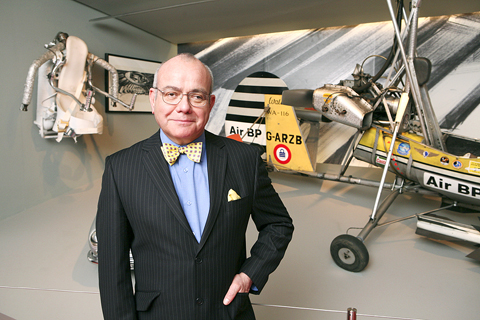
PHOTO: NY TIMES NEWS SERVICE
Fleming, who saw 40 million copies of his books sold in his lifetime but died before the Bond franchise went stratospheric, had no literary pretensions. He described his first Bond book, Casino Royale, as “an oafish opus,” and offered further disparagement in a 1963 BBC radio interview. “If I wait for the genius to come, it just doesn’t arrive,” he said. Asked if Bond had kept him from more serious writing, of the kind achieved by his older brother, Peter, a renowned explorer and travel writer, he replied: “I’m not in the Shakespeare stakes. I have no ambition.”
Fleming’s workaday approach to writing is among the revelations drawing crowds of Bond lovers to For Your Eyes Only: Ian Fleming and James Bond, an exhibition that opened at the Imperial War Museum in London last month and runs through March 2009. For the museum, founded in 1917 and guarded by two 18-inch guns from a World War I dreadnought, there is something — well, raffish — in the staging of an exhibition about the glamorous, gadget-wielding, womanizing, devil-may-care Bond and his creator, for whom the superspy was in many respects an alter ego.
The museum’s former curator, Alan Borg, whose 13-year tenure as director ended in 1995, encouraged innovative approaches by reminding his staff that “the three most off-putting words in the English language” were encompassed by the museum’s name.
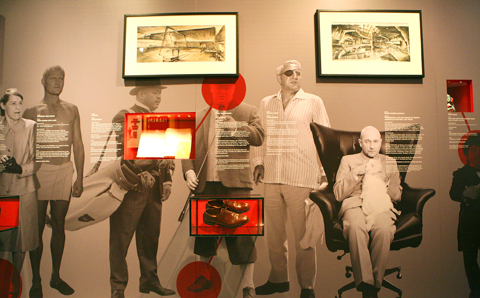
PHOTO: NY TIMES NEWS SERVICE
“And we have to fight against that,” said Terry Charman, the museum’s senior historian and curator of the Bond exhibition.
The display explores the relationship between Fleming and Bond, examining how much of the fictional spy is built on the author’s character — the degree to which Bond was his “fantasy version of himself,” as Charman put it. As well, it shows how Fleming drew on his experiences as a man about town and as a prewar foreign correspondent, in the world of banking and investment, and as a World War II aide to the head of the UK’s directorate of naval intelligence, to give what he described as “verisimilitude” to Bond’s world of spies and villains and romance.
Of his Bond plots, Fleming, ever prosaic about his talent, said, “I extracted them from my wartime memories, dolled them up, attached a hero and a villain, and there was the book.” For M, Bond’s irascible, domineering secret service overseer, he had as a model Rear Admiral John Godfrey, his wartime intelligence chief; old school friends, golfing partners and girlfriends also metamorphosed into Bond characters. Even his villains had real-life antecedents.
Bond himself, Fleming said, was “a compound of all the secret agents and commandos I met during the war,” but his tastes — in blondes, martinis “shaken, not stirred,” expensively tailored suits, scrambled eggs, short-sleeved shirts and Rolex watches — were Fleming’s own. But not all the comparisons were ones the author liked to encourage. Bond, he said, had “more guts than I have” as well as being “more handsome.” And he was eager to discourage the idea that he had been as much of a Lothario as Bond before his marriage to Ann Rothermere, whom he wed in 1952, the year he wrote Casino Royale.
But the exhibition suggests otherwise. A section of the show titled Friends and Lovers has one of a stable of prewar girlfriends, Mary Pakenham, saying of Fleming, “No one I know had sex so much on the brain as Ian.”
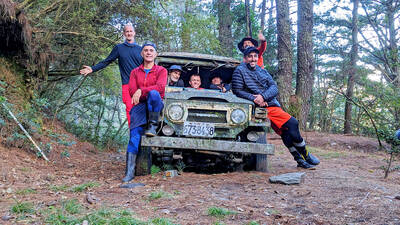
The year was 1991. A Toyota Land Cruiser set out on a 67km journey up the Junda Forest Road (郡大林道) toward an old loggers’ camp, at which point the hikers inside would get out and begin their ascent of Jade Mountain (玉山). Little did they know, they would be the last group of hikers to ever enjoy this shortcut into the mountains. An approaching typhoon soon wiped out the road behind them, trapping the vehicle on the mountain and forever changing the approach to Jade Mountain. THE CONTEMPORARY ROUTE Nowadays, the approach to Jade Mountain from the north side takes an

Last week Joseph Nye, the well-known China scholar, wrote on the Australian Strategic Policy Institute’s website about how war over Taiwan might be averted. He noted that years ago he was on a team that met with then-president Chen Shui-bian (陳水扁), “whose previous ‘unofficial’ visit to the US had caused a crisis in which China fired missiles into the sea and the US deployed carriers off the coast of Taiwan.” Yes, that’s right, mighty Chen caused that crisis all by himself. Neither the US nor the People’s Republic of China (PRC) exercised any agency. Nye then nostalgically invoked the comical specter

Relations between Taiwan and the Czech Republic have flourished in recent years. However, not everyone is pleased about the growing friendship between the two countries. Last month, an incident involving a Chinese diplomat tailing the car of vice president-elect Hsiao Bi-khim (蕭美琴) in Prague, drew public attention to the People’s Republic of China’s (PRC) operations to undermine Taiwan overseas. The trip was not Hsiao’s first visit to the Central European country. It was meant to be low-key, a chance to meet with local academics and politicians, until her police escort noticed a car was tailing her through the Czech capital. The
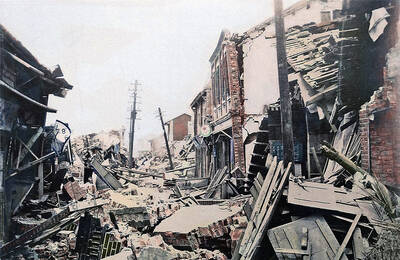
April 15 to April 21 Yang Kui (楊逵) was horrified as he drove past trucks, oxcarts and trolleys loaded with coffins on his way to Tuntzechiao (屯子腳), which he heard had been completely destroyed. The friend he came to check on was safe, but most residents were suffering in the town hit the hardest by the 7.1-magnitude Hsinchu-Taichung Earthquake on April 21, 1935. It remains the deadliest in Taiwan’s recorded history, claiming around 3,300 lives and injuring nearly 12,000. The disaster completely flattened roughly 18,000 houses and damaged countless more. The social activist and


 RSS
RSS