


The photo is dark, almost monochrome in its palate of muddy browns and greens. It shows a soldier fallen against an embankment. He is clearly exhausted. The image is slightly blurred, lacking the sharp lines and rich colors camera companies want consumers to think are the hallmarks of a good photo. But this is no castoff. This is the World Press Photo of the Year for 2007, an image chosen from among 80,536 submissions to the World Press Photo Foundation. The foundation's international exhibition, which will visit more than 50 cities this year, opens in Taipei today.
UK photographer Tim Hetherington captured the image as part of a photo series taken in Afghanistan for Vanity Fair magazine. The series won second prize in the General News Stories category.
"The main thing why this photo has become World Press Photo of the Year is that this picture is a metaphor, it's not just of one guy who is tired of a day of fighting, who's signed up to fight in a country he has never been to before, ... the Korengal Valley [in Eastern Afghanistan] has more engagements than anywhere in the world, more than in Iraq, more than in Congo ... over 135 contacts in a month, this guy is tired, but this picture is actually a metaphor for the fact that the world is tired of these kinds of wars. It's not just the man who's exhausted, the world is exhausted, ... this picture tells that story: that's what counts, that's what makes this World Press Photo of the Year," said Sander Goudswaard, curator of the World Press Photo Exhibition in Taipei.

PHOTO: COURTESY OF THE WORLD PRESS FOUNDATION
The 2007 World Press Photo Exhibition began at the end of April and now has 15 sets of prints touring internationally. These edits of the winning entries do not include all the photos, as many of the photo essays are massively compressed. "If we didn't do this," Goudswaard said, "the show would simply be too big." All photos in the single photo category are included, but the images in the photo story categories are edited down to a number of representative images. All winning photos can be accessed on the World Press Photo Web site, which also contains extended interviews with some of the winning photographers.
For Goudswaard, the exhibition is as much about the photographers as about the images themselves.
"World Press Photo is a contest for professional photographers. It's not just a contest of photography. We want to support those people who invest time, invest money and invest a lot of effort in trying to tell and communicate different stories from around the world," he said, speaking about the difference between the photographs in this exhibition and images captured by members of the public by chance on their cell phone or compact camera.
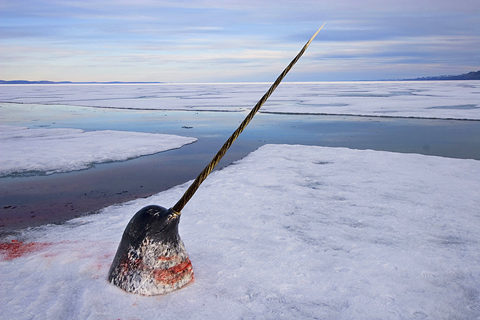
PHOTO: COURTESY OF THE WORLD PRESS FOUNDATION
A good example is a photo by South African Brent Stirton that depicts rangers evacuating the bodies of four dead mountain gorillas in Virunga National Park, in Democratic Republic of Congo. It won first prize for a single image in the Contemporary Issues category.
"This image has been really appealing to a lot of people. ... You ask why [the gorilla is being carried out of the forest], then you start reading, and then you discover that this picture has so many layers," Goudswaard said.
Choices such as Hetherington and Stirton's photos are typical of the judges' selections for 2007.

PHOTO: COURTESY OF THE WORLD PRESS FOUNDATION
"When you see this year's winners they are really challenging. The winners that were chosen are not obvious and easily understandable photography. It is photography that makes you read the caption. It challenges you [to ask] what is it, what is going on here, why is this subject photographed. What does it want to say? It makes you think, it makes you want to read, makes you want to understand. It makes you take an extra step," Goudswaard said, adding that many photographers were very happy with this aspect of this year's event.
The World Press Photo Foundation was founded in 1955 with the aim of improving the quality of photojournalism. In addition to the awards and the traveling exhibition, the foundation actively seeks to encourage the transmission of skills and sharing of knowledge through classes and workshops.
"We put a lot of energy into analyzing which countries are underrepresented and we try to encourage participation from these areas," Goudswaard said. "The more images we get in, taken from more different angles, the better the result can be in the end."
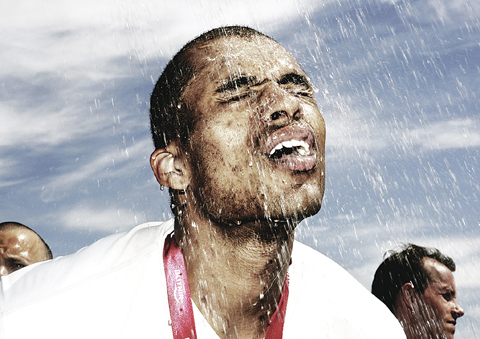
PHOTO: COURTESY OF THE WORLD PRESS FOUNDATION
This year, 5,019 photographers from 125 countries submitted works. The foundation continues to extend the range of participation to countries with little access to formal training for press photographers.
"We hooked up with local organizations, sometimes a university, sometimes a journalist association and we try to set up a lot of workshops. For example in the Philippines and in Nigeria, over the last three years we have helped set up education for photojournalists and now we back out and they are able to carry it on their own. In this way we can support press photography really at the roots of where it is happening," Goudswaard said.
To highlight the success of World Press Photo's expansion into the developing world, Goudswaard pointed to the three winners from China this year, as well as the success of Nigerian photographer Akintunde Akinleye who won the Spot News Single category in 2006 for a photo taken after a gas pipeline explosion in Lagos.
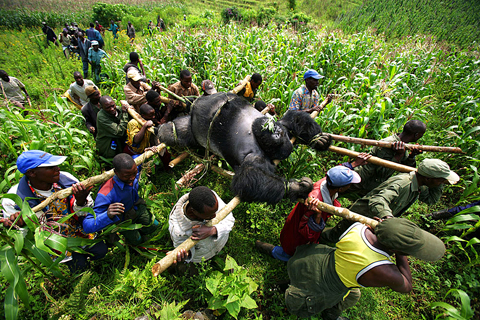
PHOTO: COURTESY OF THE WORLD PRESS FOUNDATION
"He was part of the first year of our education program in Nigeria. He was one of the first to come and say he wanted to be a photojournalist and then five years on he is one of the winners in the contest," Goudswaard said. "This is investment and our success can be measured in how many people entered from these countries. You don't know who's going to win, but there are rising numbers of entries from areas were we have had education projects, and though this cannot be measured exactly ... if these people work in photography, that means photography can play a better role. And that is our aim."

Last week Joseph Nye, the well-known China scholar, wrote on the Australian Strategic Policy Institute’s website about how war over Taiwan might be averted. He noted that years ago he was on a team that met with then-president Chen Shui-bian (陳水扁), “whose previous ‘unofficial’ visit to the US had caused a crisis in which China fired missiles into the sea and the US deployed carriers off the coast of Taiwan.” Yes, that’s right, mighty Chen caused that crisis all by himself. Neither the US nor the People’s Republic of China (PRC) exercised any agency. Nye then nostalgically invoked the comical specter
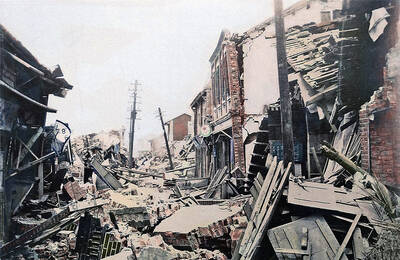
April 15 to April 21 Yang Kui (楊逵) was horrified as he drove past trucks, oxcarts and trolleys loaded with coffins on his way to Tuntzechiao (屯子腳), which he heard had been completely destroyed. The friend he came to check on was safe, but most residents were suffering in the town hit the hardest by the 7.1-magnitude Hsinchu-Taichung Earthquake on April 21, 1935. It remains the deadliest in Taiwan’s recorded history, claiming around 3,300 lives and injuring nearly 12,000. The disaster completely flattened roughly 18,000 houses and damaged countless more. The social activist and

Over the course of former President Ma Ying-jeou’s (馬英九) 11-day trip to China that included a meeting with Chinese Communist Party (CCP) leader Xi Jinping (習近平) a surprising number of people commented that the former president was now “irrelevant.” Upon reflection, it became apparent that these comments were coming from pro-Taiwan, pan-green supporters and they were expressing what they hoped was the case, rather than the reality. Ma’s ideology is so pro-China (read: deep blue) and controversial that many in his own Chinese Nationalist Party (KMT) hope he retires quickly, or at least refrains from speaking on some subjects. Regardless

Approaching her mid-30s, Xiong Yidan reckons that most of her friends are on to their second or even third babies. But Xiong has more than a dozen. There is Lucky, the street dog from Bangkok who jumped into a taxi with her and never left. There is Sophie and Ben, sibling geese, who honk from morning to night. Boop and Pan, both goats, are romantically involved. Dumpling the hedgehog enjoys a belly rub from time to time. The list goes on. Xiong nurtures her brood from her 8,000 square meter farm in Chiang Dao, a mountainous district in northern Thailand’s


 RSS
RSS