


Following the collapse of communism in the Soviet Union and Eastern Europe in the late 1980s and early 1990s, predictions that the Chinese Communist Party (CCP) was next became in fashion. While the “pessimists” have made careers predicting chaos, fissiparous dissolution or a military takeover in China, the “optimists” have argued that a democratic spring is just around the corner. In most instances, those prognostications were predicated on a monolithic CPP that is little more than a Chinese version of the Communist Party of the Soviet Union (CPSU).
In China’s Communist Party: Atrophy and Adaptation, David Shambaugh, director of the China Policy program at George Washington University, argues that the CCP has been anything but complacent since the fall of the Soviet Union and that, above all, its principal objective has been to ensure its survival.
Little known to most, the CCP and the various academic centers that fall under its purview have expended a tremendous amount of intellectual capital studying the many variables that, combined, resulted in the collapse of the CPSU and other communist governments around the world. In fact, by looking at systemic causes (economic; political/coercive; social/cultural; international), Chinese analyses of what went wrong for the Soviet Union were far more thorough than Western accounts, which tended to see Mikhail Gorbachev as the principal cause of the CPSU’s demise. In China’s view, the Soviet apparatus had become far too atrophied, too top-heavy, not flexible enough and too dogmatic, while Gorbachev’s intervention came too late, too fast, and in many ways was misguided, as it sought to emulate the Western model. As such, rather than the proximate cause of the Soviet Union’s implosion, Gorbachev was its trigger (this partly explains why former leader Zhao Ziyang (趙紫楊), whose “humanist” views echoed Gorbachev’s, was quickly sidelined following the Tiananmen Square Massacre in 1989).
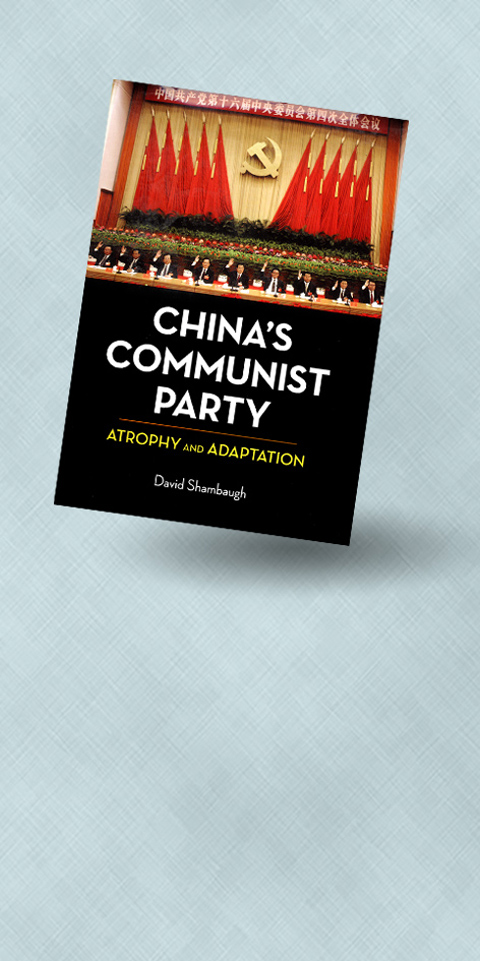
Beijing’s curiosity, Shambaugh shows, went much further than the Soviet Union and included surprisingly detailed comparative assessments of other former communist states, surviving ones — North Korea, Vietnam and Cuba — the “Color Revolutions” in the Central Asian republics, noncommunist, single-party states like Singapore and Malaysia, European socialism, and the Chinese Nationalist Party (KMT) in China in the 1940s and in Taiwan in the 1980s and 1990s. Furthermore, those efforts were far more than abstract intellectual inquiry; rather, they were undertaken “for very specific and practical reasons: to anticipate what generic challenges to the CCP may arise.”
Based on the lessons learned, the CCP has embarked on a reactive and proactive strategy of “dynamic stability” to perpetuate its power, and unlike claims to the contrary, has demonstrated an impressive capacity for adaptation and far more flexibility and open-mindedness than it has been credited for. It has also shown that, rather than a monolithic, atrophied entity, the CCP has gradually shifted its policies in line with the economic development of the country and its effect on the demands of the population. Jiang Zemin’s (江澤民) “Three Represents” and Hu Jintao’s (胡錦濤) “Scientific Development” and “Sociality Harmonious Society” paradigms show a progression in thought and greater attention — especially under Hu and Wen Jiabao (溫家寶), who, unlike the “coastal” Jiang, worked in the interior provinces — to the needs of the masses.
To meet the increasingly complex challenges of a developing China, the CCP has also professionalized itself, sought, with some success, to fight corruption, and streamlined its ranks.
Consequently, the 16th Party Congress in 2002 experienced its highest turnover of party members ever and resulted in the most educated CPP in the party’s history. Guided by the “Decision of the CPC Central Committee on Enhancing the Party’s Ruling Capacity” (2004), the party also implemented a series of unprecedented reforms at the ideological and organizational levels, introduced mechanisms, or “Opinions,” to evaluate party cadres, and imposed mid-career training.
Despite all this, the challenges to the CCP are rife. As China transforms, the top-to-bottom penetration of society under a Leninist system has become more difficult to achieve. Social and professional organizations that operate outside the CPP have proliferated, and as communist ideology loses its appeal with the masses and the private sector becomes increasingly independent, party committees have lost their strength as the sole source of legitimacy and purveyance. Rather than crack down or turn back the clock as we would expect of a monolithic authoritarian system, however, the CCP has chosen to experiment with consultative models (the Chinese People’s Political Consultative Congress) and tentatively introduced democracy within the party. It has also increasingly turned Marxist ideology, which the population sees with growing cynicism, into a more nationalistic discourse, and let reality guide ideology rather than the other way around.
There are, however, certain areas where CPP thought has remained inflexible. Its fear of China becoming a “bourgeois vassal state” and paranoid view of the US continues to inform its policies on mass media and non-governmental organizations, which it sees as Trojan Horses meant to topple it — a view that was reinforced by its assessment of the “Color Revolutions.” The CCP has also retained its zero-sum relationship with civil society and zero tolerance for organized opposition outside the party. As the challenges brought about by China’s industrialization and rapid development will only increase, the failure to allow more diversity in the political sphere — in other words to democratize outside the party — may very well be the seeds of the CPP’s demise, and the 60 to 100 years it says are needed before democracy can be fully implemented may just be too long a wait for a population whose demands, expectations and awareness will continue to grow.
But as Shambaugh demonstrates in this rich and extremely helpful guide to how the CCP has viewed itself and the world since the spring of 1989, we should not underestimate its capacity to see the challenges ahead and make the necessary adjustments to ensure the perpetuation of its rule. While the author’s views of the CCP’s successes — especially when it comes to ethnic minorities such as Tibetans and Uyghurs — may be overoptimistic, his book nevertheless makes predictions of the CCP’s inexorable collapse less plausible.

The year was 1991. A Toyota Land Cruiser set out on a 67km journey up the Junda Forest Road (郡大林道) toward an old loggers’ camp, at which point the hikers inside would get out and begin their ascent of Jade Mountain (玉山). Little did they know, they would be the last group of hikers to ever enjoy this shortcut into the mountains. An approaching typhoon soon wiped out the road behind them, trapping the vehicle on the mountain and forever changing the approach to Jade Mountain. THE CONTEMPORARY ROUTE Nowadays, the approach to Jade Mountain from the north side takes an

Relations between Taiwan and the Czech Republic have flourished in recent years. However, not everyone is pleased about the growing friendship between the two countries. Last month, an incident involving a Chinese diplomat tailing the car of vice president-elect Hsiao Bi-khim (蕭美琴) in Prague, drew public attention to the People’s Republic of China’s (PRC) operations to undermine Taiwan overseas. The trip was not Hsiao’s first visit to the Central European country. It was meant to be low-key, a chance to meet with local academics and politicians, until her police escort noticed a car was tailing her through the Czech capital. The

Last week Joseph Nye, the well-known China scholar, wrote on the Australian Strategic Policy Institute’s website about how war over Taiwan might be averted. He noted that years ago he was on a team that met with then-president Chen Shui-bian (陳水扁), “whose previous ‘unofficial’ visit to the US had caused a crisis in which China fired missiles into the sea and the US deployed carriers off the coast of Taiwan.” Yes, that’s right, mighty Chen caused that crisis all by himself. Neither the US nor the People’s Republic of China (PRC) exercised any agency. Nye then nostalgically invoked the comical specter
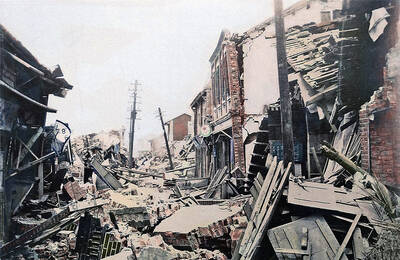
April 15 to April 21 Yang Kui (楊逵) was horrified as he drove past trucks, oxcarts and trolleys loaded with coffins on his way to Tuntzechiao (屯子腳), which he heard had been completely destroyed. The friend he came to check on was safe, but most residents were suffering in the town hit the hardest by the 7.1-magnitude Hsinchu-Taichung Earthquake on April 21, 1935. It remains the deadliest in Taiwan’s recorded history, claiming around 3,300 lives and injuring nearly 12,000. The disaster completely flattened roughly 18,000 houses and damaged countless more. The social activist and


 RSS
RSS