


Wu Song-ming (吳松明) started making woodblock prints in the late 1990s because his art school teachers told him that he was rubbish at oil painting, the discipline he was majoring in. Now he makes a living from his art, an enviable situation for a 46-year-old artist working in an unfashionable medium.
Wu’s new works, the majority of which are scenes of Taiwan in black ink, go on show in Living Under the Longan Tree (龍眼樹下), an exhibition at the German Cultural Center from next Monday. Wu’s aim for the series is simple: “To make people take a second look at the things around them.”
Hailing from a farming family on Taiwan’s northeast coast, Wu came late to art school, after making a number of attempts to get the required grades. “I was shattered that my oil paintings were taken apart by my teachers time and time again,” he said. To find consolation, he took up wood sculpture, then found a comfortable niche in woodblock printing, where he could combine his newfound medium with his desire to paint.
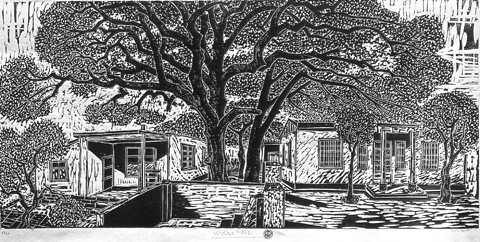
PHOTO: COURTESY OF WU SONG-MING
“Woodblock printing hardly needs to be taught because it’s so simple,” he said with a laugh, adding that it is the immediacy of the medium that appeals to him.
With woodblock printing, Wu said he experiences a palpable and delightful feeling of the theoretical baggage that burdened him during art school falling away.
“I want to express things that I see and experience in my own language,” he said. “With Western oil painting, I knew so much about it, the history and techniques, it just got in the way. I knew nothing about woodwork, but I found it really easy and fun to work in this medium.” It proved a recipe for success.
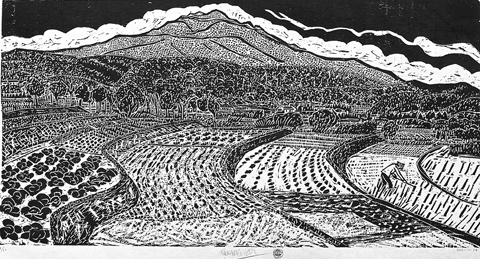
PHOTO: COURTESY OF WU SONG-MING
Wu’s earlier work, some of which was inspired by his experiences traveling in Europe during an art residency there, have an Expressionistic quality, and though he is interested the woodblock work of post-Impressionists such as Gauguin and also the German Expressionists, who worked with woodblock printing, he denies being directly influenced by them.
Although his new series Living Under the Longan Tree takes Taiwan as its theme, Wu shuns political baggage and aims to keep his distance from Chinese artistic traditions as well.
“At school, it was all about learning from books, you didn’t have to look at anything to be able to paint it,” he said.
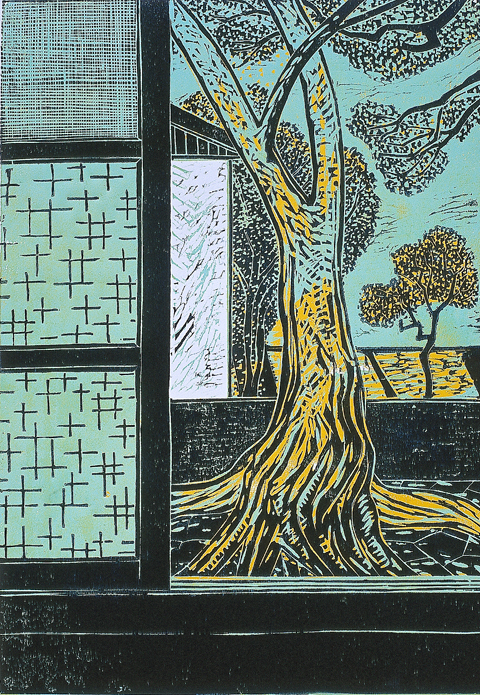
PHOTO: COURTESY OF WU SONG-MING
“Technically, woodblock printing is fairly simple, and doesn’t require expensive equipment,” Wu said, which explains how he’s been able to alternate regularly between production and exhibiting with an ease denied to more academically respectable and technically demanding mediums such as etching.
In Living Under the Longan Tree, Wu takes a close look at the scenery of his home and finds a challenge in learning how to represent the things he sees. “I will probably return to doing abstract work. But working from nature is like returning to base; it forces me to really look at things closely and work out how to express them. Imagination is like a space shuttle; it can wander to incredibly distant places, but sometimes it’s got to come back to refuel.”
This process of refueling has produced some delightful images of Taiwan. They are stylistically androgynous, with tantalizing hints of both Western and Asian influences, and in their painstaking detail and evocative composition, manage to be recognizable without completely giving up an allegorical element.
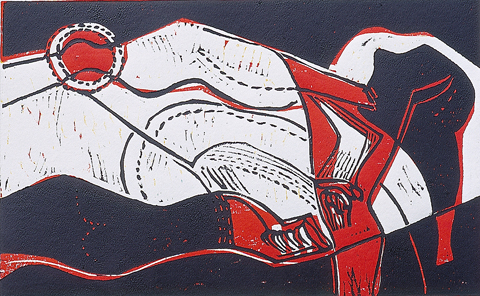
PHOTO: COURTESY OF WU SONG-MING
In the huge House With Longan Tree (有龍眼樹的住所), which measures 90cm by 45cm, from which the title of the exhibition is taken, Wu has depicted his own studio in Beitou District, Taipei City. “These are things that are right in front of me. This is the opposite of trying to show off my knowledge or my technical skill; all I want to show is a natural composition, and show how beautiful this composition can be. Perhaps then I will make people take a second look at the things that are around them, and realize the beauty of what they see.”
In another large work, Under Seven Star Mountain (七星山下), the composition, with terraced fields forming orderly rows beneath the gentle peak of Taipei’s Seven Star Mountain, is suggestive of a traditional altar laden with offerings, forming a balance between the representational and Expressionistic.
“In art school, we absorbed huge amounts of theory about the Western artistic tradition, but this tradition was not my native language; we can learn it, even become adept, but it is never our native language,” Wu said. With these new prints, he has clearly created, if not his own language, at least a fascinating and appealing argot.
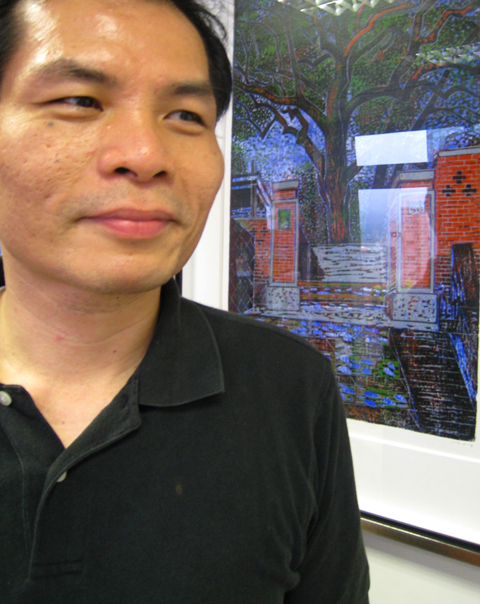
PHOTO: IAN BARTHOLOMEW, TAIPEI TIMES

In late October of 1873 the government of Japan decided against sending a military expedition to Korea to force that nation to open trade relations. Across the government supporters of the expedition resigned immediately. The spectacle of revolt by disaffected samurai began to loom over Japanese politics. In January of 1874 disaffected samurai attacked a senior minister in Tokyo. A month later, a group of pro-Korea expedition and anti-foreign elements from Saga prefecture in Kyushu revolted, driven in part by high food prices stemming from poor harvests. Their leader, according to Edward Drea’s classic Japan’s Imperial Army, was a samurai
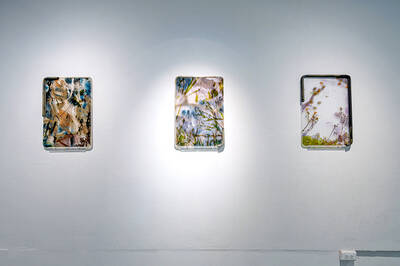
Located down a sideroad in old Wanhua District (萬華區), Waley Art (水谷藝術) has an established reputation for curating some of the more provocative indie art exhibitions in Taipei. And this month is no exception. Beyond the innocuous facade of a shophouse, the full three stories of the gallery space (including the basement) have been taken over by photographs, installation videos and abstract images courtesy of two creatives who hail from the opposite ends of the earth, Taiwan’s Hsu Yi-ting (許懿婷) and Germany’s Benjamin Janzen. “In 2019, I had an art residency in Europe,” Hsu says. “I met Benjamin in the lobby
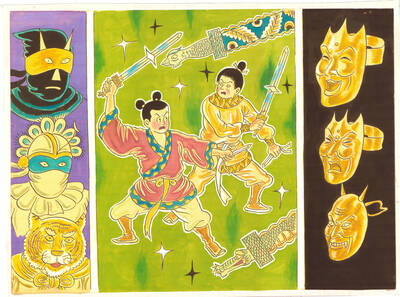
April 22 to April 28 The true identity of the mastermind behind the Demon Gang (魔鬼黨) was undoubtedly on the minds of countless schoolchildren in late 1958. In the days leading up to the big reveal, more than 10,000 guesses were sent to Ta Hwa Publishing Co (大華文化社) for a chance to win prizes. The smash success of the comic series Great Battle Against the Demon Gang (大戰魔鬼黨) came as a surprise to author Yeh Hung-chia (葉宏甲), who had long given up on his dream after being jailed for 10 months in 1947 over political cartoons. Protagonist

A fossil jawbone found by a British girl and her father on a beach in Somerset, England belongs to a gigantic marine reptile dating to 202 million years ago that appears to have been among the largest animals ever on Earth. Researchers said on Wednesday the bone, called a surangular, was from a type of ocean-going reptile called an ichthyosaur. Based on its dimensions compared to the same bone in closely related ichthyosaurs, the researchers estimated that the Triassic Period creature, which they named Ichthyotitan severnensis, was between 22-26 meters long. That would make it perhaps the largest-known marine reptile and would


 RSS
RSS