


Alan Carr would like to make it clear that he is not, and never has been, remotely cutting edge. “Oh no,” he says, sipping on a dainty cup of green tea and lifting the saucer politely as he does so. “What’s the point?”
It is true that Carr, 31, one of the UK’s most promising young comedians, does not exactly fit the mould of a foul-mouthed stand-up, the kind who out-heckles the audience and swaggers about on stage knocking back cans of lager in a haze of spittle and sweat. Carr, with his neatly buttoned shirt and non-skinny jeans, his sensible glasses and toothy smile, looks more like a kindly nephew in his first year of an accountancy course.
We are sitting in one of London’s most exclusive nightspots, a place so painfully fashionable that the lavatories have no signage on the door, presumably because everyone who is anyone will know where they are simply by word of mouth. Carr is perched on a golden leather banquette in a curious breast-shaped dome. He gazes around with a mystified expression, appearing slightly out of his element.
“I don’t really like being a celebrity,” he admits. “It’s like, you get invited to a party and say of course I’ll come and then you get the invite, and it says Hello! or OK! magazine will be hosting it and you’re just like, well I can’t get as pissed as I want to get now because I’ll be photographed with Jodie Marsh or Dean Gaffney.”
As a comedian, Carr prefers to mine the rich seam of the mundane. He made his name on the circuit with acutely observed anecdotes that poked fun at his own hapless interactions with everyday life (on the theft of his supermarket reward scheme card: “Half of me was fuming, half of me was thinking, “What about the points?’”). On television, he has crafted a popular persona that manages to be simultaneously waspish and endearing, like a particularly camp version of the old local dear holding forth in a neighborly way over a glass of sherry. He won the BBC new comedy award for stand-up in 2001 and since then has become comfortably ensconced in the mainstream as the host of two big-ticket entertainment programs on UK TV — Alan Carr’s Celebrity Ding Dong and The Friday Night Project, with Justin Lee Collins. The DVD of his 2007 stand-up show, Tooth Fairy Live, was a Christmas bestseller.
Openly gay, Carr insists he is perfectly at home in Middle England, despite his detractors pigeonholing him as the anachronistic lovechild of John Inman and Frankie Howerd. On stage or television, his demeanor is coy and mischievous. His voice — shrill, giggly, nasal — is so ubiquitous that when he called up Kwik-Fit a few weeks ago to get his tire changed, the mechanic recognized him over the phone. “He started going all camp on me, like Danny La Rue.” His act makes no overt reference to his sexuality, but his critics accuse him of being a throwback to the limp-wristed homosexual stereotypes of the 1970s.
“Gays hate me,” Carr says, affably. “I just think gay people need to get over themselves. Just because you’re gay and on the telly doesn’t mean you’re a role model. I’m just a comedian. That’s all I am. If you find me funny, good. But they look at me like, ‘Oh, you’re letting the side down.’”
“I’ve done the circuit, I’ve won competitions and awards and this wasn’t just in some tired old drag act. I haven’t just minced on to the stage and said, ‘Ooh I’ve got the willies up me.’ Please, give me a little bit of credit.
“What am I meant to do? Do I go down the Julian Clary route and talk about fisting and poppers? I don’t talk about being gay and I think what better equality for gays than that?”
In fact, being accused of any kind of edginess makes Carr terribly defensive, as if he has just been wrongly issued with a parking ticket by an overzealous traffic warden. “I go and see some comedians now and in the world of comedy, rape is the new black,” he says, putting down the teacup as it begins to clatter tremulously in his hand. “Everyone’s got a rape joke. So if that’s cutting edge, joking about rape, then I’d rather be ‘Middle England’ — that’s just another way of saying popular, isn’t it?
“I don’t know what’s up with people. Maybe I’m showing my age, but everyone’s got a Madeleine McCann joke, a rape joke or a pedophile joke. You go to a comedy club now and it’s like a barrage of people outdoing each other seeing how close to the bone they can get.”
His engaging humor and lack of pretension has, none the less, served him well: on the day that we meet, it is announced that Carr and Lee Collins have been short-listed for best comedy performance at the British Academy Television Awards (Baftas) for The Friday Night Project. He’s already dreading the thought of the red carpet. “You kit yourself out in a nice suit from Alexander McQueen and then you get there and some TV soap star comes along with two Post-it notes over her nipples and that’s it — you never get in the paper. It’s not glamorous, it’s awful.”
It is clear that the trappings of celebrity are not for him — on a recent holiday to the super exclusive Shore Club in Miami, the paparazzi snapped him poolside with a ballpoint in hand, filling out a word search.
“I just want to be trendy!” he screeches. “With Heat and Closer magazine, people want to see the bad facelift and Botox gone wrong. I think familiarity breeds contempt. I mean, we’ll never get another Greta Garbo will we? Someone would go in with a camera Sellotaped to the bottom of a tray trying to get film of her with no make-up on.”
Perhaps Carr is just too nice to be famous. When I ask him whether Elle Macpherson, the recent guest host of The Friday Night Project, is secretly hideously ugly in the flesh, he says he searched her for flaws (“I thought there’s got to be something wrong with her; I even looked for a tache.”) but dispiritingly found there were none.
Unlike many performers, Carr shies away from unnecessary cruelty, instead relying on his own authenticity to win over his audience. His on-stage persona is simply an extension of his own and therein lies the source of both his charm and his talent. “When I was starting doing stand-up, I’d get people saying, ‘So I’ll just leave you 10 minutes so you can get into character’ and I’d be, like, ‘Pardon?’”
At a recent gig in Runcorn, a woman came backstage, gave him a tearful hug and told him she’d just found a lump. “It was a mixture of, ‘Oh I’m so flattered. It’s lovely that you think you can tell me something as personal as that’ but the problem was that my jokes are all right but they haven’t got that sort of power. They’re funny but they can’t beat cancer.”
I suspect that part of what people like about Carr is his empathetic nature. As a child growing up in Northampton, he was chubby, bespectacled, gay and rubbish at sports, so he knows what it’s like to be bullied. “I get white van drivers shouting out ‘Faggot!’ — I haven’t been called that since I was at school, so actually I get all nostalgic,” he says, giggling. To make it even worse, Carr’s father, Graham, is a real man’s man: the manager of Northampton Town Football Club who is now a scout for Manchester City. Growing up, Carr recalls his father coaching him from the sidelines, stopwatch round his neck, shouting: “Faster, you fat fairy!” Carr was never enamored of the beautiful game.
Many of these formative experiences make their way into his stand-up. Tooth Fairy Live includes a sketch where Carr told his father he was going to do a performing arts degree at Middlesex University:
“Alan, why are you doing this to me?”
“I don’t know, Dad, but I think I can show you through expressive dance ... .”
His father has never been to see him perform, but Carr insists this doesn’t worry him. “He’s not interested in comedy or anything like that. He’s the simplest man you could ever meet. He’s football mad. There is nothing else that interests him in the world apart from football. My mum has come to see it and she loved it.
“Everyone’s always asking, ‘What do they feel?’ I was always coming through the door with a new idea; I wanted to be a detective, I wanted to be a forensic scientist, I wanted to be an author and they just rolled their eyes and said, ‘Oh, it’s Alan.’ So with what I do now, they just roll their eyes, ‘Oh, it’s him again.’”
But after so many years being the brunt of the family joke, I wonder whether it is especially important to feel he has finally earned his parents’ respect? “It is,” he says, lapsing into seriousness for a split-second. “I think everyone wants to please their family, don’t they? I rang my mother up to say I got nominated for a Bafta today and she was over the moon and that’s nice, isn’t it? It’s better than a grandchild, which Mum’s rooting for. I keep saying a Bafta’s for life — it never cries, you never need to change a Bafta’s nappy, do you, Mum?”
He never told his parents or his younger brother, Gary, that he was gay. Partly, he says, it was “just there” and partly it was because they simply weren’t that kind of family. They didn’t sit round the kitchen table leafing through self-help books and emoting; they just got on with things.
“There was no “Everyone, I’m ga-ay!” There was none of that. People sort of knew before I did. I remember sitting down when I was about eight and writing into a TV program asking to meet Wonder Woman; you know, so it was there. My mum once said to me, ‘Why aren’t you like other boys?’ so I just said, ‘I am like other boys’ and continued reading my Agatha Christie. It’s such a tough time when you’re growing up that you don’t know what to do. I mean, role-model wise, I didn’t see any gay people on the telly.”
Does it ever come up now? “No, it’s never mentioned and I wouldn’t want to embarrass my dad. My mum will never ask if I’m seeing anyone; I’m not that kind of person anyway. I’m very private.”
Carr is not dating (“This is going to sound so showbiz — I’m so busy at the moment I wouldn’t have the time”), but admits that he would like a boyfriend, particularly when he finds himself on his own during dreary Sundays in his house in Crouch End, north London. “I’m at a difficult stage because people come on to me because they think I live this wonderful life. The civilians think we’re all off to Elton John’s St Tropez house with Duncan James from Blue and Tara Palmer-Tomkinson. And, actually, I just sit at home reading.”
But in spite of his private nature and his professed distaste for the vacuous nature of fame, Carr is currently undergoing the modern celebrity’s rite of passage and is penning his autobiography. Unlike Jordan, he is writing it himself. And unlike most of the dross spouting forth from erstwhile Big Brother contestants, it promises to be rather good.
“It’s cathartic going back and looking at stuff, remembering it all. I just like writing. The publisher [HarperCollins] went, ‘It’s so well-written for a first draft’ and that’s so important to me because another criticism I get is that it’s just the face and the voice that make people laugh, so I wanted to write a book which is funny. Unless I’ve written it in a pink font, there’s no way they can slag it off.”
Due out in October, his publishers no doubt hope to capitalize on the extraordinary popularity of comedians’ autobiographies — when Peter Kay wrote The Sound of Laughter in 2006, it sold 600,000 in the first two months and was nominated for book of the year at the British Book Awards.
Has he read Kay’s book? “I’m steering clear because I’m one of those people who starts absorbing other people’s experiences and thinking they’re mine. I’d be saying something to my mother: ‘Oh, do you remember when that happened?’ And she’d say, ‘No Alan, that was Poirot.’”
But he confesses that he likes good historical biographies. He particularly enjoys Peter Ackroyd and we have a long conversation about the Claire Tomalin biography of Samuel Pepys, which vividly recounts Pepys’ excruciating operation to remove a bladder stone. “Cutting him open without anesthetic,” says Carr, flapping his hands in horror. “I can’t even imagine!”
I’m looking forward to reading Carr’s book, even if it contains a distinct lack of bladder stones or pink lettering. He is such an engaging, easy presence and extremely funny company, even though the target of his acerbic humor is, more often than not, himself rather than other people. After years of not fitting in, of not being picked for his school sports teams, it seems that Carr has turned this nerdy uniqueness to his advantage. It’s not clear whether he’s quite worked out how he feels about his sexuality, but perhaps this discomfort is what makes him so likable — people can understand his flawed insecurity.
On his Web site, there is a section called “Ask Alan” where you can log on and ask him a question. He says he used to answer them all himself, but now there are too many to deal with individually, particularly as he shares his name with the late Allen Carr, the anti-smoking guru who died in 2006. “I’d get people writing in saying, ‘I’m on 20 Benson should I choose the patches or one of those plastic things?’ And I just got sick of it in the end. People ask you all kinds of stupid things like, ‘Where do you live?’; ‘Can I come round for dinner?’ and I get lots of people saying, ‘I’m like you.’”
He rolls his eyes in mock-horror. But for all that Alan Carr is a one-off, he knows that his audiences like the feeling that they can relate to him. He might not get back to you about the nicotine patch, but that’s not because he doesn’t care.

Last week Joseph Nye, the well-known China scholar, wrote on the Australian Strategic Policy Institute’s website about how war over Taiwan might be averted. He noted that years ago he was on a team that met with then-president Chen Shui-bian (陳水扁), “whose previous ‘unofficial’ visit to the US had caused a crisis in which China fired missiles into the sea and the US deployed carriers off the coast of Taiwan.” Yes, that’s right, mighty Chen caused that crisis all by himself. Neither the US nor the People’s Republic of China (PRC) exercised any agency. Nye then nostalgically invoked the comical specter
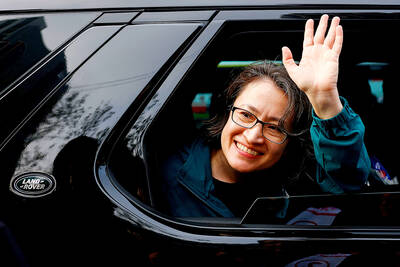
Relations between Taiwan and the Czech Republic have flourished in recent years. However, not everyone is pleased about the growing friendship between the two countries. Last month, an incident involving a Chinese diplomat tailing the car of vice president-elect Hsiao Bi-khim (蕭美琴) in Prague, drew public attention to the People’s Republic of China’s (PRC) operations to undermine Taiwan overseas. The trip was not Hsiao’s first visit to the Central European country. It was meant to be low-key, a chance to meet with local academics and politicians, until her police escort noticed a car was tailing her through the Czech capital. The
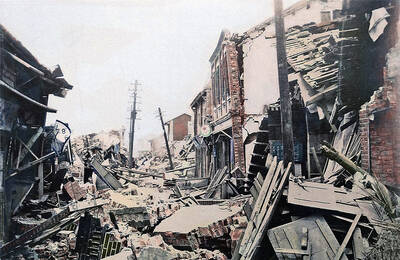
April 15 to April 21 Yang Kui (楊逵) was horrified as he drove past trucks, oxcarts and trolleys loaded with coffins on his way to Tuntzechiao (屯子腳), which he heard had been completely destroyed. The friend he came to check on was safe, but most residents were suffering in the town hit the hardest by the 7.1-magnitude Hsinchu-Taichung Earthquake on April 21, 1935. It remains the deadliest in Taiwan’s recorded history, claiming around 3,300 lives and injuring nearly 12,000. The disaster completely flattened roughly 18,000 houses and damaged countless more. The social activist and

Over the course of former President Ma Ying-jeou’s (馬英九) 11-day trip to China that included a meeting with Chinese Communist Party (CCP) leader Xi Jinping (習近平) a surprising number of people commented that the former president was now “irrelevant.” Upon reflection, it became apparent that these comments were coming from pro-Taiwan, pan-green supporters and they were expressing what they hoped was the case, rather than the reality. Ma’s ideology is so pro-China (read: deep blue) and controversial that many in his own Chinese Nationalist Party (KMT) hope he retires quickly, or at least refrains from speaking on some subjects. Regardless


 RSS
RSS