


When Time magazine covered the 921 Earthquake that devastated central Taiwan in 1999, the photographer who captured the defining image for the issue was John Stanmeyer. This week he visited Taiwan again in happier circumstances to lead a seminar on the use of Aperture 2, Apple's pro-level photo management software, which was officially launched Thursday. A former fashion photographer who worked the catwalks of Europe's glittering world of haute couture, Stanmeyer was awakened in his early 20s to the power of what he describes as "reality photography."
The 43-year-old photojournalist is best known for his work for Time magazine and National Geographic and has picked up a slew of prizes for his work, much of it recording scenes of natural and man-made disasters. Now, as one of the world's leading photojournalists, he defines himself in direct contrast to the world of fashion he used to inhabit. "I love fashion photography as an art, and I am thrilled that I had that background because it does play a role in the way I see the world ... not in a style way, but in the sense of how I am so radically different from it," Stanmeyer said in an interview with Taipei Times at the Apple Training Center in Taipei.
SEEING THE MOMENT
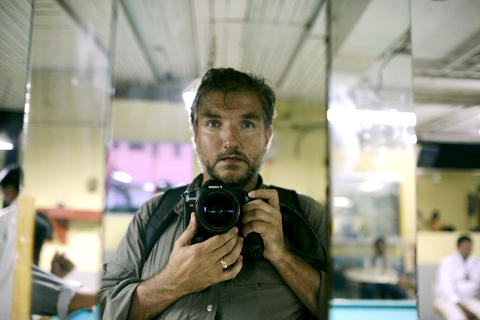
PHOTO: JOHN STANMEYER-VII
Looking back on his transition from fashion to reality photography, Stanmeyer said: "I was young, and like we all are at certain ages of our lives, terribly misguided. I wanted to view things the way I saw it. I was a victim of mass marketing and everything else that we are all bombarded with all the time ... . It took until I was in my early 20s to wake up to the fact that what I was doing was great for self-creating, but I was missing the greater potential of what my human function is. I left fashion, left Italy, moved to Spain and started to discover myself as a street photographer. ... It was an epiphany, it made me realize that this (reality photography) was what I needed to do, otherwise it was uninteresting and too self-serving, and I was brainwashing people into thinking about who they were based on what they wore."
Of his visit to Taiwan the day after the 921 Earthquake hit, he recalled: "I remember sleeping on the street because there was nothing ... everything was destroyed ... so you just found cardboard and put some cardboard over you, it wasn't that cold, ... we had three days to put some meaning to the story. I remember the smells, the silence, because all the electricity was out, I got there so early they were still trying to get bodies out."
Stanmeyer has spent more than 20 years traveling the world's trouble spots. In the face of the overwhelming catastrophe he witnesses regularly in the shape of wars and natural disasters, he is very humble about he does.
"It's not me doing anything," he said, "it's more that they (his images) get into your consciousness or make you go read about the people in the photograph. I'm doing nothing, I'm just a witness, I'm just there. They are allowing me into their world. They are doing everything, the fellow human beings who are playing the reality in the frame. All I am doing is capturing it and if that becomes iconic, it is not because of what I do, but because of the enormity and the simplicity of being a human in that moment."
The purpose of Stanmeyer's visit to Taiwan was to give a seminar on the use of photo management software, which raises the question of how digital photography - and by extension the Internet - has affected the way he works.
"For me it (photography) is all about communication, communicating something that is important to me. In that process, whether it is black-and-white or color, whether it's film or digital, whatever, I don't care," Stanmeyer said. He embraces the advantages of digital photography for situations like night photography, where he said the use of digital camera makes shooting "more feasible and less constraining." But he also cautioned that the digital revolution has loaded photographers with a much heavier responsibility for managing their photography.
"On the negative side, it requires a massive amount of management. It put a 5,000-tonne gorilla on my back ... of learning things that I didn't want to learn and going into conflicts or disaster areas and no longer being just a photographer, but also being a satellite engineer for the satellite Internet connection and a digital manager and an editor, ... this thing became so big on me that it started to take me away from being a photographer and being a human," he said. "One of the reasons I'm here is to help photographers get this 5,000-tonne gorilla off their backs. ... Digital photography up until a year ago meant you didn't have a life."
Photojournalists have also found the need to protect their work more carefully than before. This was one of the reasons behind the formation of the VII photo agency in 2001, which is described on its Web site as "designed from the outset to be an efficient, technologically enabled distribution hub for some of the world's finest photojournalism."
"We started VII because we were seven very independent photographers coming from different agencies ... We wanted to control our photography ... we wanted to make sure we could follow the entire process from our camera all the way to the client and nothing being altered or changed. ... In 2001, the Internet was becoming real, and we started talking about empowering ourselves. The Internet allowed us to empower ourselves," Stanmeyer said.
For your information: The photography of John Stanmeyer and the other members of the VII photo agency can be found on the agency's Web site at www.viiphoto.com

In late October of 1873 the government of Japan decided against sending a military expedition to Korea to force that nation to open trade relations. Across the government supporters of the expedition resigned immediately. The spectacle of revolt by disaffected samurai began to loom over Japanese politics. In January of 1874 disaffected samurai attacked a senior minister in Tokyo. A month later, a group of pro-Korea expedition and anti-foreign elements from Saga prefecture in Kyushu revolted, driven in part by high food prices stemming from poor harvests. Their leader, according to Edward Drea’s classic Japan’s Imperial Army, was a samurai

Located down a sideroad in old Wanhua District (萬華區), Waley Art (水谷藝術) has an established reputation for curating some of the more provocative indie art exhibitions in Taipei. And this month is no exception. Beyond the innocuous facade of a shophouse, the full three stories of the gallery space (including the basement) have been taken over by photographs, installation videos and abstract images courtesy of two creatives who hail from the opposite ends of the earth, Taiwan’s Hsu Yi-ting (許懿婷) and Germany’s Benjamin Janzen. “In 2019, I had an art residency in Europe,” Hsu says. “I met Benjamin in the lobby
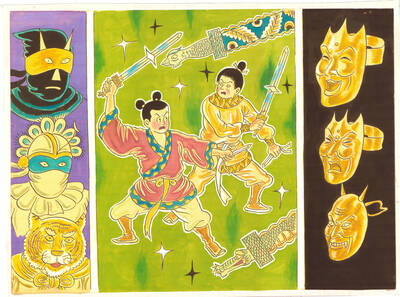
April 22 to April 28 The true identity of the mastermind behind the Demon Gang (魔鬼黨) was undoubtedly on the minds of countless schoolchildren in late 1958. In the days leading up to the big reveal, more than 10,000 guesses were sent to Ta Hwa Publishing Co (大華文化社) for a chance to win prizes. The smash success of the comic series Great Battle Against the Demon Gang (大戰魔鬼黨) came as a surprise to author Yeh Hung-chia (葉宏甲), who had long given up on his dream after being jailed for 10 months in 1947 over political cartoons. Protagonist

Peter Brighton was amazed when he found the giant jackfruit. He had been watching it grow on his farm in far north Queensland, and when it came time to pick it from the tree, it was so heavy it needed two people to do the job. “I was surprised when we cut it off and felt how heavy it was,” he says. “I grabbed it and my wife cut it — couldn’t do it by myself, it took two of us.” Weighing in at 45 kilograms, it is the heaviest jackfruit that Brighton has ever grown on his tropical fruit farm, located


 RSS
RSS