


There was disappointing news ahead of the Geneva motor show this month: For the first time in decades, Bertone, one of Italy's great coachbuilders, would not have its own display inside the exhibit halls.
Bertone is being managed by bankruptcy commissioners after the founding family was pushed aside. Like Italy's other surviving carrozzeria - the design houses that produce concept cars - Bertone is facing hard times.
But Bertone showed it still had life with a surprise unveiling at a nightclub, away from the Palexpo Geneva exhibition center, of a design study called the BAT 11. The swoopy green-gray concept car was presented as a spiritual successor to the visionary BAT cars, Nos. 5, 7, and 9, that the company created on Alfa Romeo mechanicals in the 1950s and displayed at auto shows in Turin.
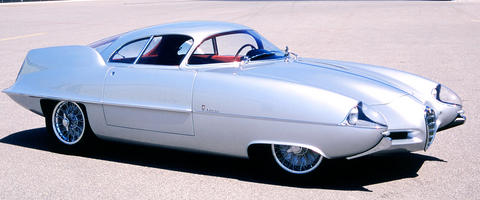
PHOTO: NY TIMES NEWS SERVICE
The BAT 11, whose creation was led by David Wilkie, design director at Bertone, has a helmet-like body comprising loosely joined planes, a central spine, taillights inset in its fins and black wheels shaped like a jet's turbine.
BAT stands for Berlinetta Aerodinamica Tecnica; berlinetta is an industry term for a sporty coupe, and the cars were exercises in the technology of aerodynamics. The cars combine aerodynamic principles - the chief designer of the original trio, Franco Scaglione, had studied the science - with sheer fantasy. The 1950s BAT's are viewed as milestones by design historians.
"The BAT cars combined fantasy with extraordinary aerodynamic performance, extraordinary sculptural qualities, extraordinary beauty and timeless forms and organization," said Geoff Wardle, director of advanced mobility research at the Art Center College of Design in Pasadena, California. "They had a subliminal influence on future vehicle designs."

PHOTO: NY TIMES NEWS SERVICE
The BAT 11 evokes Bertone's glorious past. It was commissioned by Gary Kaberle, an American collector. As a teenager he had fallen in love with the BAT 9, which had fallen on hard times and was parked in front of a Dodge dealership in his Michigan hometown to draw customers. The young man, who is now a dentist, saved up his money and bought the car, according to an article in Classic & Sports Car Magazine, but sold it years later to pay medical bills.
The BAT 9 joined its siblings when the cars were restored and brought together in 1989. In 2005, they were shown at the Concours d'Elegance at Pebble Beach, California, by their new owner, Cars International Kensington Ltd, a British dealer of expensive road and racing cars. They were valued by the company at US$8 million before being sold to a private collector.
Haberle went to Bertone a couple of years ago with the idea of a new BAT. The BAT 11 is built on the chassis of the new Alfa Romeo 8C Competizione.
Bertone began literally as a builder of coaches, the horse-drawn sort, having been founded by Giovanni Bertone in 1912. After World War I, the company shifted to car bodies. Giovanni's son Giuseppe, known as Nuccio, was born in 1914 and took over direction of the company in 1934.
Claudia Neumann, a design historian, called Bertone "one of the greats of Italian design." Among the great creations of Bertone were the Lamborghini Miura and Countach; the Ferrari Dino 308 GT4; and the Lancia Stratos. For BMW, Bertone did the 3200 CS in 1961; in 1975 it shaped the Polo for VW. It also did work for Citroen and Volvo. The 1956 Alfa Romeo Giulietta Sprint was planned as a limited edition of 500 cars, but instead sold 40,000 over 14 years.
The company is also distinguished for giving starts to design stars like Marcello Gandini and Giorgetto Giugiaro, who each followed Franco Scaglione, designer of the BAT's, as the top designers at Bertone.
Concepts from Italy's carrozzeria are often the highlights of the Geneva auto show. Last year, Bertone showed a design study for Fiat called the Barchetta. This year, Zagato showed a concept called the Bentley GTZ, and Pininfarina offered one called the Sintesi.
But revered coachbuilders like Ghia and Touring are now gone, and survivors like Zagato, Pininfarina and Italdesign-Giugiaro are feeling extreme pressure. The carrozzeria declined as the number of aristocrats, plutocrats and movie stars willing to pay for bespoke or limited-production bodies declined. Most moved from operating as the automotive versions of skilled tailors to becoming consultants on engineering and production, and serving as small-volume manufacturers. Bertone, for instance, produced 2,000 copies of the limited edition Mini GT through 2006.
Against a backdrop of court actions among Lilli Bertone, the widow of Nuccio Bertone, and their daughters, the new BAT can be viewed as either a last gasp of the coachbuilders or a defiant assertion of their intent to survive.
Wardle of Art Center College points out that the coachbuilders have been lagging for years, as automakers turn inward for design. Over the years, coachbuilders have produced some of the most esteemed designs in the history of the automobile, but today they are being run by second- or third-generation members of their founder's families or outsiders, "who do not have the same vision, talent or focus as their progenitors," he said.
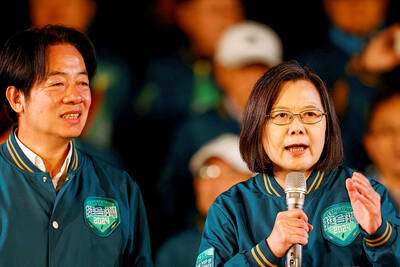
Last week Joseph Nye, the well-known China scholar, wrote on the Australian Strategic Policy Institute’s website about how war over Taiwan might be averted. He noted that years ago he was on a team that met with then-president Chen Shui-bian (陳水扁), “whose previous ‘unofficial’ visit to the US had caused a crisis in which China fired missiles into the sea and the US deployed carriers off the coast of Taiwan.” Yes, that’s right, mighty Chen caused that crisis all by himself. Neither the US nor the People’s Republic of China (PRC) exercised any agency. Nye then nostalgically invoked the comical specter
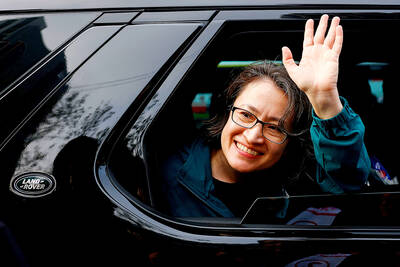
Relations between Taiwan and the Czech Republic have flourished in recent years. However, not everyone is pleased about the growing friendship between the two countries. Last month, an incident involving a Chinese diplomat tailing the car of vice president-elect Hsiao Bi-khim (蕭美琴) in Prague, drew public attention to the People’s Republic of China’s (PRC) operations to undermine Taiwan overseas. The trip was not Hsiao’s first visit to the Central European country. It was meant to be low-key, a chance to meet with local academics and politicians, until her police escort noticed a car was tailing her through the Czech capital. The
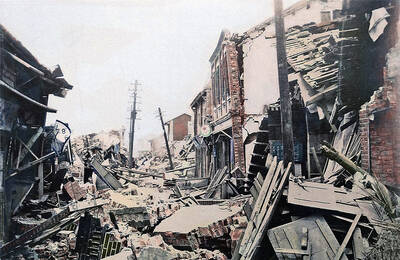
April 15 to April 21 Yang Kui (楊逵) was horrified as he drove past trucks, oxcarts and trolleys loaded with coffins on his way to Tuntzechiao (屯子腳), which he heard had been completely destroyed. The friend he came to check on was safe, but most residents were suffering in the town hit the hardest by the 7.1-magnitude Hsinchu-Taichung Earthquake on April 21, 1935. It remains the deadliest in Taiwan’s recorded history, claiming around 3,300 lives and injuring nearly 12,000. The disaster completely flattened roughly 18,000 houses and damaged countless more. The social activist and

Over the course of former President Ma Ying-jeou’s (馬英九) 11-day trip to China that included a meeting with Chinese Communist Party (CCP) leader Xi Jinping (習近平) a surprising number of people commented that the former president was now “irrelevant.” Upon reflection, it became apparent that these comments were coming from pro-Taiwan, pan-green supporters and they were expressing what they hoped was the case, rather than the reality. Ma’s ideology is so pro-China (read: deep blue) and controversial that many in his own Chinese Nationalist Party (KMT) hope he retires quickly, or at least refrains from speaking on some subjects. Regardless


 RSS
RSS