


One rainy night in Paris in 1970, Bernardo Bertolucci was standing outside the Drugstore Saint Germain. It was a quarter to midnight. He was waiting for his mentor, the great New Wave director Jean-Luc Godard, to arrive from the French premiere of the Italian's new film, The Conformist. "I haven't talked about this for dozens of years," says Bertolucci, "but Godard was my real guru, you understand? I used to think there was cinema before Godard and cinema after - like before and after Christ. So what he thought about the film meant a great deal to me."
The Conformist was an adaptation of Alberto Moravia's novel, about a 30-year-old Italian Marcello Clerici (played by Jean-Louis Trintignant), a repressed upper-class intellectual who, during Mussolini's rule, is hired by fascists to go to Paris and murder a dissident who was his former philosophy teacher. It's not just a politically engaged film, but also a stylish thriller complete with car chases, murders and sex that Bertolucci thought the Frenchman would like.
At midnight, Godard arrived for the rendezvous. Bertolucci, 37 years after the event, recalls exactly what happened next: "He doesn't say anything to me. He just gives me a note and then he leaves. I take the note and there was a Chairman Mao (毛澤東) portrait on it and with Jean-Luc's writing that we know from the handwriting on his films. The note says: 'You have to fight against individualism and capitalism.' That was his reaction to my movie. I was so enraged that I crumpled it up and threw it under my feet. I'm so sorry I did that because I would love to have it now, to keep it as a relic."

PHOTOS: EPA AND AP
The Conformist, despite Godard's contempt, has proved to be one of the most influential postwar films. With it, Bertolucci looked back at Italy's fascist past, finding psychosexual dysfunction at its heart. It is a film made in the aftermath of 1968's failed utopian dreams, and yet one so visually daring and structurally sophisticated that without it, such masterpieces as The Godfather and Apocalypse Now would have been unimaginable.
Why do you think Godard didn't like The Conformist, I ask Bertolucci. It was, after all, partly a trenchant diagnosis of a fascistic mentality. "I had finished the period in which to be able to communicate would be considered a mortal sin. He had not."
But there might be another reason Godard didn't like the film. In it, Clerici asks for his doomed teacher's phone number and address. "The number was Jean-Luc's and the address was his on Rue Saint Jacques. So you can see that I was The Conformist wanting to kill the radical."

PHOTOS: EPA AND AP
Indeed, Bertolucci takes delight in the fact that, for all Godard's Maoist contempt for The Conformist, a rising generation of filmmakers saw his picture as a revelation.
"What always made me proud - almost blushing with pride -is that Francis Coppola, Martin Scorsese, Steven Spielberg all told me that The Conformist is their first modern influence."
What did they find inspiring in the film? Its complex flashback structure, the symbolic color-coded photography of Bertolucci's director of photography Vittorio Storaro (whom Coppola would later use on Apocalypse Now) and several of its virtuosic showpiece scenes find echoes in many later films.
But The Conformist deserves to be appreciated not for prefiguring future cinematic masterpieces, but for itself. The chaotic handheld camera as fascist hitmen chase the central figure's lover through the woods. The chilly framing of iconic fascist buildings such as EUR in Rome and the Palais de Tokyo in Paris. The expressionist angles when The Conformist visits his dotty mother. And, perhaps best of all, the ingenious sequence in a Parisian cafe in which Clerici's reluctance to participate in a farandole dance leads him to being surrounded by an ever-tightening spiral of dancers, the whole thing shot ingeniously from above. Rarely has cinema been so poetic, so daring or freighted. This film will be a revelation for cinemagoers who only know Bertolucci for his later, relatively stodgy films such as The Last Emperor, Stealing Beauty or The Sheltering Sky.
So what is at the heart of The Conformist? Marcello is a weak-willed man seeking to blend into the crowd. He "The funny line he gave me once was: 'You're very smart. You have killed me many times without going to jail.'"
What did your father think of The Conformist? "He loved all my movies for a simple reason - he felt as if he had done them. He loved his puppet, which is me, because I was very good at doing his movies. He thought he had taught me everything, which is true." What a monstrous egotist, I say. So in a sense, whatever you did, you couldn't kill your father, or eradicate his influence from your work completely? "That's true. My movies are always in the same field as my father. They occupy a certain kind of cultural area - the same as from Parma." It is from this little Italian city that the Bertolucci family hailed, and significantly, Bernardo's 1967 film Before the Revolution is a loose adaptation of Stendhal's novel The Charterhouse of Parma.
Attilio was not just a poet, but also a film critic who was friends with Pier Paolo Pasolini. The father was obsessed by the cinematic medium and so keen that his sons, Bernardo and Giuseppe, should share his love that he took them along to screenings and gave them a camera. They both became film directors, Bernardo going on to become one of Italy's most famous and the winner of two Oscars.
One of Attilo's poems is called The Cableway, with the dedication "To B. with an eight millimetre cine camera." It includes this fond memory of his adolescent son filming the Bertolucci family as they walk in the Apennines:
But your adolescence sweetens, matures/in the subtle craftsman's patience/with which you shoot from below/and from behind the ragged hedge, so weaving/its real time of berries, thorns and leaves/into the story pulsating in the furtive steps of the children.
It's hard not to read into this Attilio's delight in his 14-year-old son's directorial apprenticeship.
Fifteen years later, Bernardo was still obsessed with his shots. The Conformist's assassination scene was virtuosically filmed in the snowy Piedmontese hills, and is one aspect of the story that Bertolucci rewrote, making Clerici a spectator of the murder. "I told Moravia before starting: 'In order to be faithful to your book, I must betray it.' He said: 'I completely agree with you.' Bertolucci's most bravura change comes at the end - if you don't want to know, look away now. "In the novel," says Bertolucci, "after the fall of Mussolini, The Conformist is fleeing Rome with his family. An airplane comes down and machine guns The Conformist and his family, and that's the end. I thought it was too moralistic, like the hand of God punishing the guilty one." Bertolucci's ending is more disturbing. One night Clerici wanders into the Coliseum and finds the aged chauffeur who he wrongly thought he had killed. The chauffeur is trying to seduce a beautiful young boy. Clerici loudly denounces the chauffeur, yelling that he is a fascist. But that isn't the end: the last shot has Clerici alone with the boy. The camera tracks over the boy's naked buttocks to Clerici, who looks at the camera.
What are we supposed to make of that, I ask Bertolucci - that they had just had sex? "It's very possible. The boy is naked and has the slow movement of after love in a way - so you're right." But that is a troubling idea, suggesting that fascism can be linked with repressed homosexual desire, particularly when Bertolucci adds that it is only at this moment that Clerici truly understands who he is and why he was a fascist.
If that is the case, though, Bertolucci refuses to take the rap for this homophobic denouement. "With all my old movies, I feel I am no more responsible - read: guilty - for them. The person who made these films is so distant from me." You don't feel responsible even for the film you made immediately after The Conformist, namely Last Tango in Paris, with its notorious sex scenes? "Least of all that film." But he feels sufficiently connected to Last Tango to defend one of its stars, Marlon Brando. "When I wanted Brando for that film, the head of Paramount said to me 'Not that old fart!' And yet Brando was the greatest thing in that film."
His most recent film was The Dreamers, an adaptation of Gilbert Adair's novel set amid the student riots of Paris 1968. That was made five years ago. Why nothing since - after all you're only 66?
"My back. I had an operation three years ago which went badly and so for three years I've been punished badly with pain and I can't walk well." He has had to set aside two plans: a long-cherished project to direct a film on the life of Gesualdo da Venosa, the 16th-century Neapolitan composer, and an adaptation of Bel Canto, Ann Patchett's novel about a group of terrorists and their hostages living in a house together. "I have to find a solution for my back. And then I will direct again."
Is it true that you won't see your old movies or is it just a misleading story for journalists? "I can't see them - I feel embarrassed." Oh, Bernardo, surely not! "It's true! To see what today I think is wrong, mistakes, pathetic things that maybe nobody sees but I do. But maybe when a movie is so far away I can forgive it." He sounds like a priest forgiving the sins of his earlier self.
As a result of this irresponsibility, it's strange to talk to Bertolucci about his early work. The man who felt so outraged by Godard's gnomic note no longer exists. "I feel something for this old film and that old me, but I don't feel the weight, the responsibility. For the artist, that is a relief." chooses to become a fascist killer and to marry a materialistic petit bourgeois wife (whom he describes as "good in bed, good in the kitchen") - not out of political commitment, nor out of lust, but because he has an (ostensibly) shameful secret. His desire to conform, he discovers in the film's last shot, is because of an adolescent incident in which his gay chauffeur tried to seduce him and whom (he thinks) he shot dead.
Bertolucci elaborates on the theme: "The Conformist understands that the reason of his desperate look for conformism is that he realizes he is different and that he never accepted his difference. In that last scene, he understands why he became a fascist - even the worst fascist of all, because he wanted to hide and forget what he feels are his differences in his deep, deep consciousness. It's like realizing that even fascists have a subconsciousness."
Significantly, it was during the making of The Conformist that Bertolucci went into Freudian analysis. Up to that point, his earlier films such as Before the Revolution, The Spider's Stratagem and even The Grim Reaper, had been made under Godard's influence. Do you feel you grew up in making The Conformist? "Completely. At a certain moment I had to be careful not to be imitating, not to be a forger, to do Godard fakes. I think it's not only my experience but the experience of a lot of people of my generation."
One early result of going into analysis was that Bertolucci was impelled to symbolically destroy his leading mentors. Not just Godard, but his father, the great Italian poet Attilio Bertolucci. "With Freudian analysis I realized that making movies is my way to kill my father. In a way I make movies for - how can I say - the pleasure of guilt. I have to accept it at a certain moment, my father too had to accept that he was killed in every movie.
“The funny line he gave me once was: ‘You’re very smart. You have killed me many times without going to jail.’”
What did your father think of The Conformist? “He loved all my movies for a simple reason — he felt as if he had done them. He loved his puppet, which is me, because I was very good at doing his movies. He thought he had taught me everything, which is true.” What a monstrous egotist, I say. So in a sense, whatever you did, you couldn’t kill your father, or eradicate his influence from your work completely? “That’s true. My movies are always in the same field as my father. They occupy a certain kind of cultural area — the same as from Parma.” It is from this little Italian city that the Bertolucci family hailed, and significantly, Bernardo’s 1967 film Before the Revolution is a loose adaptation of Stendhal’s novel The Charterhouse of Parma.
Attilio was not just a poet, but also a film critic who was friends with Pier Paolo Pasolini. The father was obsessed by the cinematic medium and so keen that his sons, Bernardo and Giuseppe, should share his love that he took them along to screenings and gave them a camera. They both became film directors, Bernardo going on to become one of Italy’s most famous and the winner of two Oscars.
One of Attilo’s poems is called The Cableway, with the dedication “To B. with an eight millimetre cine camera.” It includes this fond memory of his adolescent son filming the Bertolucci family as they walk in the Apennines:
But your adolescence sweetens, matures/in the subtle craftsman’s patience/with which you shoot from below/and from behind the ragged hedge, so weaving/its real time of berries, thorns and leaves/into the story pulsating in the furtive steps of the children.
It’s hard not to read into this Attilio’s delight in his 14-year-old son’s directorial apprenticeship.
Fifteen years later, Bernardo was still obsessed with his shots. The Conformist’s assassination scene was virtuosically filmed in the snowy Piedmontese hills, and is one aspect of the story that Bertolucci rewrote, making Clerici a spectator of the murder. “I told Moravia before starting: ‘In order to be faithful to your book, I must betray it.’ He said: ‘I completely agree with you.’ Bertolucci’s most bravura change comes at the end — if you don’t want to know, look away now. “In the novel,” says Bertolucci, “after the fall of Mussolini, The Conformist is fleeing Rome with his family. An airplane comes down and machine guns The Conformist and his family, and that’s the end. I thought it was too moralistic, like the hand of God punishing the guilty one.” Bertolucci’s ending is more disturbing. One night Clerici wanders into the Coliseum and finds the aged chauffeur who he wrongly thought he had killed. The chauffeur is trying to seduce a beautiful young boy. Clerici loudly denounces the chauffeur, yelling that he is a fascist. But that isn’t the end: the last shot has Clerici alone with the boy. The camera tracks over the boy’s naked buttocks to Clerici, who looks at the camera.
What are we supposed to make of that, I ask Bertolucci — that they had just had sex? “It’s very possible. The boy is naked and has the slow movement of after love in a way — so you’re right.” But that is a troubling idea, suggesting that fascism can be linked with repressed homosexual desire, particularly when Bertolucci adds that it is only at this moment that Clerici truly understands who he is and why he was a fascist.
If that is the case, though, Bertolucci refuses to take the rap for this homophobic denouement. “With all my old movies, I feel I am no more responsible — read: guilty — for them. The person who made these films is so distant from me.” You don’t feel responsible even for the film you made immediately after The Conformist, namely Last Tango in Paris, with its notorious sex scenes? “Least of all that film.” But he feels sufficiently connected to Last Tango to defend one of its stars, Marlon Brando. “When I wanted Brando for that film, the head of Paramount said to me ‘Not that old fart!’ And yet Brando was the greatest thing in that film.”
His most recent film was The Dreamers, an adaptation of Gilbert Adair’s novel set amid the student riots of Paris 1968. That was made five years ago. Why nothing since — after all you’re only 66?
“My back. I had an operation three years ago which went badly and so for three years I’ve been punished badly with pain and I can’t walk well.” He has had to set aside two plans: a long-cherished project to direct a film on the life of Gesualdo da Venosa, the 16th-century Neapolitan composer, and an adaptation of Bel Canto, Ann Patchett’s novel about a group of terrorists and their hostages living in a house together. “I have to find a solution for my back. And then I will direct again.”
Is it true that you won’t see your old movies or is it just a misleading story for journalists? “I can’t see them — I feel embarrassed.” Oh, Bernardo, surely not! “It’s true! To see what today I think is wrong, mistakes, pathetic things that maybe nobody sees but I do. But maybe when a movie is so far away I can forgive it.” He sounds like a priest forgiving the sins of his earlier self.
As a result of this irresponsibility, it’s strange to talk to Bertolucci about his early work. The man who felt so outraged by Godard’s gnomic note no longer exists. “I feel something for this old film and that old me, but I don’t feel the weight, the responsibility. For the artist, that is a relief.”

Last week Joseph Nye, the well-known China scholar, wrote on the Australian Strategic Policy Institute’s website about how war over Taiwan might be averted. He noted that years ago he was on a team that met with then-president Chen Shui-bian (陳水扁), “whose previous ‘unofficial’ visit to the US had caused a crisis in which China fired missiles into the sea and the US deployed carriers off the coast of Taiwan.” Yes, that’s right, mighty Chen caused that crisis all by himself. Neither the US nor the People’s Republic of China (PRC) exercised any agency. Nye then nostalgically invoked the comical specter
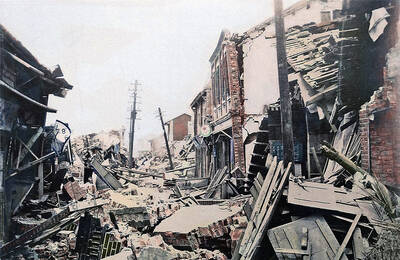
April 15 to April 21 Yang Kui (楊逵) was horrified as he drove past trucks, oxcarts and trolleys loaded with coffins on his way to Tuntzechiao (屯子腳), which he heard had been completely destroyed. The friend he came to check on was safe, but most residents were suffering in the town hit the hardest by the 7.1-magnitude Hsinchu-Taichung Earthquake on April 21, 1935. It remains the deadliest in Taiwan’s recorded history, claiming around 3,300 lives and injuring nearly 12,000. The disaster completely flattened roughly 18,000 houses and damaged countless more. The social activist and

Over the course of former President Ma Ying-jeou’s (馬英九) 11-day trip to China that included a meeting with Chinese Communist Party (CCP) leader Xi Jinping (習近平) a surprising number of people commented that the former president was now “irrelevant.” Upon reflection, it became apparent that these comments were coming from pro-Taiwan, pan-green supporters and they were expressing what they hoped was the case, rather than the reality. Ma’s ideology is so pro-China (read: deep blue) and controversial that many in his own Chinese Nationalist Party (KMT) hope he retires quickly, or at least refrains from speaking on some subjects. Regardless

Approaching her mid-30s, Xiong Yidan reckons that most of her friends are on to their second or even third babies. But Xiong has more than a dozen. There is Lucky, the street dog from Bangkok who jumped into a taxi with her and never left. There is Sophie and Ben, sibling geese, who honk from morning to night. Boop and Pan, both goats, are romantically involved. Dumpling the hedgehog enjoys a belly rub from time to time. The list goes on. Xiong nurtures her brood from her 8,000 square meter farm in Chiang Dao, a mountainous district in northern Thailand’s


 RSS
RSS