


OK, raise your hand if you have used your skis to fly off a jump backward this winter.
Or, have you taken a jump and landed backward on your skis? (Accidentally doesn't count.)
Some of you, with pristine knee cartilage and bodies that bounce instead of thud on impact, raised your hands. Most of you did not.

PHOTO : NY TIMES NEWS SERVICE
Now, there is an active, expanding group of new-school/free-skiing youngsters who are charging into the parks and pipes and flying off hits in all directions. It is probably the fastest-growing segment of the snow-sliding population. But overall, those soaring through the air backward still make up a minority of skiers.
How then, do we explain the most significant equipment trend in the snow-sports industry this season - the exploding sales of twin-tip skis? Twin-tips are skis rounded and curved up at the tail the same as the front of a traditional ski. They were introduced more than 10 years ago to make it easier to go off jumps backward and to land backward.
The answer to their sudden popularity is as old-fashioned as it is modern: Twin-tips are new, cool and make people feel young. So middle-age men and women are buying them, and not just for their sons and daughters.
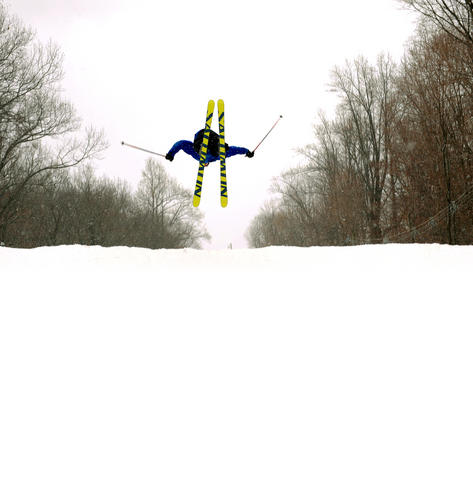
PHOTO : NY TIMES NEWS SERVICE
First, the facts from specialty ski and snowboard stores and Internet sales throughout the country: In what the ski industry calls adult flat-ski sales, which means skis sold without bindings, twin-tips have vaulted into the best-selling category this season. In the US, 46,429 twin-tip skis were sold from last August to December, according to SnowSports Industries America, compared with 27,924 in the same period the year before.
Twin-tips are outpacing mid-fat skis - wider planks and more suited to powder - and carving skis, which are more popular in the Northeast, where many people ski on groomed or harder surfaces.
Among skis that have integrated bindings, mid-fat skis still reign, but the twin-tip phenomenon has gotten everybody's attention.
"It's been building for years, but twin-tip sales are almost even with non-twin-tip sales in our place," said Tom Rossi, who manages the Ski Barn in Paramus, New Jersey. "Ten years ago, I was offering maybe two twin-tip ski models. I now offer 15, including four for women."
Kelly Davis, research director for SnowSports Industries, a nonprofit trade group, said twin-tip sales nationally have increased by 32 percent in specialty stores and by 167 percent in online sales over last season.
The only kind of ski that has been more popular is the junior ski. People like to say that snowboarding is capturing the youth market, and Madison Avenue has certainly bought into that notion. The fact is that ski sales have outnumbered snowboard sales by nearly 70,000 units this season, according to SnowSports Industries, and there have been nearly 89,000 junior skis sold. Almost 21 percent of all skiers are under 17 years old.
Many of those youngsters will no doubt migrate to twin-tip skis as they get older. The key question is, why?
"I get requests for twin-tips from 15-year-olds to 50-year-olds," said Matt Carroll, general manager at the venerable Double Diamond ski shop in Vail, Colorado. "We know what the 15-year-old wants them for, and for the people in their 50s or 60s, I think it's a ski that looks a little more youthful and it is a little more forgiving. If you're not quite as good a skier, you can sit back a bit because it won't shoot you into the next turn. A lot of people really like the feel."
Carroll added that because the twin-tip ski has less edge in contact with the snow it also skis like a shorter ski, something most people should be moving toward anyway since modern, more maneuverable skis have made older long boards obsolete.
But most agree that what is probably driving the trend is the appeal of a stylish and dynamic-looking ski.
"The graphics on the ski are more fun and aggressive," Rossi said. "It looks more like a snowboard, really."
Davis called twin-tips "the ski to have right now."
"Why would someone who is never going to ski or jump backward buy a twin-tip ski?" she asked. "Why do people buy dual-suspension mountain bikes to ride around the neighborhood? It's the thing to have."
Almost everyone interviewed said the twin-tips were versatile skis for varied terrain and with the many models now available - virtually every major manufacturer offers them, as do boutique ski makers - there are twin-tip skis for every ability level. Rossi said his twin-tip flat skis sell for US$250 to US$670, with bindings about US$200 additional.
Separate from the popularity of twin-tip skis, though maybe not totally separate, is another revealing trend in the country's ski shops. For only the second time, according to SnowSports Industries, more money has been spent this season on snow-sports apparel than on equipment.
Guess what's driving that phenomenon? Slope chic is in, even if you never get to the mountains.
"What that indicates is that these sports really are a lifestyle as much as a sport," Davis said. "A lot of people are dressing up like skiers or snowboarders even if they aren't actually going to the slopes."
Apparel is defined as parkas, jackets, fleeces, sweaters, base layers and winter boots. Personally, I think this fashion development might be related to the sales of the omnipresent Ugg and Moon boots, but that's a nonscientific observation. Whatever the cause, snow-sports apparel sales have totaled US$791 million so far this winter, while US$541 million has been spent on equipment.
In general, so far, it hasn't been a bad year for ski-shop retailers. That certainly hasn't been true of every recent winter.
There is, of course, a simple explanation for any increase in sales this season. There have been heavy snowfalls in the West and Rocky Mountains, as well as in northern New England and parts of New York. When it snows, people will buy what they need to have fun in the mountains, even if it's a ski that nearly looks the same regardless of the direction you're headed.
There's nothing backward about
that thinking.

In late October of 1873 the government of Japan decided against sending a military expedition to Korea to force that nation to open trade relations. Across the government supporters of the expedition resigned immediately. The spectacle of revolt by disaffected samurai began to loom over Japanese politics. In January of 1874 disaffected samurai attacked a senior minister in Tokyo. A month later, a group of pro-Korea expedition and anti-foreign elements from Saga prefecture in Kyushu revolted, driven in part by high food prices stemming from poor harvests. Their leader, according to Edward Drea’s classic Japan’s Imperial Army, was a samurai

The following three paragraphs are just some of what the local Chinese-language press is reporting on breathlessly and following every twist and turn with the eagerness of a soap opera fan. For many English-language readers, it probably comes across as incomprehensibly opaque, so bear with me briefly dear reader: To the surprise of many, former pop singer and Democratic Progressive Party (DPP) ex-lawmaker Yu Tien (余天) of the Taiwan Normal Country Promotion Association (TNCPA) at the last minute dropped out of the running for committee chair of the DPP’s New Taipei City chapter, paving the way for DPP legislator Su

Located down a sideroad in old Wanhua District (萬華區), Waley Art (水谷藝術) has an established reputation for curating some of the more provocative indie art exhibitions in Taipei. And this month is no exception. Beyond the innocuous facade of a shophouse, the full three stories of the gallery space (including the basement) have been taken over by photographs, installation videos and abstract images courtesy of two creatives who hail from the opposite ends of the earth, Taiwan’s Hsu Yi-ting (許懿婷) and Germany’s Benjamin Janzen. “In 2019, I had an art residency in Europe,” Hsu says. “I met Benjamin in the lobby
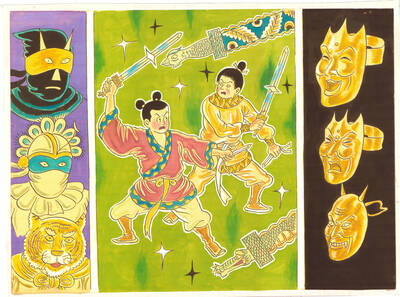
April 22 to April 28 The true identity of the mastermind behind the Demon Gang (魔鬼黨) was undoubtedly on the minds of countless schoolchildren in late 1958. In the days leading up to the big reveal, more than 10,000 guesses were sent to Ta Hwa Publishing Co (大華文化社) for a chance to win prizes. The smash success of the comic series Great Battle Against the Demon Gang (大戰魔鬼黨) came as a surprise to author Yeh Hung-chia (葉宏甲), who had long given up on his dream after being jailed for 10 months in 1947 over political cartoons. Protagonist


 RSS
RSS