


Dalat is Vietnam's Shangri-la, or at least it would dearly like you to think so. And on a crisply sunny morning early in the year it indeed feels very attractive. After a breakfast of raspberries and cream, croissants and the local coffee, you emerge into the dryness and brilliance Dalat shares with some of Asia's other choice upland destinations - Kathmandu or Manali, or Alishan (阿里山) perhaps. Dalat, at some 1,400m, doesn't match Alishan's altitude, but it's a much bigger place, a small city set on a broad plain flanked by low hills, strangely temperate for tropical Vietnam, and hence the venue of choice for local honeymooners. It's a true retreat, and its prime characteristics are flowers, lakes and waterfalls.
You can fly there from Ho Chi Minh City (formerly Saigon) very cheaply with Vietnam Airlines at US$29 for the 40-minute flight. Or you can take the eight-hour bus ride for US$6, with the forested hills becoming more and more impressive the higher you climb.
Mornings are Dalat's best time. The chilly dawn is soon warmed by a hot sun, so that the locals wear their anoraks against the quickly burning sunlight as well as against the cold in the evenings. You can ride on a motorbike in the intense, clear light past jacaranda flowering blue against the even bluer sky, and feel the exhilaration of a fine May morning in the English Lake District. The landscape is a patchwork of green and brick red, with thin lines of smoke rising into the serene stillness. I was driven last month on a rented motorbike (US$4 a day) past strawberries, broccoli and vast piles of cabbages towards the twin peaks of Langbiang, as gladioli and branches of pink blossom were being cut in anticipation of Tet, the Vietnamese New Year.

PHOTOS: BRADLEY WINTERTON
Access to the mountain's summit (2,169m) is problematic. You can be taken by jeep for US$10 to a low peak, Dankia Hill, marked by a red radar mast, with various attractions along the route - a hotel in the forest, a display of Chinese song and dance, an orchid garden by a river. But access to the two higher peaks involves some serious hiking because of the overgrown nature of the terrain and is best tackled as part of a group.
Returning to Dalat in a midday that could easily be an English summer afternoon, you're struck by the smell of animal dung, the hollyhocks and the terraced hillsides topped with pines. Even a Vietnamese funeral, with its gaudy hearse and brass band playing American laments, couldn't detract from the atmosphere of ease and contentment.
Dalat itself clusters round an artificial lake, Xuan Huong, and visitors ride round it (40 minutes) on ancient but sturdy tandem bicycles. The city itself is marked by its churches and pagodas, smart beauty salons advertising Pierre Cardin, dim Internet cafes and men struggling up hills with wood for nighttime fires. But most of all, as with much of the rest of Vietnam, what time and again catch the eye are the brilliantly painted buildings - orange, vermilion, blue and vivid yellow, visual poems made all the more memorable by the purity of the light.
PHOTOS: BRADLEY WINTERTON
Vietnam's new-found prosperity, although still patchy, is everywhere evident in Dalat where so many of the rich maintain holiday villas. As for hotels, there's an abundance, from the Sofitel Dalat Palace (www.sofitel.com; telephone: 84-63-825444; from US$280 a night) downwards. This grand old dowager among hostelries is perched on a low hill overlooking the lake. Its chosen style is the renovated antique, and if you happen to visit when the guests are taking breakfast on the balcony you'd hardly be surprised to see David Beckham or Bill Gates sipping an apricot juice or getting to work on a home-made yogurt. Polished floors, paintings in heavy gilt frames and old-fashioned bathtubs rub shoulders with a quick-connection business center. Billiard balls click quietly as the guests - almost all, it seems, foreigners - stride up to their rooms to admire the view of the lake once again, and pour themselves a morning cognac from the Minibar.
But there are plenty of other options. The centrally-located Golf 3 Hotel (www.vinagolf.vn), starting at US$50, was recommended to me by a Canadian couple staying there, while the Thanh Binh next door (Email: ksthanhbinhdl@vnn.vn) has rooms from a mere US$13. I found the Fortune Hotel (www.dailoihotel.com.vn) good value at US$20, with evidence of Chinese-speaking guests being especially catered for. There are many mini-hotels on Phan Boi Chau Street, freshly painted outside but sometimes less impressive within, all with rooms at around US$10.
Coffee shops line the central street called Nguyen Chi Thanh, all with attractive views across the city, while the Thanh Thuy Bluewater Restaurant offers food and drink right on the edge of the lake.
PHOTOS: BRADLEY WINTERTON
Nights in Dalat can be a problem. A small-scale imitation of the Eiffel Tower, hardly noticeable by day, is imposingly lit-up after dark, but it is cold. So after an excellent Vietnamese dinner for only US$3 at the Nha Hang Nam Son (54 Khu Hoa Binh) I opted for the local disco opposite, Chez Moi. Entrance is US$2, a Smirnoff and tonic will set you back US$5, and even on a mid-week evening there was a sizeable crowd by 10pm. Lights flash, smoke gushes, and you can well find yourself dragged onto the dance-floor by enthusiastic locals if you happen to be, as I was, the only Westerner present.
But in Dalat there's a strong incentive to get up early. There are many things to see, and the best way to see them is on one of the ubiquitous Vietnamese motorcycle taxis called xe-om (literally "hug the driver"). Paying the driver US$10 for a whole day would be considered reasonable, and even perhaps generous.
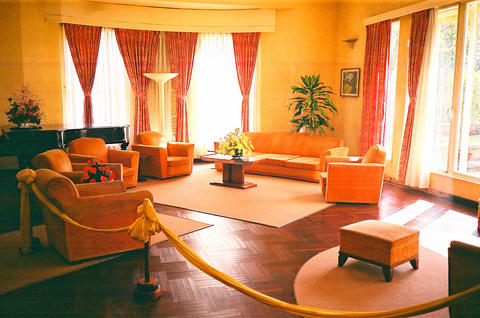
If you're historically minded, then the summer palace of the last Vietnamese emperor, Bao Dai, is worth a look. It's a rather modest 1930s suburban house, the kind of thing Hollywood stars, even at that period, might well have preferred not to live in. Clearly its claim to status here in then-remote Vietnam derived from its modernity. Today almost nothing has changed, and you walk round, with cloth pouches to cover your shoes, peering into the faded rooms and, for an extra dollar, getting yourself photographed sitting on the imperial throne wearing a royal costume of your choice (they hang on a clothes rack in the corner).
PHOTOS: BRADLEY WINTERTON
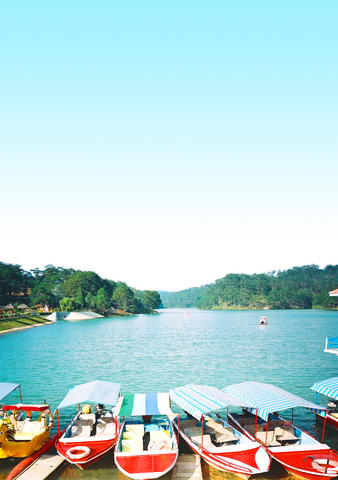
And then there's the Valley of Love. Initially it looks like an amusement park, with Peter Pan statues and pixies on toadstools. The celebrated Dalat cowboys hang out here, likely lads sitting astride tightly reined-in ponies hoping to take you for a ride. But soon you discover the hidden lake surrounded by forested hills. The awnings of the swan-necked pedalos flap lazily in the light breeze, and the occasional motorbike putters along the lakeside road. I was lucky, said one Vietnamese visitor, to catch it on such a quiet day.
Take a boat out on the lake and you can fantasize a thousand things - that Harry Potter is watching you with bespectacled gaze, ready at any moment to sail across the lake on his Quidditch broomstick, that Marie Antoinette is somewhere between the trees playing games with lovelorn shepherdesses, or that a distant relative of the Loch Ness monster lies slumbering under the pellucid green wavelets. That it's an enchanted place was somehow recognized by the creators of pixies on toadstools and the like, and if they didn't quite catch its real magic, they nonetheless knew it was there. So they called it the Valley of Love, knowing that love itself has, after all, an incomparable magic of its own.
Dalat's Crazy House is Gaudi on a small scale, architecture that might have originated as candle drippings into which have been inserted various Hobbit-like structures. It's dusty and rather dated now, but is currently being given a major face-lift so, who knows, it may soon turn out to be quite fun again, especially for children. The small Lam Ty Ni Pagoda close by was locked when I tried to visit, with no indication as to when it might open.
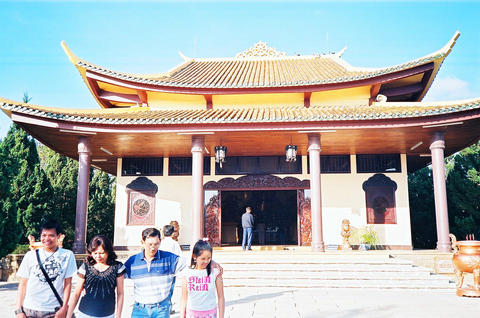
Waterfalls are considered romantic places by the Vietnamese and attract large crowds. At the Datania Waterfall, 20 minutes out along the road back to Ho Chi Minh City, I met the Vietnam Everest 2008 team, due to attempt the peak in May and perfecting their climbing technique on the slabs overlooking the falls. This was surprising enough, but even more astonishing was to stumble on an idyllic Buddhist temple, Truc Lam, completed in 1994, overlooking the adjacent valley. Hollyhocks bloomed crimson against the evening sky, a bell was slowly pounded, and all in all it seemed the most peaceful place in all Vietnam.
Dalat is where Vietnam's extensive wine industry operates, but I decided not to visit the vineyards this time. Sometimes it's a good idea to leave something undone simply to entice you back again. And Dalat, where man-made splendors combine with a fine natural setting, is certainly a place that's well worth re-visiting.

Last week Joseph Nye, the well-known China scholar, wrote on the Australian Strategic Policy Institute’s website about how war over Taiwan might be averted. He noted that years ago he was on a team that met with then-president Chen Shui-bian (陳水扁), “whose previous ‘unofficial’ visit to the US had caused a crisis in which China fired missiles into the sea and the US deployed carriers off the coast of Taiwan.” Yes, that’s right, mighty Chen caused that crisis all by himself. Neither the US nor the People’s Republic of China (PRC) exercised any agency. Nye then nostalgically invoked the comical specter
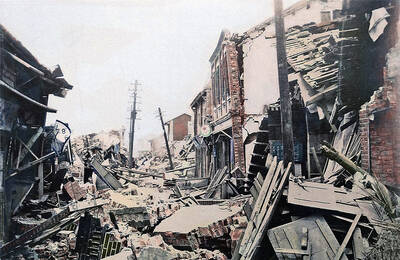
April 15 to April 21 Yang Kui (楊逵) was horrified as he drove past trucks, oxcarts and trolleys loaded with coffins on his way to Tuntzechiao (屯子腳), which he heard had been completely destroyed. The friend he came to check on was safe, but most residents were suffering in the town hit the hardest by the 7.1-magnitude Hsinchu-Taichung Earthquake on April 21, 1935. It remains the deadliest in Taiwan’s recorded history, claiming around 3,300 lives and injuring nearly 12,000. The disaster completely flattened roughly 18,000 houses and damaged countless more. The social activist and

Over the course of former President Ma Ying-jeou’s (馬英九) 11-day trip to China that included a meeting with Chinese Communist Party (CCP) leader Xi Jinping (習近平) a surprising number of people commented that the former president was now “irrelevant.” Upon reflection, it became apparent that these comments were coming from pro-Taiwan, pan-green supporters and they were expressing what they hoped was the case, rather than the reality. Ma’s ideology is so pro-China (read: deep blue) and controversial that many in his own Chinese Nationalist Party (KMT) hope he retires quickly, or at least refrains from speaking on some subjects. Regardless

Approaching her mid-30s, Xiong Yidan reckons that most of her friends are on to their second or even third babies. But Xiong has more than a dozen. There is Lucky, the street dog from Bangkok who jumped into a taxi with her and never left. There is Sophie and Ben, sibling geese, who honk from morning to night. Boop and Pan, both goats, are romantically involved. Dumpling the hedgehog enjoys a belly rub from time to time. The list goes on. Xiong nurtures her brood from her 8,000 square meter farm in Chiang Dao, a mountainous district in northern Thailand’s


 RSS
RSS