


Now that Uno, the 38cm beagle, has captured the crown, becoming the first of his breed to win best in show at the Westminster Kennel Club dog show, and now that more than 2,600 other canine competitors have been leashed and crated and hauled home to familiar kennels and sofas, it seems fitting to consider an overlooked aspect of this crowd-pleasing sport: the strange collision of fashion and dog shows.
"You want something sparkly," Teri Rosenblatt-Tevlin explained Monday as she circled her dog through the sawdust of a fenced enclosure by the staging area at Madison Square Garden. "But tasteful," she added. "You want to look classy but not draw attention away from the dog."
The dog in question was an Afghan hound named Poseidon of Mountain Top One, known familiarly as JP, and based on what he was wearing before the show, he would be a hard dog to outshine. There were the patterned snood and the glossy belted jumpsuit, custom made by Rosenblatt-Tevlin's mother to protect the dog from his urine stream.
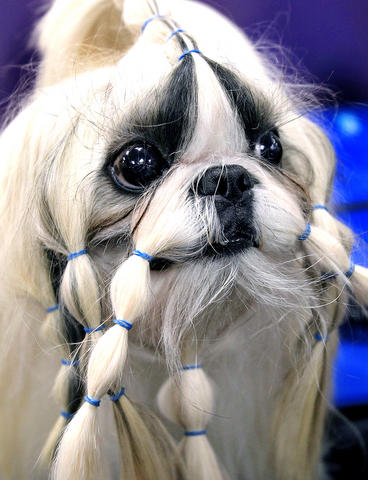
PHOTO: AFP
He also had a luxuriant coat, combed to the texture of the cascading tresses in a L'Oreal ad. The coat was his own, of course, developed to help cope with the frigid winters in mountainous Afghanistan.
While nature provided JP with a reason for his foppish appearance, dog show humans have no such excuse for the strangeness of their attire. The rule of thumb at dog shows is "for handlers to be invisible, so they don't take away from the breed," said David Frei, the director of communications for the 132-year-old Westminster Kennel Club show.
And for the final night of judging, that rule was generally observed. Under the bright lights in a packed arena, the dogs shone and the handlers, in their dark suits and rubber-soled shoes, tended to recede. Or most did, if one omits Alessandra Folz, who appeared to be making a style statement by wearing a suit of bubble gum pink to conduct the 4-year-old Weimaraner called Marge through the ring.
And why shouldn't she wear it? Dog shows are essentially fashion shows, after all, demonstrations of the many ways that selective breeding can be used to accommodate alterations in taste. Despite all the marketing and mythologizing about bloodlines extending backward into antiquity, many canine breeds are relatively modern and man-made.
In more than one sense, Westminster bears a resemblance to the New York fashion shows that folded up tents just days before the dog show rolled into town. Both are hybrid forms that marry entertainment to merchandising. Both have a tendency to stir up questions about the relationship between aesthetics and genetics. Both take place in a setting one associates with a circus, although they sell hot dogs at the Garden, and that will never happen under the big top at Bryant Park.
Replace the poodles with Latvian giantesses and the staging area at the Garden could have been any backstage segment from Full Frontal Fashion. Everywhere you looked there were fur-bearing divas parked passively on tables, surrounded by adoring handlers who primped and arranged their coiffures. In every corner were Jiffy Steamers, blow-dryers, rat combs, curlers, manicure scissors, cylinder brushes, hot combs and all the other weaponry of the beauty arsenal.
As at many fashion shows, a pale nimbus of hair spray floated above the backstage area. And this caused one to think that when people of the future wonder why they are forced to live in underground tunnels, it will be explained that in the early 21st century the hair spray used to make models look like poodles and poodles look like Lady Bunny ate a hole in the atmosphere.
At Madison Square Garden, as at many fashion shows, a chasm yawns between those who are blessed by nature and those whose job it is to prepare Cinderella for the ball. At Madison Square Garden, as at fashion shows, the anointed beauties perform for a moment and then rush to let down their fur. At Madison Square Garden, there are many reasons to envy dogs their essential nakedness.
These reasons include metallic brocade jackets, novelty jumpers, purple sweatsuit ensembles, sweat shirts with dog portraits outlined in Swarovski crystals, trousers with origami pleats and lug-soled walking shoes of a sort one associates with the lady ornithologist in Hitchcock's The Birds.
"Her coat is called oyster brindle," said Juan Miranda, a Mexican breeder, as he methodically used a hot comb to straighten the fur of an Afghan bitch known as Dolce
Gabbana of Damos. Unlike many of the handlers at Westminster, Miranda was simply attired, in a trim D&G suit. He was three hours into a grooming process, he explained, all for perhaps a half-hour in the ring.
In this way, too, dog and fashion shows are alike: orgies of effort yielding transitory effects. "It's about eight hours altogether," explained a groomer slumped in a chair beside Remy, the white standard poodle formally known as Brighton Minimoto. "It's three hours just for the bath and a couple hours more to clipper her," the groomer went on, adding that two more hours would be devoted to washing the hair spray out of Remy's tortured Bret Michaels (frontman of the band, Poison) bouffant, using Dawn dish soap.
Although a favorite to win Westminster, Remy was ultimately beaten by the little beagle Uno. And even in this unanticipated result could be detected elements of fashion.
With her topiary hairdo and visual allusions to the go-go 1980s ("a masterpiece carved with a pair of clippers," in the words of the Associated Press), Remy's was probably the wrong look for tough economic times. She was a Christian Lacroix pouf, to strain the analogy. And Uno the beagle was an honest cloth coat, much like the ones Michael Kors showed a week ago in Bryant Park.

In late October of 1873 the government of Japan decided against sending a military expedition to Korea to force that nation to open trade relations. Across the government supporters of the expedition resigned immediately. The spectacle of revolt by disaffected samurai began to loom over Japanese politics. In January of 1874 disaffected samurai attacked a senior minister in Tokyo. A month later, a group of pro-Korea expedition and anti-foreign elements from Saga prefecture in Kyushu revolted, driven in part by high food prices stemming from poor harvests. Their leader, according to Edward Drea’s classic Japan’s Imperial Army, was a samurai

Approaching her mid-30s, Xiong Yidan reckons that most of her friends are on to their second or even third babies. But Xiong has more than a dozen. There is Lucky, the street dog from Bangkok who jumped into a taxi with her and never left. There is Sophie and Ben, sibling geese, who honk from morning to night. Boop and Pan, both goats, are romantically involved. Dumpling the hedgehog enjoys a belly rub from time to time. The list goes on. Xiong nurtures her brood from her 8,000 square meter farm in Chiang Dao, a mountainous district in northern Thailand’s
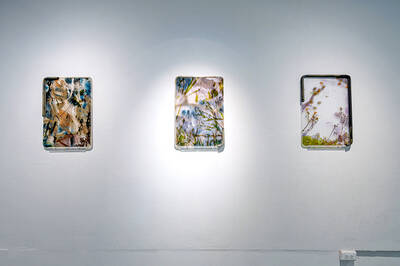
Located down a sideroad in old Wanhua District (萬華區), Waley Art (水谷藝術) has an established reputation for curating some of the more provocative indie art exhibitions in Taipei. And this month is no exception. Beyond the innocuous facade of a shophouse, the full three stories of the gallery space (including the basement) have been taken over by photographs, installation videos and abstract images courtesy of two creatives who hail from the opposite ends of the earth, Taiwan’s Hsu Yi-ting (許懿婷) and Germany’s Benjamin Janzen. “In 2019, I had an art residency in Europe,” Hsu says. “I met Benjamin in the lobby
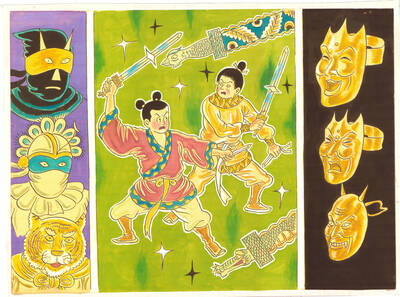
April 22 to April 28 The true identity of the mastermind behind the Demon Gang (魔鬼黨) was undoubtedly on the minds of countless schoolchildren in late 1958. In the days leading up to the big reveal, more than 10,000 guesses were sent to Ta Hwa Publishing Co (大華文化社) for a chance to win prizes. The smash success of the comic series Great Battle Against the Demon Gang (大戰魔鬼黨) came as a surprise to author Yeh Hung-chia (葉宏甲), who had long given up on his dream after being jailed for 10 months in 1947 over political cartoons. Protagonist


 RSS
RSS