


Politics and high fashion may seem like strange bedfellows, but New York Fashion Week's occurrence during this election year points up some important similarities.
While candidates for both parties stump to win votes, the designers stage their own campaigns, those runway shows calculated to win them support from retailers who are like delegates.
The hype and hoopla surrounding the tents in Bryant Park are very much like the frenzy of either party's convention. Some very similar issues concern both politicians and designers: It's about the economy.
And if a recession is imminent, will customers be able to afford the prices of the lavish, luxurious fashions previewed last week?
Another similarity can be seen in the designs themselves. They emulate the party system: Some lean left with liberal experiments and new design platforms.
Others are dyed-in-the-wool (literally) conservatives, while a few are rugged independents.
Max Azria is a lefty with three collections - a first here - that feature experimental silhouettes and tricky effects such as a bra worn over a dress. Tommy Hilfiger surprised his audience when the designer known for his rock and hip-hop fashions did an about-face with an ultrasafe, well groomed, uptight, uptown collection shown in classy Lincoln Center.
Ralph Lauren, the archetype of classic Americana, remained true to his love of the Old West but brought it to town by super-shaping those plaids and adding gaudy millinery, thereby mixing heritage with new wealth.
Bill Blass had been a favorite with conservative ladies who lunch, and this season's re-launch of the late designer's line with young Peter Som at the helm is a reassuring return to the sporty but elegant looks that seem so right again. They inspire consumer confidence.
The indies are one of a kind and they range from eternally young Betsey Johnson to indigestible eclectically ethnic Anna Sui.
Voters will go to the polls to elect a president in November, of course.
Shoppers will cast their fashion votes by choosing to buy - or not - when these new looks hit the stores come fall.
The choices facing consumers will be as diverse and challenging as casting votes for the next prez. The nation is in a time of turmoil - and fashion, as always, reflects the spirit of those who buy and wear it. Just think back to the Great Depression and the Vietnam War.
Michael Kors, whose 1950s-inspired collection evoked "how Hitchcock's women dressed," commented: "We live in uncertain times, we don't know what's going to happen with the economy but what we do know is that delicious fabrics, beautiful tailoring, great colors - all these things will make you feel good."
Another significant change: Youth is losing its dominant grip on fashion culture. Hilfiger, one of the most notable names in American fashion, recognizes the change. "The girls grow up. They become more chic, more sophisticated, more dressed up," he said after his show.
As a result, grown-up clothes are becoming fashionable, and the most important and ongoing evidence of this style shift is a halt to overdesigned, overembellished looks. Simply put, decoration and details are being replaced by fabric and form in directional collections.
One of the season's most eagerly anticipated shows, the re-launch of Halston designed by Marco Zanini, reintroduced the late designer's sublime simplicity.
Streamlined sleek gowns and pulled together sportswear had longtime fan Liza Minnelli cheering in the front row. Francisco Costa continued to refine the minimalism that has always been the signature of Calvin Klein collections.
Donna Karan got the shape message and made it her own, adding volume to not-very-flattering, slouchy, draped shapes. Call it relaxed, if you will, but Karan was a long way from the power dressing that made her famous.
Marc Jacobs, the most copied designer in America, presented a collection of shockingly wearable (for him, anyway) coats and jackets with low-slung sashes, some with front vertical folds and others with shawl-collared pouch backs.
Tadashi Shoji's collection of draped and tied gowns and sportswear (his first ever) looked deceptively simple but on closer inspection revealed a complex tour de force of construction.
Color is also a divisive issue for designers; some are standing still, others are endorsing change. There are those caught in a time warp, not budging further than gray from reliable black.
But more sensitive creators have moved on to a deep, rich palette of antique colors: garnet, bronze, emerald, taupe, iris, absinthe and blue.
The new mood is most apparent in the shapes and structure seen on the runways. Gone are most of the skintight and exhibitionistic get-ups of the recent celebrity-driven past. Dresses remain important, but they aren't baby dolls anymore. The incoming silhouettes are more like sculpture made of fabrics that drape, fold, swirl, bunch and envelop the body.
This complex construction recalls the golden age of haute couture in the 1950s when Charles James, Jacques Fath and Madame Alix Gres created some of the most breathtaking, dramatically shaped and draped clothes in fashion history.
Once again, designers are trying to take our breath away. Some succeed: Shoji, Costa, Zanini, Kors, Karan, Vera Wang and, surprisingly, the grad students from San Francisco's Academy of Art University.
This season, fabric is the eye candy and tactile inducement for many designers.
Brocade, metallic tweed, wool lace, silk charmeuse, chiffon, boiled cashmere, tapestry, moire, velvet, jacquard, taffeta - and outfits usually mixed and layered them together.
As if that wasn't enough, longhaired fur trims were used lavishly as wraps, as sleeves and in shrugs. And there were even feathers flying occasionally as they were worked into fabric, used as trims on garments and hats and mixed into furs.
Som's juxtapositions of mouth-watering luxury fabrics stood out. An ombre shaded mink jacket topped a plaid taffeta skirt and smudged floral silk top.
Carolina Herrera showed mixes of hunting checks, taffeta, chiffon and fox fur.
DKNY jumbled metallic brocade, spotted chiffon and bulky knits.
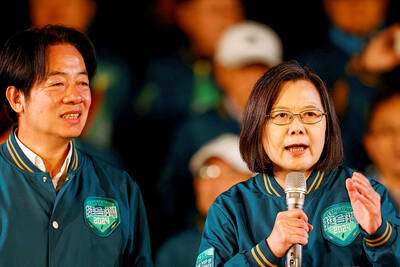
Last week Joseph Nye, the well-known China scholar, wrote on the Australian Strategic Policy Institute’s website about how war over Taiwan might be averted. He noted that years ago he was on a team that met with then-president Chen Shui-bian (陳水扁), “whose previous ‘unofficial’ visit to the US had caused a crisis in which China fired missiles into the sea and the US deployed carriers off the coast of Taiwan.” Yes, that’s right, mighty Chen caused that crisis all by himself. Neither the US nor the People’s Republic of China (PRC) exercised any agency. Nye then nostalgically invoked the comical specter
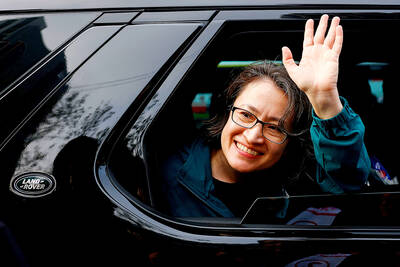
Relations between Taiwan and the Czech Republic have flourished in recent years. However, not everyone is pleased about the growing friendship between the two countries. Last month, an incident involving a Chinese diplomat tailing the car of vice president-elect Hsiao Bi-khim (蕭美琴) in Prague, drew public attention to the People’s Republic of China’s (PRC) operations to undermine Taiwan overseas. The trip was not Hsiao’s first visit to the Central European country. It was meant to be low-key, a chance to meet with local academics and politicians, until her police escort noticed a car was tailing her through the Czech capital. The
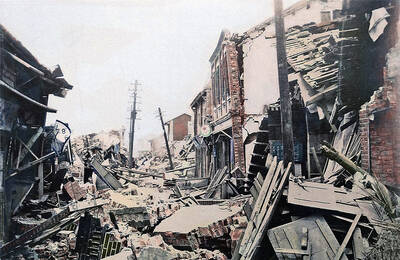
April 15 to April 21 Yang Kui (楊逵) was horrified as he drove past trucks, oxcarts and trolleys loaded with coffins on his way to Tuntzechiao (屯子腳), which he heard had been completely destroyed. The friend he came to check on was safe, but most residents were suffering in the town hit the hardest by the 7.1-magnitude Hsinchu-Taichung Earthquake on April 21, 1935. It remains the deadliest in Taiwan’s recorded history, claiming around 3,300 lives and injuring nearly 12,000. The disaster completely flattened roughly 18,000 houses and damaged countless more. The social activist and

Over the course of former President Ma Ying-jeou’s (馬英九) 11-day trip to China that included a meeting with Chinese Communist Party (CCP) leader Xi Jinping (習近平) a surprising number of people commented that the former president was now “irrelevant.” Upon reflection, it became apparent that these comments were coming from pro-Taiwan, pan-green supporters and they were expressing what they hoped was the case, rather than the reality. Ma’s ideology is so pro-China (read: deep blue) and controversial that many in his own Chinese Nationalist Party (KMT) hope he retires quickly, or at least refrains from speaking on some subjects. Regardless


 RSS
RSS