


A video of Heath Ledger hanging out at a drug-fueled party two years before his death would seem to constitute must-see material for a tabloid entertainment show.
But when such a video ended up in the hands of the producers of Entertainment Tonight, the program declined to broadcast it, a spokeswoman said, "out of respect for Heath Ledger's family." The 28-year-old actor died on Jan. 22 from what the medical examiner called an accidental overdose of prescription medications.
Amy Winehouse did not merit the same discretion. Images from a video that showed her smoking what a British tabloid, The Sun, said was a pipe of crack cocaine, as well as admitting to having taken "about six" Valium, were widely disseminated in the news media around the same time.
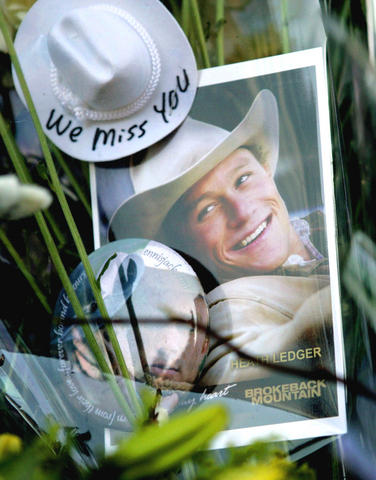
PHOTO: AP
When Owen Wilson was hospitalized in August after an apparent suicide attempt, his plight was the subject of a single US Weekly cover story. Not so Britney Spears, recently confined in a psychiatric ward, who has inspired six cover stories for the magazine during the same time span.
When Kiefer Sutherland was released from the jail in Glendale, California, after serving a 48-day sentence for a drunken driving conviction, the event merited little more than buried blurbs.
Contrast this to Paris Hilton's return to jail last year after a brief release to serve the rest of a 45-day sentence for a probation violation involving alcohol-related reckless driving. The event invited a level of attention that evoked the OJ Simpson trial. Hordes of cameras enveloped the limousine that ferried the tear-streaked heiress to jail.
Yes, women are hardly the only targets of harsh news media scrutiny - just ask Mel Gibson. But months of parallel incidents like these seem to demonstrate disparate standards of coverage. Men who fall from grace are treated with gravity and distance, while women in similar circumstances are objects of derision, titillation and black comedy.
Some celebrities and their handlers are now saying straight out that the news media have a double standard.
"Without a doubt, women get rougher treatment, less sensitive treatment, more outrageous treatment," said Ken Sunshine, a publicist whose clients include Ben Affleck and Barbra Streisand. "I represent some pretty good-looking guys, and I complain constantly about the way they're treated and covered. But it's absolutely harder for the women I represent."
Liz Rosenberg, a publicist at Warner Bros/Reprise Records who represents Madonna, among others, also thinks sexism is at work. "Do you see them following Owen Wilson morning, noon and night?" she asked.
Some editors confirm that they handle female celebrities differently. But the reason, they contend, is rooted not in sexist attitudes, but in the demographics of their audience.
The readership of US Weekly, for example, is 70 percent female; for People, it's more than 90 percent, according to the editors of these magazines.
"Almost no female magazines will put a solo male on the cover," said Janice Min, the editor in chief of US Weekly. "You just don't. It's cover death. Women don't want to read about men unless it's through another woman: a marriage, a baby, a breakup."
Thus, magazine coverage of Ledger's death gave way to stories about Michelle Williams, Ledger's former girlfriend and the mother of his daughter; US Weekly, for instance, put the headlines "A Mother's Pain" and "My Heart is Broken" atop a four-page spread. Mary-Kate Olsen, telephoned several times by the discoverer of Ledger's body, came in for it, too: "What Mary-Kate Knows" trumpeted In Touch Weekly.
Indeed, while one of People's best-selling issues of the last year was its cover story on Wilson's suicide attempt, a follow-up cover on his recovery was one of the worst sellers, said Larry Hackett, the managing editor.
Conversely, he said, the Spears story continues to flourish precisely because women are fascinated by the challenges facing a young mother.
"If Britney weren't a mother, this story wouldn't be getting a fraction of the attention it's getting," Hackett said. "The fact that the custody of her children is at stake is the fuel of this narrative. If she were a single woman, bombing around in her car with paparazzi following, it wouldn't be the same."
Others, like Roger Friedman, an entertainment reporter for FoxNews.com, said that female celebrities tend to make more-compelling stories because "they are more emotional and open" about their problems. Male stars, he said, tend to be "circumspect."
Rebecca Roy, a psychotherapist in Beverly Hills, California, who has several clients in the entertainment industry, said that male celebrities can often wriggle out of trouble with a rakish bad-boy shrug. But, she said, the double standard can reinforce the destructive behavior of female stars, pushing them to further depths of substance abuse and erratic behavior.
Roy said that troubled male stars like Robert Downey Jr are encouraged to move past problems to a second act in their careers, while the personal battles of women like Lindsay Lohan or the late Anna Nicole Smith are often played for maximum entertainment value.
"With men, there's an emphasis on, 'he had this issue, but he's getting over it,'" Roy said. "But with women, it's like they keep at it, keep at it. It's almost like taking the wings off of a fly."
Min acknowledged that her magazine played down its coverage of Wilson and Ledger. Part of the reason, she said, was that female readers tend to be sympathetic toward young men in crisis.
"With Heath Ledger, people walked on eggshells trying to strike the right tone," Min said, adding that "public sentiment for Heath Ledger factored into our coverage."
Edna Herrmann, a clinical psychologist in Los Angeles, said that while schadenfreude is part of the enjoyment of star travails, women especially respond to female celebrities with commonplace demons. "Misery likes company," Herrmann said.
But some believe the power of a celebrity's publicist has more bearing on coverage than gender. Entertainment Tonight reversed its plans to show the video of Ledger following protests from stars like Natalie Portman and Josh Brolin organized by ID, which represented Ledger and still represents Williams.
In some cases, celebrities may be victims of their own appetites for media attention.
"It would seem to me that no one who demanded, who expected privacy, at the get-go was denied that privacy," said Stan Rosenfield, a publicist who represents George Clooney.
And Harvey Levin, the managing editor of the gossip Web site TMZ.com, said that female stars are afforded every opportunity to move past their sins, as long as they clean up their behavior.
"Nicole Richie, who took a beating generally for being a screw-up, has turned it around, and everyone's cheering for her now," Levin said of the former Hilton sidekick and tabloid staple, now the mother of a month-old daughter.
Even if news media coverage is weighted in their favor, male celebrities aren't exactly feeling immune from harsh scrutiny.
"There is certainly an argument for it being incredibly sexist, the attention that's given to women and the hounding of them," the actor Colin Farrell said at a recent party for his new film, In Bruges.
Farrell, who has attracted his share of attention, said such potential bias did not make him any less of a news media target. "If they catch me out and about," he said, "they'll go for it."
As Farrell spoke in a room filled with journalists and photographers, he was not even sipping a beer.

The year was 1991. A Toyota Land Cruiser set out on a 67km journey up the Junda Forest Road (郡大林道) toward an old loggers’ camp, at which point the hikers inside would get out and begin their ascent of Jade Mountain (玉山). Little did they know, they would be the last group of hikers to ever enjoy this shortcut into the mountains. An approaching typhoon soon wiped out the road behind them, trapping the vehicle on the mountain and forever changing the approach to Jade Mountain. THE CONTEMPORARY ROUTE Nowadays, the approach to Jade Mountain from the north side takes an
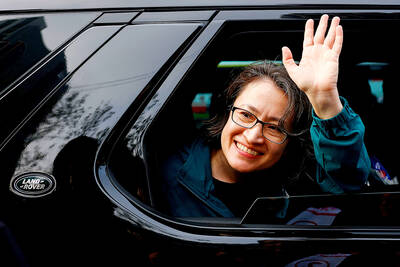
Relations between Taiwan and the Czech Republic have flourished in recent years. However, not everyone is pleased about the growing friendship between the two countries. Last month, an incident involving a Chinese diplomat tailing the car of vice president-elect Hsiao Bi-khim (蕭美琴) in Prague, drew public attention to the People’s Republic of China’s (PRC) operations to undermine Taiwan overseas. The trip was not Hsiao’s first visit to the Central European country. It was meant to be low-key, a chance to meet with local academics and politicians, until her police escort noticed a car was tailing her through the Czech capital. The

Last week Joseph Nye, the well-known China scholar, wrote on the Australian Strategic Policy Institute’s website about how war over Taiwan might be averted. He noted that years ago he was on a team that met with then-president Chen Shui-bian (陳水扁), “whose previous ‘unofficial’ visit to the US had caused a crisis in which China fired missiles into the sea and the US deployed carriers off the coast of Taiwan.” Yes, that’s right, mighty Chen caused that crisis all by himself. Neither the US nor the People’s Republic of China (PRC) exercised any agency. Nye then nostalgically invoked the comical specter
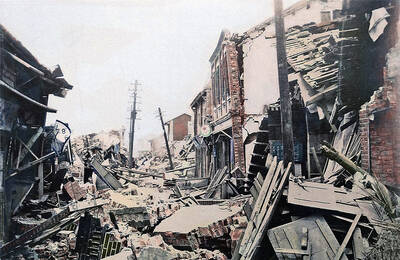
April 15 to April 21 Yang Kui (楊逵) was horrified as he drove past trucks, oxcarts and trolleys loaded with coffins on his way to Tuntzechiao (屯子腳), which he heard had been completely destroyed. The friend he came to check on was safe, but most residents were suffering in the town hit the hardest by the 7.1-magnitude Hsinchu-Taichung Earthquake on April 21, 1935. It remains the deadliest in Taiwan’s recorded history, claiming around 3,300 lives and injuring nearly 12,000. The disaster completely flattened roughly 18,000 houses and damaged countless more. The social activist and


 RSS
RSS