


Books about Tibet form a genre all of their own. For 100 years thousands of volumes have described the challenging terrain, the esoteric monastic practices, and the exhilaration, mixed with hardship, experienced by travelers. Since the flight of the Dalai Lama to India in 1959 stories of the suffering inflicted by occupying forces, and of the near-destruction of one of the world's most distinctive and, until recently, untouched cultures, have been added.
But there's more to it than this. Tibet has long come to represent for the West the antithesis of the rational, scientific, commercial culture that is now spreading all over the planet. If this scientific outlook brings with it its own woes, then Tibet is the place, many feel, where a healing counter-balance can be found.
Claire Scobie was a writer working on the UK's Telegraph Magazine when, in 1996, she had the chance to join a botanical expedition to find a rare red lily, never before successfully naturalized in the West. Another six trips to Tibet followed, the last in 2005. These had a variety of journalistic motives - covertly filming prior to the 40th anniversary of the 1959 Tibet Uprising, investigating the rise of pornography and prostitution in Lhasa, and so on. She got to know Tibet well, and even briefly acquired a Tibetan lover.

In the course of these trips she twice visited and made a circuit of Mount Kailash, the first time in the company of a Tibetan nun called Ani. In this book, earlier and subsequent meetings with Ani form the thread that aspires to bind together what might otherwise have seemed Scobie's unconnected and very different trips.
Last Seen in Lhasa by and large makes an attractive read. The author has the ability to incorporate background information with a light touch, and she certainly observes many aspects of Tibetan life, from sky-burials (the chopping up of corpses and then leaving them to the tender mercies of vultures) to the advent of smart beauty salons in Lhasa.
The friendship with Ani, however, does seem to have been introduced as a somewhat artificial link to hold together what may have originated as a series of re-worked travel articles, together with other material. In theory each woman moves towards the other's world, Ani acquiring a pair of glasses from a fashionable Chinese optician on the one hand, Scobie experiencing a modicum of success with meditation (though only in the final chapter, and not very convincingly at that) on the other.
If books on Tibet can be divided into those describing physical treks and those describing spiritual voyages of discovery, then this one aims to combine the two types. Claire Scobie comes out as having little aptitude for the latter, and the book is best viewed as a generous and kindly rag-bag of Tibet lore and information, easy to read, and not without its astute observations.
Nothing much is new. The depredations of the occupying Chinese forces, the recent influx of Chinese settlers, the resulting depression of many Tibetans, the arcane spiritual practices, the vast landscapes - all these can be found more fully described elsewhere. But it's as a general book, containing all of these things and more, and in digestible portions, that this one scores relatively highly.
The most interesting chapters are the early ones. These describe plant-hunting in the eastern Tibetan region of Pemako, close to the border with India - and some of it still disputed territory between the two Asian super-powers. The
terrain is so inhospitable that the area has been for centuries the subject of Tibetan myths of a promised land, of hidden valleys where the conditions for an ideal existence are secreted. All you need do is find the secret entrance to these places and your soul's pilgrimage will be at an end.
This is a scenario that's extraordinarily common in stories dealing with magic and spiritual knowledge worldwide. It's there in the wardrobe that leads into Narnia in C.S. Lewis' novels, platform nine and three-quarters in the Harry Potter books, and the rabbit hole which Alice falls into in Lewis Carroll's Victorian fantasies - and this is only to consider English fiction. Think of Odysseus and Aeneas visiting the underworld, Gilgamesh's underground journey, and Dante's three-tiered visit to the Catholic version of an afterlife and you begin to understand just how universal the human dream of escaping a world that's ambiguous and temporary, and going to one where life's absolutes can genuinely be encountered, actually is.
Is Tibet really like that? There seems little doubt that we all dream of somewhere that's mythic and unchanging, an ideal place where we "truly belong," and that Tibet fulfils that function for a large number of disillusioned modern people. What they'll find there once they arrive, especially today, is another matter. Claire Scobie found piles of human excrement, plastic bags and discarded beer bottles everywhere from Pemako to Mount Kailash, a place that's often considered the sacred heart of an everywhere more-or-less sacred landscape. And as for Lhasa, it's difficult to know what she really thinks of somewhere with elevators, tourist admission fees to the most famous sites, and Tibetan students waiting at the airport for flights back to their universities in China.
Even the great mythic places are subject to change, in other words. It's the human imagination that tends to return over and over again to the same archetypes. This is what the Dalai Lama (who Claire Scobie interviews) meant when he told her that the greatest searches are within you, and many spiritual seekers might frankly be better advised to stay happily at home.

In late October of 1873 the government of Japan decided against sending a military expedition to Korea to force that nation to open trade relations. Across the government supporters of the expedition resigned immediately. The spectacle of revolt by disaffected samurai began to loom over Japanese politics. In January of 1874 disaffected samurai attacked a senior minister in Tokyo. A month later, a group of pro-Korea expedition and anti-foreign elements from Saga prefecture in Kyushu revolted, driven in part by high food prices stemming from poor harvests. Their leader, according to Edward Drea’s classic Japan’s Imperial Army, was a samurai
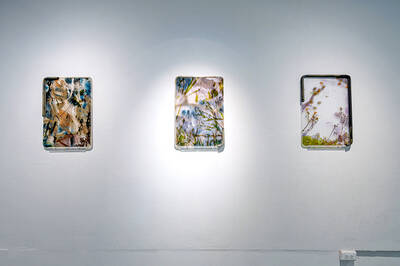
Located down a sideroad in old Wanhua District (萬華區), Waley Art (水谷藝術) has an established reputation for curating some of the more provocative indie art exhibitions in Taipei. And this month is no exception. Beyond the innocuous facade of a shophouse, the full three stories of the gallery space (including the basement) have been taken over by photographs, installation videos and abstract images courtesy of two creatives who hail from the opposite ends of the earth, Taiwan’s Hsu Yi-ting (許懿婷) and Germany’s Benjamin Janzen. “In 2019, I had an art residency in Europe,” Hsu says. “I met Benjamin in the lobby
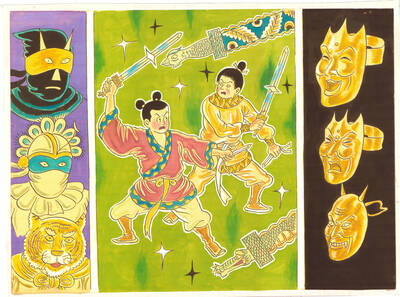
April 22 to April 28 The true identity of the mastermind behind the Demon Gang (魔鬼黨) was undoubtedly on the minds of countless schoolchildren in late 1958. In the days leading up to the big reveal, more than 10,000 guesses were sent to Ta Hwa Publishing Co (大華文化社) for a chance to win prizes. The smash success of the comic series Great Battle Against the Demon Gang (大戰魔鬼黨) came as a surprise to author Yeh Hung-chia (葉宏甲), who had long given up on his dream after being jailed for 10 months in 1947 over political cartoons. Protagonist

A fossil jawbone found by a British girl and her father on a beach in Somerset, England belongs to a gigantic marine reptile dating to 202 million years ago that appears to have been among the largest animals ever on Earth. Researchers said on Wednesday the bone, called a surangular, was from a type of ocean-going reptile called an ichthyosaur. Based on its dimensions compared to the same bone in closely related ichthyosaurs, the researchers estimated that the Triassic Period creature, which they named Ichthyotitan severnensis, was between 22-26 meters long. That would make it perhaps the largest-known marine reptile and would


 RSS
RSS