


It is shaping up to be a critical year for Asian cinema as it struggles to fulfill recent expectations and to come to grips with intense competition.
Asian movie making might have won international recognition in recent years as a new force in the global movie business, but leading national film industries in the region such as China and South Korea are facing a tough 12 months as they try to ensure the Asian cinema wave does not peter out.
This has coincided with emergence the new generation of filmmakers who are now making their mark on Asian cinema with films portraying the often grim reality of modern urban life.

PHOTO: AGENCIES
"There are no longer the big social statements," said Jacob Wong from the Hong Kong Film Festival. "The new generation of movie makers are more self-absorbed with many of the films made by directors who are not much older than the target audience."
Signs that some Asian filmmakers have been pulling back from politics and history and delving more into the often personal stresses unleashed by urban living have been on display from the crop of Asian films screened at this year's Berlin Film Festival.
This includes South Korean director Hong Sangsoo's Night and Day (Bam gua Nat) where the main character admits he is a quest to find himself or young Taiwanese director Zero Chou's (周美玲) Drifting Flowers (飄浪青春). The film is about three women living in different parts of Taiwan who are all seeking their true identity.

"There a lot of stories to be told about Taiwan, which people even in mainland China don't know about," said Taiwanese director Chang Tso-chi (張作驥) whose film Soul of a Demon (蝴蝶) which touches on a young man exploring his past, was also shown at this year's Berlinale.
On the face of it, Asian cinema has had a remarkably successful year winning top prizes at each of the world's major film festivals - in Cannes, Berlin and Venice.
But behind the scenes, the film industry in many Asian countries is under pressure not the least because of the global credit crunch and the current uncertain world economic climate, which has resulted producers becoming more worried about budgets and the box office.

PHOTO: AGENCIES
This in turn has raised the prospects of many film producers becoming conservative about the movie scripts they are prepared to back just when international film critics would like Asian cinema to become more daring.
The result could be that instead of more experimental filmmaking, Asian cinema could retreat to the relative safety of romantic comedies and horror movies.
This is particularly the case with Korea, which in recent years has helped to spearhead the so-called new wave in Asian cinema.
But a dozen years after South Korea emerged as a new filmmaking nation, some industry analysts say that the country risks tempting the same fate as Hong Kong, which has been unable to shake off the downturn that hit the industry a decade ago.
Moreover some industry analysts say Korea could soon find itself eclipsed in the coming years by other rivals, including Thailand or Taiwan, which are now being eyed off as potentially the next new thing in Asian cinema.
The problems facing Korea's film business have been compounded by a retreat in Japanese buying interest in the country's movies and Seoul's decision - under US pressure - to cut the local screen quota two years ago.
Apart from badly shaking the industry, the quota decision plunged filmmakers into almost a state of war with the government with the nation's critics already complaining about the films produced.
At the same time, China is still battling to come up with the magic movie formula to produce films that meets its ambitions to become a global movie powerhouse and which strike a chord with western, Asian and national Chinese audiences alike.
Tuya's Wedding (圖雅的婚禮) from Chinese director Wang Quan'an (王全安) about a Mongolian shepherd family, which took home the Berlin's Film Festival coveted Golden Bear last year flopped badly at the box office in China.
While the sheer size of the Chinese market has made co-productions with China almost a necessary part of filmmaking for many Asian countries, looming large over China's film sector is censorship which appears to become even more rigorous recently.
This includes the censors' demands for cuts to Taiwanese-born director Ang Lee's (李安) Lust, Caution (色,戒), which won the top prize at last year's Venice Film Festival, and a ban on Chinese director Li Yu's (李玉) Lost in Beijing (蘋果), which premiered a year ago in Berlin.
What is more, Beijing's stance on censorship appears to be the one issue hindering any quick moves to draw the three key Chinese language filmmaking worlds - Taiwan, Hong Kong and China.
"In the future Hong Kong cinema will gradually form part of Chinese filmmaking," said acclaimed Hong Kong director Johnnie To (杜琪峰) whose film Sparrow (文雀) is in the running for top honors at this year's Berlinale.
"But as Hong Kong becomes more part of Chinese cinema, I hope that Hong Kong filmmakers will continue to make films that are integral to the local culture," he said with Hong Kong still having the advantage of escaping the heavy hand of Beijing's censors.

In late October of 1873 the government of Japan decided against sending a military expedition to Korea to force that nation to open trade relations. Across the government supporters of the expedition resigned immediately. The spectacle of revolt by disaffected samurai began to loom over Japanese politics. In January of 1874 disaffected samurai attacked a senior minister in Tokyo. A month later, a group of pro-Korea expedition and anti-foreign elements from Saga prefecture in Kyushu revolted, driven in part by high food prices stemming from poor harvests. Their leader, according to Edward Drea’s classic Japan’s Imperial Army, was a samurai

Located down a sideroad in old Wanhua District (萬華區), Waley Art (水谷藝術) has an established reputation for curating some of the more provocative indie art exhibitions in Taipei. And this month is no exception. Beyond the innocuous facade of a shophouse, the full three stories of the gallery space (including the basement) have been taken over by photographs, installation videos and abstract images courtesy of two creatives who hail from the opposite ends of the earth, Taiwan’s Hsu Yi-ting (許懿婷) and Germany’s Benjamin Janzen. “In 2019, I had an art residency in Europe,” Hsu says. “I met Benjamin in the lobby
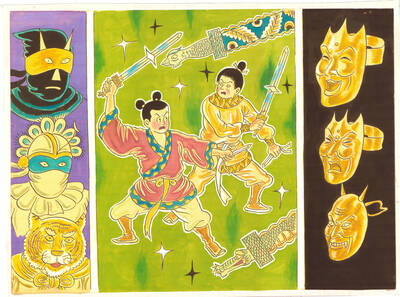
April 22 to April 28 The true identity of the mastermind behind the Demon Gang (魔鬼黨) was undoubtedly on the minds of countless schoolchildren in late 1958. In the days leading up to the big reveal, more than 10,000 guesses were sent to Ta Hwa Publishing Co (大華文化社) for a chance to win prizes. The smash success of the comic series Great Battle Against the Demon Gang (大戰魔鬼黨) came as a surprise to author Yeh Hung-chia (葉宏甲), who had long given up on his dream after being jailed for 10 months in 1947 over political cartoons. Protagonist

The following three paragraphs are just some of what the local Chinese-language press is reporting on breathlessly and following every twist and turn with the eagerness of a soap opera fan. For many English-language readers, it probably comes across as incomprehensibly opaque, so bear with me briefly dear reader: To the surprise of many, former pop singer and Democratic Progressive Party (DPP) ex-lawmaker Yu Tien (余天) of the Taiwan Normal Country Promotion Association (TNCPA) at the last minute dropped out of the running for committee chair of the DPP’s New Taipei City chapter, paving the way for DPP legislator Su


 RSS
RSS