


Mozart intended The Magic Flute to be fun. Written in the last days of the composer's life, he wanted to create a crowd-pleaser. Despite the glorious music, the manic sense of fun and the fairy-tale romanticism, The Magic Flute has been relegated to the temples of high culture, seen only by the suited and gowned in the rarefied atmosphere of an opera house.
Kenneth Branagh's cinematic adaptation of the opera puts The Magic Flute right back where it belongs - in the world of popular art. Ever since his directorial debut in 1989 with Shakespeare's Henry V, the director has tirelessly made classic plays accessible to a new generation. It must be said that he has not always been successful: His 2006 adaptation of As You Like It, set in feudal Japan, will hopefully sink quietly into oblivion.
But his willingness to take risks is not in doubt. Setting Mozart's work against a World War I background (a harsh transplanting from its original setting in ancient Egypt) has irked some critics, who see it as needless tampering and a distraction from the music. But unlike As You Like It, in which the new setting, one suspects, simply offered a chance to have Japanese fans and sliding doors, in The Magic Flute, Branagh uses the backdrop to make a modern plea for peace.
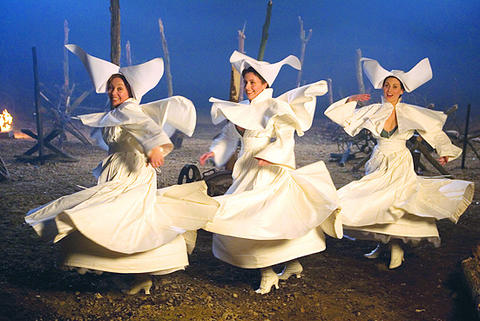
PHOTO COURTESY OF CINEPLEX
In giving the film a political dimension, Branagh makes a successful appeal to an audience for whom inspired nonsense is not quite enough - after all, this work has been enjoyed for centuries despite a plot that really does not make much dramatic sense.
The story goes something like this: Pamina, daughter of the Queen of the Night, has been kidnapped. Prince Tamino is chased by a snake and falls unconscious. (In this case, the snake is a serpentine smoke of mustard gas.) He is saved by the buxom servants of the queen, who recruit him to rescue Pamina from her abductor Sarastro. Tamino embarks on his adventure with Papageno, the birdman. Tamino discovers that Sarastro is not the evil tyrant that he had been led to believe, but a person of great wisdom. He undergoes a number of trials to be initiated into Sarastro's following. His love for Pamina helps him endure these trials, but the stress of being in Sarastro's court causes both Pamina and Papageno to contemplate suicide. Both are stopped in the nick of time. The Queen of the Night, having failed to destroy Sarastro through Tamino, launches an assault against him. It is foiled, and so the story ends.
It is all utter nonsense, but rich and inspirational nonsense, in the tradition of Alice in Wonderland. It must be said at this point that while the film is purportedly in English, much of the exposition is sung in strung-out operatic riffs, making it difficult to follow. The vernacular libretto by Steven Fry gives the opera a rich comic vein (for an English speaking audience at least). This vintage Branagh piece takes high, and seemingly inaccessible art, and brings it to eye-level, were all can see and enjoy the treats, not just of Mozart's music, but of a wonderful fairy-tale told by a narrator who understands his contemporary audience.

Last week Joseph Nye, the well-known China scholar, wrote on the Australian Strategic Policy Institute’s website about how war over Taiwan might be averted. He noted that years ago he was on a team that met with then-president Chen Shui-bian (陳水扁), “whose previous ‘unofficial’ visit to the US had caused a crisis in which China fired missiles into the sea and the US deployed carriers off the coast of Taiwan.” Yes, that’s right, mighty Chen caused that crisis all by himself. Neither the US nor the People’s Republic of China (PRC) exercised any agency. Nye then nostalgically invoked the comical specter

Relations between Taiwan and the Czech Republic have flourished in recent years. However, not everyone is pleased about the growing friendship between the two countries. Last month, an incident involving a Chinese diplomat tailing the car of vice president-elect Hsiao Bi-khim (蕭美琴) in Prague, drew public attention to the People’s Republic of China’s (PRC) operations to undermine Taiwan overseas. The trip was not Hsiao’s first visit to the Central European country. It was meant to be low-key, a chance to meet with local academics and politicians, until her police escort noticed a car was tailing her through the Czech capital. The
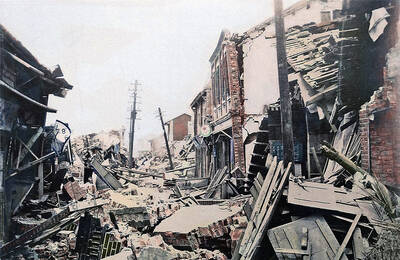
April 15 to April 21 Yang Kui (楊逵) was horrified as he drove past trucks, oxcarts and trolleys loaded with coffins on his way to Tuntzechiao (屯子腳), which he heard had been completely destroyed. The friend he came to check on was safe, but most residents were suffering in the town hit the hardest by the 7.1-magnitude Hsinchu-Taichung Earthquake on April 21, 1935. It remains the deadliest in Taiwan’s recorded history, claiming around 3,300 lives and injuring nearly 12,000. The disaster completely flattened roughly 18,000 houses and damaged countless more. The social activist and

Over the course of former President Ma Ying-jeou’s (馬英九) 11-day trip to China that included a meeting with Chinese Communist Party (CCP) leader Xi Jinping (習近平) a surprising number of people commented that the former president was now “irrelevant.” Upon reflection, it became apparent that these comments were coming from pro-Taiwan, pan-green supporters and they were expressing what they hoped was the case, rather than the reality. Ma’s ideology is so pro-China (read: deep blue) and controversial that many in his own Chinese Nationalist Party (KMT) hope he retires quickly, or at least refrains from speaking on some subjects. Regardless


 RSS
RSS