


When Michelle Louise Hogg embarked on a theatrical make-up course at the London College of Fashion she can little have imagined that it would lead to her having to spend the rest of her life on the run. Nor can she have guessed that she would, one day, have to employ the very skills she learned for changing the appearances of actors to disguise herself.
The 33-year-old hairdresser from Woolwich, southeast London, was the first piece in the jigsaw puzzle that led Kent police to the gang who carried out Britain's largest ever cash robbery and made off with over US$105 million from the Securitas depot in Tonbridge, Kent. Last month, five of the gang allegedly at the center of the conspiracy were jailed at the Old Bailey criminal court in London.
Hogg had helped to disguise four of the robbers, using latex, false hair, grease paint and modeling wax, so that they could impersonate police officers without being recognized later. The prosthetic masks were well made and effective and none of the Securitas staff or the manager and his family who were kidnapped at gunpoint by the robbers were able to identify them. But within 24 hours of the lorry driving away with the looted money, there was a knock at Hogg's door.

PHOTO: EPA
It was the beginning of a frightening two years for the woman who had once worked on makeup counters at the London department stores Harvey Nichols and Selfridges.
The detectives who first interviewed Hogg found a flustered young woman clearly out of her depth in the midst of such a huge crime, one to which 100 officers had been assigned, three times as many as to an ordinary murder case. "I have committed no crime so far as I know," she said in a statement handed to the police by her lawyer. "I may have done some work innocently without any knowledge of how my work would be used. I would like to assist police further ... but I am terrified as to what may happen to me and my family if I say too much."
She told the police that she had assumed that the men needed the masks for a music video. She said that she would certainly never have embarked on the work if she had known anything illegal was involved. The police were not convinced and she was charged with conspiracy to commit robbery and conspiracy to kidnap.

PHOTO: EPA
When the trial started in court eight of the Old Bailey last July, Hogg was clearly in a very distressed state. She shook as she went into the dock alongside her seven co-defendants and was weeping, anxious and breathless. Some days she was too ill to attend court, and there were rumors of a breakdown. Eventually, she was given permission to sit outside the dock with her mother, as she claimed she was being intimidated by the other defendants. Four of them - Lea Rusha, Roger Coutts, Stuart Royle and Jetmir Bucpapa - knew that she would be able to identify them.
Then, halfway through the trial, came a dramatic twist. Her legal team approached the Crown Prosecution Service (CPS) and said that she was prepared to give evidence for the prosecution.
While the CPS' Roger Coe-Salazar said later that they were confident of securing convictions without Hogg, it was soon apparent that her evidence was dynamite.
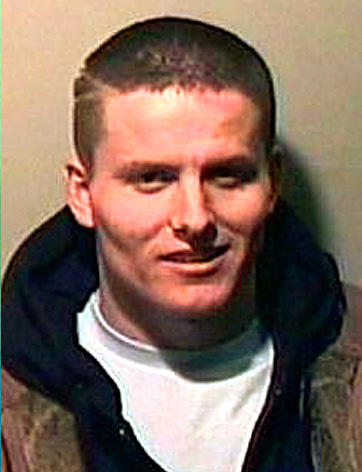
PHOTO: EPA
She was adamant that she had disguised the men and denied that she was giving evidence to protect herself. There were angry clashes in the court. One of the defendants, Royle, who had sacked his lawyers and was defending himself, told her that "I am going to try and be as nice as I can." He admitted she had cut his hair at Hair Hectik shortly after he had had it dyed, but claimed that that was their only contact, and that she had never made a mask for him. "You trimmed my hair and said it looked nice," he told her as the cat and mouse game in the court developed. "You said I was a gentleman for helping you with your bags." She agreed that the new color suited him. But when he claimed that she must have been at a different bungalow from his when she fitted the men with their disguises, she shot back: "Bless you, Stuart, but it was that bungalow. I did a face cast of you, Stuart, a nose was made for you. I am sorry but that is the bungalow that I went to. You offered me a drink and a cake or a biscuit ... . You are absolutely lying and you are lying by saying the makeup wasn't done at your mom's bungalow."
In the course of testimony, she gave a detailed description of how she had made the disguises. She made bald caps, fake noses, fake chins. After Hogg had delivered her detailed and damning evidence, the prosecution's case was made. The jury may have taken more than a week to reach their verdicts but there can be little doubt that she played a very crucial part in helping them reach their decisions.
But there are at least three key members of the gang who are still at large (along with more than half of the money stolen). The alleged ringleader, a cage fighter, is believed to be in Morocco. If they could be brought back to the UK, Hogg would again be the prosecution's star witness. There are rumors that there is a contract out on her life, but then there are always such rumors when someone has to assume a new identity for their own safety, which is Hogg's fate. She currently has 24-hour armed police protection, will be under the witness protection for the foreseeable future and is believed to be planning to radically alter her appearance.
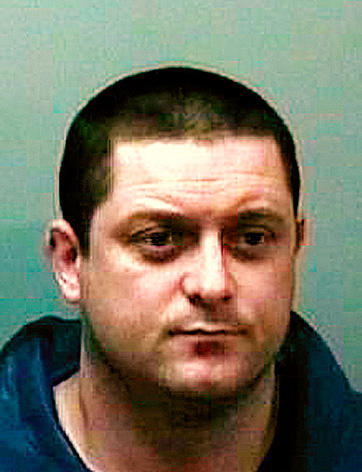
PHOTO: EPA
The Witness Protection Scheme is designed to look after people who have essential evidence about some of the most serious offences, and who therefore face a real threat to their safety. Most of these protected witnesses are criminals who have turned on their associates in order to save their own skins. But some are simply innocent bystanders, or people on the fringes of gang culture.
Individuals living under the scheme have to trade in their old life for a new one – moving (usually going to another part of the country, and sometimes as far away as Australia, Canada or New Zealand) and changing their identity, with medical records and educational qualifications under a new name. They are also given a lump sum of money to help them start their new life.
Hogg will be very well looked after by the officers assigned to her. Given her importance to any future trial, the police will be taking absolutely no risks that anyone can get to her. But her life will not be easy.

PHOTO: EPA
Danielle Cable, whose evidence helped convict the man who murdered her fiance, Stephen Cameron, has been living under the scheme since 1998. In 2000, she told a newspaper that she was only given a few minutes to pack her bags and leave her old home. She hadn't seen two of her brothers since she was relocated, she told the reporter, and was unable to see her mother for four months. Two years after she went into hiding, her phone calls were still strictly limited, she said - she could only make calls from untraceable locations - and it took six weeks for letters to reach her. "I have lost twice," she said, "Stephen and my old life."
In Britain, the police have a very good record of protecting their witnesses, although some have claimed that, once the evidence has been given, they are treated with less care and respect.
But witness protection does not guarantee safety. In 1999, the IRA witness Martin McGartland survived an attempt on his life after being shot six times in the stomach while living under an assumed identity in Whitley Bay.
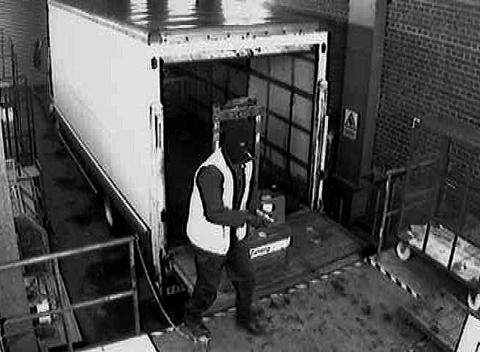
PHOTO: EPA
More recently, in 2006, the issue came up in court in the wake of the case of Giles van Colle, who was killed by a man against whom he was due to give evidence. A court awarded nearly US$100,000 in damages to his family after the judge ruled that the police had failed in their duty to protect him.
The numbers of witnesses in the UK who need protection grows every year - probably because of the increase in gang-related and organized crime. While it is relatively easy for an individual to disappear without trace, the way they can most easily be found is through family members. Sometimes family members are moved, too - but police have to weigh up the risks: how many members of an extended family can be given a new identity, and how many of them will be able to keep their mouths shut?
Although giving evidence in these circumstances is terrifying, the truth is that most witnesses and informants are not pursued by the people against whom they have given evidence. Professional criminals might like the satisfaction of exacting vengeance but they also know that any action they took would place them at a far greater risk than they already were and would probably ensure that they spend the rest of their life in jail. But this can be little comfort to Hogg, as she starts her new life today.

PHOTO: EPA

Last week Joseph Nye, the well-known China scholar, wrote on the Australian Strategic Policy Institute’s website about how war over Taiwan might be averted. He noted that years ago he was on a team that met with then-president Chen Shui-bian (陳水扁), “whose previous ‘unofficial’ visit to the US had caused a crisis in which China fired missiles into the sea and the US deployed carriers off the coast of Taiwan.” Yes, that’s right, mighty Chen caused that crisis all by himself. Neither the US nor the People’s Republic of China (PRC) exercised any agency. Nye then nostalgically invoked the comical specter
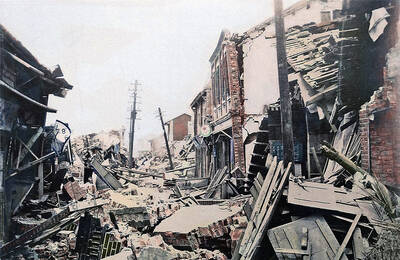
April 15 to April 21 Yang Kui (楊逵) was horrified as he drove past trucks, oxcarts and trolleys loaded with coffins on his way to Tuntzechiao (屯子腳), which he heard had been completely destroyed. The friend he came to check on was safe, but most residents were suffering in the town hit the hardest by the 7.1-magnitude Hsinchu-Taichung Earthquake on April 21, 1935. It remains the deadliest in Taiwan’s recorded history, claiming around 3,300 lives and injuring nearly 12,000. The disaster completely flattened roughly 18,000 houses and damaged countless more. The social activist and

Over the course of former President Ma Ying-jeou’s (馬英九) 11-day trip to China that included a meeting with Chinese Communist Party (CCP) leader Xi Jinping (習近平) a surprising number of people commented that the former president was now “irrelevant.” Upon reflection, it became apparent that these comments were coming from pro-Taiwan, pan-green supporters and they were expressing what they hoped was the case, rather than the reality. Ma’s ideology is so pro-China (read: deep blue) and controversial that many in his own Chinese Nationalist Party (KMT) hope he retires quickly, or at least refrains from speaking on some subjects. Regardless

Approaching her mid-30s, Xiong Yidan reckons that most of her friends are on to their second or even third babies. But Xiong has more than a dozen. There is Lucky, the street dog from Bangkok who jumped into a taxi with her and never left. There is Sophie and Ben, sibling geese, who honk from morning to night. Boop and Pan, both goats, are romantically involved. Dumpling the hedgehog enjoys a belly rub from time to time. The list goes on. Xiong nurtures her brood from her 8,000 square meter farm in Chiang Dao, a mountainous district in northern Thailand’s


 RSS
RSS