


For nearly three decades, John Sayles, 57, has stayed true to his vision of an independent filmmaker. He's spent that time working outside of the Hollywood system, making movies on his own time and very little money.
A Schenectady, New York, native and Williams College graduate, Sayles began his career as a novelist, earning early acclaim and a National Book Award nomination for 1978's Union Dues.
The same year, he earned his first screenwriting credit for the energetic Jaws rip-off Piranha, produced by low-budget king Roger Corman. Witty scripts for the beloved creature features Alligator and The Howling followed.
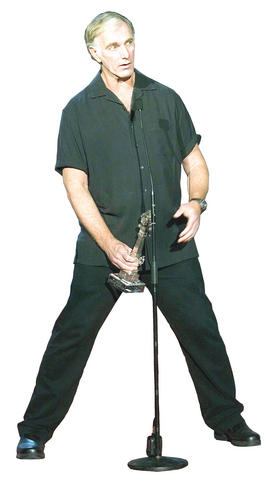
PHOTO: EPA
Since Sayles' 1980 directorial debut The Return of the Secaucus Seven, he has built one of the broadest canvases in American cinema, delving into stories of homeowners fighting developers in modern-day Florida (Sunshine State) and coal miners on strike in Depression-era West Virginia (Matewan), paraplegic soap opera actresses (Passion Fish) and extraterrestrial slaves on the run (The Brother From Another Planet).
Sayles' movies - co-produced with his longtime partner Maggie Renzi - feature multiracial and multigenerational casts. Over the course of three decades, his films have introduced audiences to actors who have gone on to be honored at the Oscars: He's collaborated multiple times with Chris Cooper and Williams classmate David Strathairn.
Meanwhile, Sayles has continued to work for other directors as both a credited screenwriter (most recently on the upcoming fantasy The Spiderwick Chronicles, co-starring Strathairn) and a behind-the-scenes script doctor.
His new film, Honeydripper, brought Sayles back to his hometown for a screening at historic Proctor's Theatre, which celebrated his previous release, the political farce-thriller Silver City, in 2004.
Honeydripper features Hollywood players such as Danny Glover, Charles Dutton, Lisa Gay Hamilton and Stacy Keach. Austin, Texas, guitarist Gary Clark Jr appears in his film debut as a hotshot guitarist hired by Tyrone (Glover), the proprietor of the fading Honeydripper juke joint, in a last-ditch effort to drum up business.
Danielle Furfaro: What's the plot of your new film, Honeydripper?
John Sayles: It's set in 1950 in a little, crossroads, cotton-picking town called Harmony, Alabama. Danny Glover is a club owner who's not doing so well. His place is still playing live music, old-fashioned blues. The place across the street has a jukebox and is doing much better. He's going to lose his club and his sense of himself. He's the one African-American guy in that town in 1950 who can walk around and be his own boss. So he hires a guy named Guitar Sam to come on a big Saturday night. The guy doesn't show up on the train, and Danny spends most of the rest of the movie trying to figure out what to do.
DF: What was your inspiration for the film?
JS: It came out of my long relationship with American music. I grew up in the 1950s listening to the radio like everyone else. You assume the music was always there; as you get older, you realize it came from somewhere. Sam Cooke led me to soul, and Ray Charles led me to the blues. I started thinking about what it must have been like for musicians when the solid-body guitar and the amplifier showed up. It was, "Either I get on board with this thing or I get left behind."
DF: Your movies tend to have a down-home atmosphere and are far less flashy than films coming out of Hollywood. Why?
JS: The main reason is I started out as a fiction writer. So most of my ideas, unlike Hollywood movies, don't come from other movies. In Hollywood, you have to be aware of other movies and who your audience is. When I come up with the subjects and the characters, I'm not thinking about movies. Hollywood movies have to attract hundreds of millions of people even to bother to get them made, so they have to make a movie that doesn't bother anyone. I don't worry about that.
DF: You've consistently had to struggle to find financing both to get your films made and to get them distributed and promoted. What have you learned about that over the years?
JS: Anytime you're making a movie that is not a teen comedy or Spider-Man, it's risky. We've never gotten money from a studio, and when you're looking outside the studio system, that gets pretty quirky. The money that I've made back from previous movies and from screenwriting goes to finance the financing. Looking for funding takes a lot of plane rides and long-distance phone calls. Honeydripper we made for US$5 million, which is really low for a period movie as ambitious as it is.
DF: What is your favorite film that you've made?
JS: I don't have a favorite film. It's more like some of the experiences were more fun. Certainly shooting (1999's Limbo) in Alaska was fun. And we had a great time in West Virginia with Matewan. Our bond with the community there was pretty strong. They really got into the movie. With Sunshine State we got to live on the beach in condos.
DF: Why did you decide to premiere Honeydripper at Proctor's?
JS: It's such a beautiful theater. One of the things we have to do with this film is create our own buzz and distribute the film ourselves. We are competing with a lot of movies this time of year. In the next two months, we'll do 17 different cities. At each one, we'll do a different event. In Boston, I'll read from a short story book. At some of the others, we'll have a Honeydripper all-star band, with some of the musicians from the film.
DF: All your films have a moral theme, and often depict an underdog facing a sociological force. Is this a conscious tactic?
JS: It has to do with how you see the world. For me, drama is conflict. A lot of the conflict people go through isn't wars, it's more of an ethical or moral conflict. I don't always know how I feel about the characters and the decisions they make. Like with the current writers' strike - some of them will go back to work, and some will have reasons you'll be sympathetic to. To me, those are the kind of dramatic situations I want to make films about.

In late October of 1873 the government of Japan decided against sending a military expedition to Korea to force that nation to open trade relations. Across the government supporters of the expedition resigned immediately. The spectacle of revolt by disaffected samurai began to loom over Japanese politics. In January of 1874 disaffected samurai attacked a senior minister in Tokyo. A month later, a group of pro-Korea expedition and anti-foreign elements from Saga prefecture in Kyushu revolted, driven in part by high food prices stemming from poor harvests. Their leader, according to Edward Drea’s classic Japan’s Imperial Army, was a samurai

The following three paragraphs are just some of what the local Chinese-language press is reporting on breathlessly and following every twist and turn with the eagerness of a soap opera fan. For many English-language readers, it probably comes across as incomprehensibly opaque, so bear with me briefly dear reader: To the surprise of many, former pop singer and Democratic Progressive Party (DPP) ex-lawmaker Yu Tien (余天) of the Taiwan Normal Country Promotion Association (TNCPA) at the last minute dropped out of the running for committee chair of the DPP’s New Taipei City chapter, paving the way for DPP legislator Su

Located down a sideroad in old Wanhua District (萬華區), Waley Art (水谷藝術) has an established reputation for curating some of the more provocative indie art exhibitions in Taipei. And this month is no exception. Beyond the innocuous facade of a shophouse, the full three stories of the gallery space (including the basement) have been taken over by photographs, installation videos and abstract images courtesy of two creatives who hail from the opposite ends of the earth, Taiwan’s Hsu Yi-ting (許懿婷) and Germany’s Benjamin Janzen. “In 2019, I had an art residency in Europe,” Hsu says. “I met Benjamin in the lobby

April 22 to April 28 The true identity of the mastermind behind the Demon Gang (魔鬼黨) was undoubtedly on the minds of countless schoolchildren in late 1958. In the days leading up to the big reveal, more than 10,000 guesses were sent to Ta Hwa Publishing Co (大華文化社) for a chance to win prizes. The smash success of the comic series Great Battle Against the Demon Gang (大戰魔鬼黨) came as a surprise to author Yeh Hung-chia (葉宏甲), who had long given up on his dream after being jailed for 10 months in 1947 over political cartoons. Protagonist


 RSS
RSS