


Tim Burton makes fantasy movies. Stephen Sondheim writes musicals. It is hard to think of two more optimistic genres of popular art, or of two popular artists who have so systematically subverted that optimism. Sondheim has always gravitated toward the dissonance lurking in hummable tunes, and has threaded his song-and-dance spectaculars with subtexts of anxiety and alienation. Burton, for his part, dwells most naturally (if somewhat uneasily) in the realms of the Gothic and the grotesque, turning comic books and children's tales into scary, nightmarish shadow plays.
And so it should not be surprising that Sweeney Todd: The Demon Barber of Fleet Street, Burton's film adaptation of the musical, is as dark and terrifying as any motion picture in recent memory, not excluding the bloody installments in the Saw franchise. Indeed, Sweeney Todd is as much a horror film as a musical: It is cruel in its effects and radical in its misanthropy, expressing a breathtakingly, rigorously pessimistic view of human nature. It is also something close to a masterpiece, a work of extreme - I am tempted to say evil - genius.
As it was originally performed onstage, with all the songs Sondheim composed for it, Sweeney Todd balanced its inherent grisliness with a whimsical vitality. The basic story is a revenger's tragedy more Jacobean than Victorian, but Sondheim nonetheless wrings some grim, boisterous comedy out of both the impulse for vengeance and the bustling spirit of commerce. A barber, wronged by a powerful judge, returns to London and sets up shop, cutting throats as well as hair. The bodies of his victims are turned into savory meat pies by Mrs Lovett, his energetic partner in business and crime. Cannibalism and mass murder: The basis for a hit show.
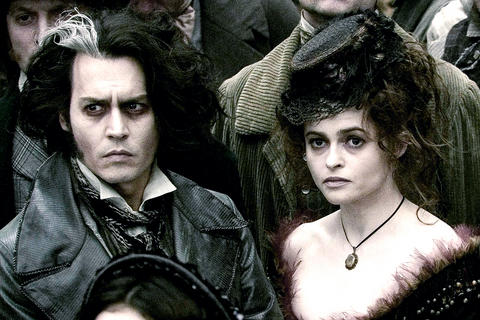
It seemed a lot less funny in the recent revival, which starred Michael Cerveris and Patti Lupone in roles originated on Broadway by Len Cariou and Angela Lansbury in 1979. Burton's film, in spite of the participation of Sacha Baron Cohen (as a mountebank barber in a skin-tight costume) and Timothy Spall (as a louche bailiff) pretty much casts out frivolity altogether. Burton's London is a dark, smoky oil slick of a city. Dante Ferretti's production design, which owes something to the Victorian city confected for Carol Reed's Oliver!, can make even daylight look sinister. Innocence, represented by a pair of young would-be lovers (Jayne Wisener and Jamie Campbell Bower) has virtually no chance in this place; it is a joke played by fate, something to be corrupted, imprisoned or destroyed.
Lovett the pie maker is played by Helena Bonham Carter, a witchy fixture of Burton's cinematic universe as well as the mother of his children. If the director has an alter ego, or at least an actor consistently able to embody his ideas onscreen, it would have to be Johnny Depp. He was the hurt, misunderstood man-child in Edward Scissorhands, the cracked visionary in Ed Wood and the cold, creepy candy mogul in Charlie and the Chocolate Factory, in each case giving form to an emotional equation that had never quite been seen on film before. As Sweeney, his hair streaked with white and his eyes rimmed in black, he is an avatar of rage.
Depp's singing voice is harsh and thin, but amazingly forceful. He brings the unpolished urgency of rock 'n' roll to an idiom accustomed to more refinement, and in doing so awakens the violence of Sondheim's lyrics and melodies. Some of the crowd-pleasing numbers, like The Ballad of Sweeney Todd, have been pared away, but their absence only contributes to the diabolical coherence of the film, which moves with a furious momentum toward its sanguinary conclusion.
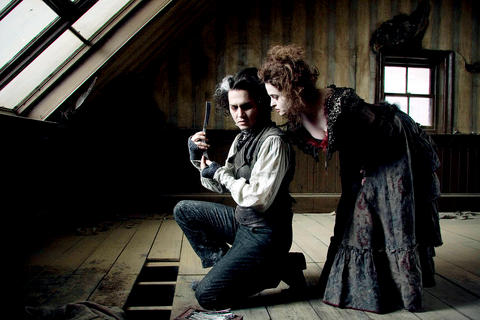
Like nearly every other horror-film serial killer, Sweeney starts out as a sympathetic figure. Once upon a time, he was a happy husband and father, until his lovely wife (Laura Michelle Kelly) caught the eye of a malignant judge (Alan Rickman), who transported the poor barber to Australia. Now, after many years, he has returned to find that his daughter, now a teenager, has become the judge's ward. Finding his old straight razors - "my friends" - under the floorboards of his former shop, Sweeney sets out to ensnare the judge, a project that requires the deaths of quite a few customers along the way.
"They'll never be missed," sings the practical Mrs Lovett. Sweeney's view is harsher, almost genocidal. "They all deserve to die," he says, looking out over the rooftops of the city. And Burton depicts those deaths ruthlessly.
It may seem strange that I am praising a work of such unremitting savagery. I confess that I'm a little startled myself, but it's been a long time since a movie gave me nightmares. And the unsettling power of Sweeney Todd comes above all from its bracing refusal of any sentimental consolation, from Burton's willingness to push the most dreadful implications of the story to their blackest conclusions.
Sweeney Todd is a fable about a world from which the possibility of justice has vanished, replaced on one hand by vain and arbitrary power, on the other by a righteous fury that quickly spirals into madness. There may be a suggestion of hopefulness near the end, but you don't see hope on the screen. What you see is as dark as the grave. What you hear is equally infernal, except that you might also call it heavenly.

In late October of 1873 the government of Japan decided against sending a military expedition to Korea to force that nation to open trade relations. Across the government supporters of the expedition resigned immediately. The spectacle of revolt by disaffected samurai began to loom over Japanese politics. In January of 1874 disaffected samurai attacked a senior minister in Tokyo. A month later, a group of pro-Korea expedition and anti-foreign elements from Saga prefecture in Kyushu revolted, driven in part by high food prices stemming from poor harvests. Their leader, according to Edward Drea’s classic Japan’s Imperial Army, was a samurai

The following three paragraphs are just some of what the local Chinese-language press is reporting on breathlessly and following every twist and turn with the eagerness of a soap opera fan. For many English-language readers, it probably comes across as incomprehensibly opaque, so bear with me briefly dear reader: To the surprise of many, former pop singer and Democratic Progressive Party (DPP) ex-lawmaker Yu Tien (余天) of the Taiwan Normal Country Promotion Association (TNCPA) at the last minute dropped out of the running for committee chair of the DPP’s New Taipei City chapter, paving the way for DPP legislator Su

It’s hard to know where to begin with Mark Tovell’s Taiwan: Roads Above the Clouds. Having published a travelogue myself, as well as having contributed to several guidebooks, at first glance Tovell’s book appears to inhabit a middle ground — the kind of hard-to-sell nowheresville publishers detest. Leaf through the pages and you’ll find them suffuse with the purple prose best associated with travel literature: “When the sun is low on a warm, clear morning, and with the heat already rising, we stand at the riverside bike path leading south from Sanxia’s old cobble streets.” Hardly the stuff of your

Located down a sideroad in old Wanhua District (萬華區), Waley Art (水谷藝術) has an established reputation for curating some of the more provocative indie art exhibitions in Taipei. And this month is no exception. Beyond the innocuous facade of a shophouse, the full three stories of the gallery space (including the basement) have been taken over by photographs, installation videos and abstract images courtesy of two creatives who hail from the opposite ends of the earth, Taiwan’s Hsu Yi-ting (許懿婷) and Germany’s Benjamin Janzen. “In 2019, I had an art residency in Europe,” Hsu says. “I met Benjamin in the lobby


 RSS
RSS