


Though expected, the news last week that Philippe de Montebello would retire as director of the Metropolitan Museum of Art elicited a range of emotions among museumgoers: pride and sadness at the end of a stellar era, and anxiety about the future.
"I was shaky," said Jerry Saltz, the art critic for New York magazine, striking a common note. "Because just at a time when big museums are getting things like new wings so spectacularly wrong, the Met has been getting things close to perfect."
De Montebello is indeed leaving strong, following several recent gallery renovations and a run of well-attended, scholarly, rigorous and critically acclaimed exhibitions. What happens next at the Met has relevance for all major institutions undergoing a generational shift - and all museums in this young century. Here are some themes certain to arise.
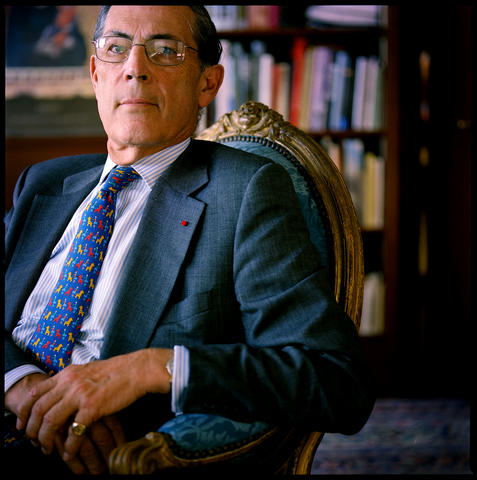
PHOTO: NY TIMES NEWS SERVICE
THE ART OF THE UNDEAD
A major concern is how the world's leading encyclopedic museum will approach contemporary art. In recent years, the Met has organized scattershot exhibitions by relatively young artists like Neo Rauch and Kara Walker. This past fall, crowds came - and some critics groaned - when the Met put Damien Hirst's shark in formaldehyde on view. Is that a sign of things to come?
"The Met's approach to contemporary art has been extremely erratic and pretty bad, really," said Peter Schjeldahl, the art critic for The New Yorker. But, he added, "I don't see that that should be a priority for that place," especially "in a city full of museums that have that mandate."
Still, as the New York Times art critic Michael Kimmelman put it last week, "so many artists have made the Met their lifelong schoolroom," and their work "would be illuminated next to older art in innumerable ways, not to mention vice versa."
Showing more contemporary art "would be wonderful for Chelsea," said the gallery owner Marianne Boesky, since championing work by relatively new artists would drive up their prices. But is that a good role for the Met? "I'd think very gingerly about placing the Metropolitan's imprimatur on objects," said the gallery owner Richard Feigen. "I'd be very, very covetous of those baptismal certificates."
THE RIGHTFUL OWNERS
In 2006, De Montebello deftly struck a deal with the Italian government to return 21 objects Italy says were looted, in exchange for the long-term loan of other antiquities. But the story isn't going away. In the fall, Yale announced it would return to Peru a group of artifacts excavated from Machu Picchu in 1912. Every so often, new Holocaust art restitution cases emerge.
In a globalized world, where assertions of cultural nationalism are just as politicized as they were when museums first built their collections on expatriated art, restitution claims could be "the biggest trouble" facing the Met's next director, said Peter Plagens, a former art critic for Newsweek.
THE SPACE
Forbidden from expanding further into Central Park, under De Montebello, the Met carved out more exhibition space underground, even under the grand staircase. Unlike every other museum in the world, the Met hasn't embarked on a new wing or an annex for its vast holdings. Will that change? Could it? Should it?
Again, directors and boards don't always see eye to eye. "In the business world, if you don't grow, supposedly you're dying," Perl said. "But I think that's a very dangerous model to impose on the cultural group."
THE POWER OF THE CURATOR
In recent years, the directors of the Museum of Modern Art, Boston Museum of Fine Arts and Brooklyn Museum, among others, have been accused of diminishing the power of their curators. But the Met has remained a bastion of curatorial authority, where curators, not board members or directors, take the lead in conceiving exhibitions based on sound scholarship. "I keep them in line but they keep me in line," De Montebello once said of the Met's 100-plus curators. Will his successor continue that approach?
De Montebello is "the beau ideal of curatorial leadership," said Elizabeth Easton, the director of the Center for Curatorial Leadership. In a news conference last week, De Montebello reasserted his priorities. "Art is first," he said. By contrast, "other institutions have embraced as a primary part of their mission the museum experience, in opposition to the experience of coming to look at a work of art."
De Montebello once referred to the Met as "a great ship that you don't turn around that easily." Maybe so, but things change fast. "If you'd said to people 15 years ago, 'The Guggenheim will become a kind of rental room for Eurotrash and that the Modern will become a museum that's unfriendly to curators,' everyone would have said, 'You're crazy,'" Perl said. Yet both those things have arguably come to pass. "The problem," he said, "is institutional history is not an assurance for the future."

In late October of 1873 the government of Japan decided against sending a military expedition to Korea to force that nation to open trade relations. Across the government supporters of the expedition resigned immediately. The spectacle of revolt by disaffected samurai began to loom over Japanese politics. In January of 1874 disaffected samurai attacked a senior minister in Tokyo. A month later, a group of pro-Korea expedition and anti-foreign elements from Saga prefecture in Kyushu revolted, driven in part by high food prices stemming from poor harvests. Their leader, according to Edward Drea’s classic Japan’s Imperial Army, was a samurai
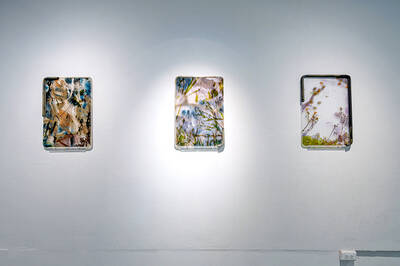
Located down a sideroad in old Wanhua District (萬華區), Waley Art (水谷藝術) has an established reputation for curating some of the more provocative indie art exhibitions in Taipei. And this month is no exception. Beyond the innocuous facade of a shophouse, the full three stories of the gallery space (including the basement) have been taken over by photographs, installation videos and abstract images courtesy of two creatives who hail from the opposite ends of the earth, Taiwan’s Hsu Yi-ting (許懿婷) and Germany’s Benjamin Janzen. “In 2019, I had an art residency in Europe,” Hsu says. “I met Benjamin in the lobby
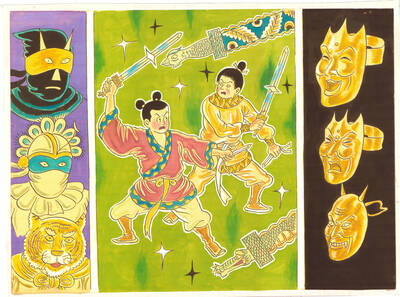
April 22 to April 28 The true identity of the mastermind behind the Demon Gang (魔鬼黨) was undoubtedly on the minds of countless schoolchildren in late 1958. In the days leading up to the big reveal, more than 10,000 guesses were sent to Ta Hwa Publishing Co (大華文化社) for a chance to win prizes. The smash success of the comic series Great Battle Against the Demon Gang (大戰魔鬼黨) came as a surprise to author Yeh Hung-chia (葉宏甲), who had long given up on his dream after being jailed for 10 months in 1947 over political cartoons. Protagonist

A fossil jawbone found by a British girl and her father on a beach in Somerset, England belongs to a gigantic marine reptile dating to 202 million years ago that appears to have been among the largest animals ever on Earth. Researchers said on Wednesday the bone, called a surangular, was from a type of ocean-going reptile called an ichthyosaur. Based on its dimensions compared to the same bone in closely related ichthyosaurs, the researchers estimated that the Triassic Period creature, which they named Ichthyotitan severnensis, was between 22-26 meters long. That would make it perhaps the largest-known marine reptile and would


 RSS
RSS