

listen to music, chat with friends, read books and surf the Internet. There is, however, a darker side to the technology


Young Japanese people are evolving a new lifestyle for the 21st century based on the cellphones that few are now able to live without.
While about one-third of Japanese primary school students aged 7-12 years old use cellphones, by the time they get to high school that figure has shot up to 96 percent, according to a government survey released last month.
They are using their phones to read books, listen to music, chat with friends and surf the Internet - an average of 124 minutes a day for high school girls and 92 minutes for boys.
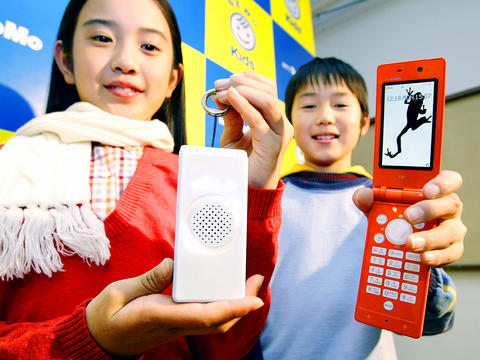
PHOTO: AFP
While the wired world they now inhabit holds enormous advantages for learning and communicating, it also brings a downside, say experts who point to a rise in cyberbullying and a growing inability among teenagers to deal with other people face to face.
"Kids say what's most important to them, next to their own lives, is their cellphone," said Masashi Yasukawa, head of the private National Web Counseling Council.
"They are moving their thumbs while eating or watching television," he said.

PHOTO: AFP
The passion in 20-year-old Ayumi Chiba's voice backs up this assertion.
"My life is impossible without it," she says of her cellphone. "I used to pretend I was sick and leave school early when I forgot to take it with me."
Hideki Nakagawa, a sociology professor at Nihon University in Tokyo, said cellphones have become "an obsession" for youngsters.
"They feel insecure without cellphones, just the way sales people do without their name cards," he said.
As the multi-faceted cellphone takes center stage in teen life, it plays a number of roles - including a weapon that children can wield against each other with no thought for the consequences.
Yasukawa recalls the case of a 15-year-old girl who regularly received messages telling her: "Die," "You're a nuisance" and "You smell."
They turned out to have been sent by a friend in whom she had confided and who told her not to take the messages too seriously.
"The girl who was doing the bullying confessed it made her feel good to see the unease spreading on her friend's face," Yasukawa said.
"Some children send nasty messages to a 'friend' while in her company, pretending to be looking at her profile page on the cellphone.
"It's a very scary world," he said. "Parents don't know there's a very scary world behind cellphone screens."
As they reveal personal information about themselves, children can become prey for fraudsters and pedophiles, as only about 1 percent have blocks on potentially harmful material.
But on protected sites such as school bulletin boards that do block adults, bullies are free to anonymously post comments without any teacher oversight or intervention.
"Bully-to-bullied relations can be easily reversed with a targeted kid pointing the finger at somebody else for some trivial thing," Yasukawa said, adding that this potentially created "a survival game among children."
Japan's largest mobile carrier NTT DoCoMo Inc launched a line of cellphones last month for small children, with software ranging from picture books to school scheduling pads aimed at helping them to learn.
The cellphones will eventually become their main means of communication.
Education professor Tetsuro Saito said a survey of 1,600 middle school students aged around 14 found about 60 percent carried cellphones and nearly half used them to send 20 or more e-mails a day.
Most middle school cellphone users rarely used their phone to talk, the survey found. Saito, of Kawamura Gakuen Women's University near Tokyo, said children seemed to want the security of communicating with someone, without the bother of dealing with a real person.
"Communication ability is bound to decline as cellphones and other devices are now getting between people," he said.
Tomomi, 18, who would not give her full name, said: "I send some 20 e-mails a day. There are people I don't talk with - even if I see them at school, I just exchange mail with them. I guess we're connected only by a machine."
Saito's survey found that students can also use their cellphones as an emotional crutch, and the more problems they have at home, the more dependent they seem to become on their phones.
More than 60 percent of students who said they do not enjoy being with their families send 20 or more e-mails a day, compared with 35 percent of those happy with their families.
And even if cellphones can bring solace, it can come at a terrible cost.
Kanae Yokoyama, 36, is facing trial for allegedly beating and spraining the neck of her 15-year-old daughter after catching her secretly using her cellphone in November.
The girl had been prohibited from using her phone as the bill had hit about US$1,060 in October, mostly wracked up by downloading music and playing games, according to local police.
They said the mother had a history of abusing her daughter.
"Considering she was often absent from school, the mobile phone may have been her sole 'friend' to spend her days with," a police official said.

In late October of 1873 the government of Japan decided against sending a military expedition to Korea to force that nation to open trade relations. Across the government supporters of the expedition resigned immediately. The spectacle of revolt by disaffected samurai began to loom over Japanese politics. In January of 1874 disaffected samurai attacked a senior minister in Tokyo. A month later, a group of pro-Korea expedition and anti-foreign elements from Saga prefecture in Kyushu revolted, driven in part by high food prices stemming from poor harvests. Their leader, according to Edward Drea’s classic Japan’s Imperial Army, was a samurai

Located down a sideroad in old Wanhua District (萬華區), Waley Art (水谷藝術) has an established reputation for curating some of the more provocative indie art exhibitions in Taipei. And this month is no exception. Beyond the innocuous facade of a shophouse, the full three stories of the gallery space (including the basement) have been taken over by photographs, installation videos and abstract images courtesy of two creatives who hail from the opposite ends of the earth, Taiwan’s Hsu Yi-ting (許懿婷) and Germany’s Benjamin Janzen. “In 2019, I had an art residency in Europe,” Hsu says. “I met Benjamin in the lobby

April 22 to April 28 The true identity of the mastermind behind the Demon Gang (魔鬼黨) was undoubtedly on the minds of countless schoolchildren in late 1958. In the days leading up to the big reveal, more than 10,000 guesses were sent to Ta Hwa Publishing Co (大華文化社) for a chance to win prizes. The smash success of the comic series Great Battle Against the Demon Gang (大戰魔鬼黨) came as a surprise to author Yeh Hung-chia (葉宏甲), who had long given up on his dream after being jailed for 10 months in 1947 over political cartoons. Protagonist

A fossil jawbone found by a British girl and her father on a beach in Somerset, England belongs to a gigantic marine reptile dating to 202 million years ago that appears to have been among the largest animals ever on Earth. Researchers said on Wednesday the bone, called a surangular, was from a type of ocean-going reptile called an ichthyosaur. Based on its dimensions compared to the same bone in closely related ichthyosaurs, the researchers estimated that the Triassic Period creature, which they named Ichthyotitan severnensis, was between 22-26 meters long. That would make it perhaps the largest-known marine reptile and would


 RSS
RSS