


Eli Broad, the billionaire financier and philanthropist whose private collection of some 2,000 works of modern and contemporary art is one of the most sought-after by museums nationwide, has decided to retain permanent control of his works in an independent foundation that makes loans to museums rather than give any of the art away.
The decision is a striking reversal by Broad, who as recently as a year ago said that he planned to give most of his holdings to one or several museums.
Long assumed to be at the top of the list of potential recipients was the Los Angeles County Museum of Art, which next month is to open the US$56 million Broad Contemporary Art Museum, a building designed by Renzo Piano and financed by Broad, as the centerpiece of its redesigned campus on Wilshire Boulevard.
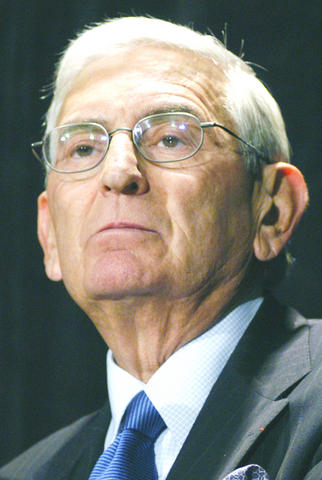
PHOTO: AP
Coming on the eve of the opening, the decision is a potential embarrassment for the museum. It was widely criticized in 2001 for mounting a major exhibition of works from Broad's collection without having secured a promised gift of the works, an act that is prohibited at many prominent art institutions because it can increase the market value of the collection.
The decision also has far-reaching implications for the way museums interact with big donors. In recent years a dizzying rise in art prices and an abiding institutional thirst for acquisitions have given well-heeled donors more influence over what a museum buys and puts on its walls.
Broad has long been a dominant force on the Los Angeles art scene, helping to found museums and serving on their boards, overseeing fundraising for the construction of the landmark Disney Hall, which was designed by Frank Gehry, and spurring a drive to revitalize downtown.
Broad has been especially visible at the county museum, serving as a vice chairman of its board, leading fund-raising campaigns and strongly influencing the comings and goings of the museum's directors, including the hiring in 2006 of the current one, Michael Govan.
In an interview in his foundation's office in Los Angeles, Broad (whose name rhymes with road) said he did not view his decision as a vote of no confidence in the museum. Rather, he said, it represents no less than a new paradigm for the way museums in general collect art and interact with one another.
"I think it's a new model that makes sense for other collections," he said. "If it was up to me, I believe that museums ought to own works jointly." Broad encouraged that practice last year with his purchase of a work by the artist Chris Burden, which he then gave jointly to the county museum and another Los Angeles institution, the Museum of Contemporary Art, where he was a founding trustee.
His decision not to donate his holdings evolved over the last year, Broad said, as his collection grew, and it became clear that no museum, the Los Angeles County Museum of Art included, would commit to placing a large percentage of the works on permanent exhibit.
The collection has roughly doubled in size in the last five years and includes personal holdings and those of the Broad Art Foundation. Among the best-known works are some by contemporary artists including Cindy Sherman, Jeff Koons, Ed Ruscha and John Baldessari, as well as earlier art-world titans like Roy Lichtenstein, Andy Warhol and Robert Rauschenberg.
"We don't want it to end up in storage, in either our basement or somebody else's basement," Broad said. "So I, as the collector, am saying, 'If you're not willing to commit to show it, why don't we just make it available to you when you want it, as opposed to giving it to you, and then our being unhappy that it's only up 10 percent or 20 percent of the time or not being shown at all?"'
Through a spokeswoman, Govan, who became the county museum's director after being heavily recruited by Broad, declined comment on Monday.
Broad took pains to make clear that the county museum would be "the favored institution" when it came to loans from the Broad Art Foundation. "If it weren't going to be favored, I wouldn't have given it US$50 million to build the building," he said.
He also gave US$10 million for the acquisition of works, which Broad said had already been spent on two pieces: a Richard Serra sculpture, Band, and a maplike tapestry by the artist Alighiero Boetti.
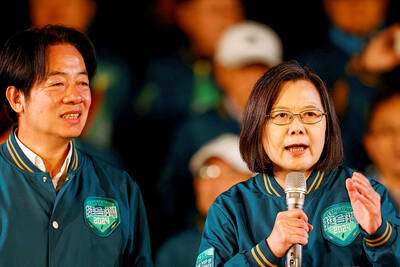
Last week Joseph Nye, the well-known China scholar, wrote on the Australian Strategic Policy Institute’s website about how war over Taiwan might be averted. He noted that years ago he was on a team that met with then-president Chen Shui-bian (陳水扁), “whose previous ‘unofficial’ visit to the US had caused a crisis in which China fired missiles into the sea and the US deployed carriers off the coast of Taiwan.” Yes, that’s right, mighty Chen caused that crisis all by himself. Neither the US nor the People’s Republic of China (PRC) exercised any agency. Nye then nostalgically invoked the comical specter
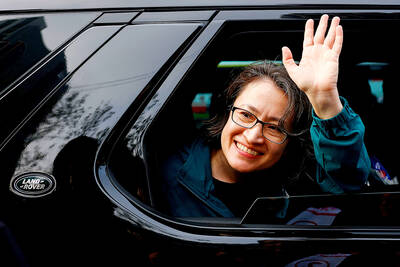
Relations between Taiwan and the Czech Republic have flourished in recent years. However, not everyone is pleased about the growing friendship between the two countries. Last month, an incident involving a Chinese diplomat tailing the car of vice president-elect Hsiao Bi-khim (蕭美琴) in Prague, drew public attention to the People’s Republic of China’s (PRC) operations to undermine Taiwan overseas. The trip was not Hsiao’s first visit to the Central European country. It was meant to be low-key, a chance to meet with local academics and politicians, until her police escort noticed a car was tailing her through the Czech capital. The
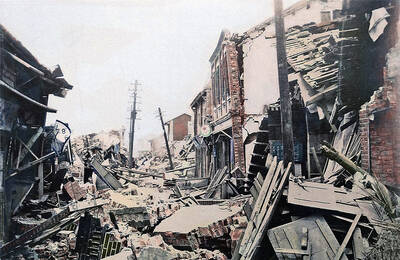
April 15 to April 21 Yang Kui (楊逵) was horrified as he drove past trucks, oxcarts and trolleys loaded with coffins on his way to Tuntzechiao (屯子腳), which he heard had been completely destroyed. The friend he came to check on was safe, but most residents were suffering in the town hit the hardest by the 7.1-magnitude Hsinchu-Taichung Earthquake on April 21, 1935. It remains the deadliest in Taiwan’s recorded history, claiming around 3,300 lives and injuring nearly 12,000. The disaster completely flattened roughly 18,000 houses and damaged countless more. The social activist and

Over the course of former President Ma Ying-jeou’s (馬英九) 11-day trip to China that included a meeting with Chinese Communist Party (CCP) leader Xi Jinping (習近平) a surprising number of people commented that the former president was now “irrelevant.” Upon reflection, it became apparent that these comments were coming from pro-Taiwan, pan-green supporters and they were expressing what they hoped was the case, rather than the reality. Ma’s ideology is so pro-China (read: deep blue) and controversial that many in his own Chinese Nationalist Party (KMT) hope he retires quickly, or at least refrains from speaking on some subjects. Regardless


 RSS
RSS