


About a dozen years ago, the Rough Guides and Lonely Planet series of travel books, rival bibles for the footloose and fancy free, crossed a new frontier onto the Internet. But they found their road maps to the digital future hard to read.
Guidebooks were soon overtaken online by Internet-era upstarts like TripAdvisor.com, which draws content from volunteer contributors and revenue from links to online reservations systems and advertising.
Now travel publishers are trying to catch up. They are moving more of their work onto the Internet and extending their content and brands into new areas like mobile services, in-flight entertainment systems and satellite navigation devices. Travel books are getting a makeover, too.
NY TIMES NEWS SERVICE
And the recent acquisition by BBC Worldwide, the commercial arm of the British Broadcasting Corp, of a majority stake in Lonely Planet has prompted that publisher and its rivals to accelerate their search for new sources of revenue in the online world and elsewhere.
"We want to be in a position where, if the business suddenly collapses in five years, we have a plan - unlike the music industry," said Martin Dunford, publishing director of Rough Guides, which is part of the Penguin division of the media company Pearson, based in London.
So far, the digital media revolution has been much less turbulent for guidebook publishers than for record companies, which are fighting rampant online copying. Sales of travel guides, while flat in some traditionally stalwart markets like Britain, have been growing strongly in developing countries and in the US - despite a weak US dollar, which has made overseas trips more expensive for Americans.
Travel publishers sold 14.8 million books in the US last year, up 11 percent from two years ago, according to Nielsen BookScan. Still, guidebook companies may have missed an opportunity on the Internet.
TripAdvisor spotted the potential in tapping users' reviews of hotels, package trips and tourist attractions, and collecting a fee each time they click through to reserve a room, for instance, on a partner site. The site supplements users' reviews with links to sites run by guidebook publishers like Frommer's. TripAdvisor, which is owned by Expedia, does not break out financial figures separately from its parent.
TripAdvisor has clearly been a big success in reaching an Internet audience. About 3.6 percent of users of travel Web sites visit TripAdvisor in an average month, according to Nielsen Online, placing it third behind Expedia and another booking service, Orbitz. Among guidebook sites, Lonely Planet ranks first, Nielsen says.
While many travel publishers have had Web sites for a long time, some of them, along with booksellers, initially worried about cannibalizing sales of guidebooks. The easy availability of travel information online may indeed have cut into sales of guides to mainstream destinations, publishers say; Londoners traveling to Paris for the weekend are less likely than they used to be to buy an entire Lonely Planet guide to France.
But new book formats are aiming at niche interests and travelers taking short breaks on low-cost flights. Meanwhile, more guidebook content is being uploaded to the Internet, where it is often available free.
Everything that appears, for example, in the Dorling Kindersley Eyewitness Top 10 guides, which feature only the highlights of a destination, is already available online at traveldk.com, said Douglas Amrine, publisher of Dorling Kindersley travel books, another division of Penguin.
Alastair Sawday Publishing, a smaller travel publisher based in England, put all of its content, which consists mostly of hotel reviews, onto the Internet this past summer, at sawdays.co.uk. Previously, only 30 words of each review were available. Joe Green, who runs the Web site, said that the move was aimed at developing Internet advertising as a new source of revenue, to complement sales of the books and income from hotels that pay to be listed in them.
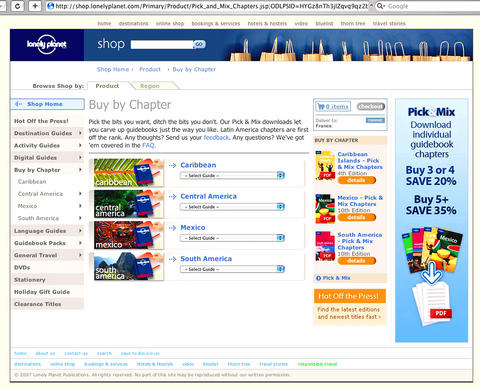
Lonely Planet plans to put all its content onto the Internet within two years, said Judy Slatyer, chief executive of the company. Not all of that content will be free, though. Over the summer, Lonely Planet began selling on its Web site, lonelyplanet.com, individual chapters from guidebooks to Latin America, pricing chapters at a few US dollars each. That way, the impulse traveler to Buenos Aires, for example, no longer needs to buy an entire book.
Slatyer said that the program would be expanded to the US this month and that other destinations would be added throughout the year. While many content owners have had difficulty getting consumers to pay for anything on the Internet, Slatyer said that sales of the chapters had exceeded expectations.
Dorling Kindersley is also trying to generate revenue directly from consumers who visit its Web site. It allows travelers to create customized guides. A group heading to Prague for a bachelor party, for instance, could assemble a list of the best bars in that city but skip information on, say, the opera.
Taking its cue from social networking services like MySpace and Facebook, Dorling Kindersley lets users share the books with other people. They can also order printed, bound copies of the customized guides for US$15.
Publishers are also making their content available in a variety of other ways. Rough Guides, for instance, has made some material available in airplane seatback entertainment systems, including those in the new Airbus A380s operated by Singapore Airlines.
Alastair Sawday Publishing recently started selling a guide to the pubs and inns of England and Wales that alerts drivers, via their satellite navigation systems, when they approach a selected watering hole or guesthouse.
Digital business still generates relatively little revenue for guidebook publishers - less than 5 percent of sales at Penguin's travel division, for example, according to executives there.
"There's been a lot of experimentation, but maybe not enough revenue coming back from digital," said Joel Rickett, deputy editor of The Bookseller, a trade publication based in London.
And publishers like Lonely Planet, which says it sells about 6.5 million books a year, are not giving up on the guidebook.
"The travel guide business, the good old-fashioned paper book, is still a strong and healthy business," Slatyer said. "And we think it will be for some time."

In late October of 1873 the government of Japan decided against sending a military expedition to Korea to force that nation to open trade relations. Across the government supporters of the expedition resigned immediately. The spectacle of revolt by disaffected samurai began to loom over Japanese politics. In January of 1874 disaffected samurai attacked a senior minister in Tokyo. A month later, a group of pro-Korea expedition and anti-foreign elements from Saga prefecture in Kyushu revolted, driven in part by high food prices stemming from poor harvests. Their leader, according to Edward Drea’s classic Japan’s Imperial Army, was a samurai

Located down a sideroad in old Wanhua District (萬華區), Waley Art (水谷藝術) has an established reputation for curating some of the more provocative indie art exhibitions in Taipei. And this month is no exception. Beyond the innocuous facade of a shophouse, the full three stories of the gallery space (including the basement) have been taken over by photographs, installation videos and abstract images courtesy of two creatives who hail from the opposite ends of the earth, Taiwan’s Hsu Yi-ting (許懿婷) and Germany’s Benjamin Janzen. “In 2019, I had an art residency in Europe,” Hsu says. “I met Benjamin in the lobby

April 22 to April 28 The true identity of the mastermind behind the Demon Gang (魔鬼黨) was undoubtedly on the minds of countless schoolchildren in late 1958. In the days leading up to the big reveal, more than 10,000 guesses were sent to Ta Hwa Publishing Co (大華文化社) for a chance to win prizes. The smash success of the comic series Great Battle Against the Demon Gang (大戰魔鬼黨) came as a surprise to author Yeh Hung-chia (葉宏甲), who had long given up on his dream after being jailed for 10 months in 1947 over political cartoons. Protagonist

Peter Brighton was amazed when he found the giant jackfruit. He had been watching it grow on his farm in far north Queensland, and when it came time to pick it from the tree, it was so heavy it needed two people to do the job. “I was surprised when we cut it off and felt how heavy it was,” he says. “I grabbed it and my wife cut it — couldn’t do it by myself, it took two of us.” Weighing in at 45 kilograms, it is the heaviest jackfruit that Brighton has ever grown on his tropical fruit farm, located


 RSS
RSS