


We have witnessed a welcomed diversity both of form and content in Taiwanese cinema over the past year as young commercial directors and emerging auteurs handed in new works catering to moviegoers of different tastes. At the commercial end of the spectrum was Jay Chou's (周杰倫) box-office success Secret (不能說的祕密) featuring the Mando-pop king himself. Exit No. 6 (六號出口) by up-and-coming filmmaker Lin Yu-hsien (林育賢) spiced up the commercial cinema with its genre-mixing storytelling about the adventure of a group of young people living in Taipei's Ximending district. Further down the line were Spider Lilies (刺青), a melodrama about lesbian love by Zero Chou (周美玲), which picked up an award in Berlin, and Lin Jing-jie's (林靖傑) Venice-winning directorial debut The Most Distant Course (最遙遠的距離). At the art house end of the spectrum was director Tsai Ming-liang's (蔡明亮) ninth film, I Don't Want to Sleep Alone (黑眼圈), an ambitious work which made it into the Taipei Times' top five films of the year, despite being slammed by last year's Golden Horse jury as self-indulgent.
I Don't Want to Sleep Alone may well be Tsai's most accessible feature to date with the return of most of his trademark motifs - the impossibility of uprooted individuals connecting with each other and their yearnings for companionship and reciprocation - blended with his personal commentary on the social underclass in a time of social unrest. The work is filled with a pronounced sense of tenderness and uncanny poetry.
Lavish colors, a bold use of light and shade, the emphasis on small gestures and evocative scenes prolonged to achieve a hypnotic effect reveal Tsai to be a consummate visual artist as well as a cinematic humanist.

PHOTO: COURTESY OF DISTRIBUTOR
Cinematographer Yao Hung-i (姚宏易), a Hou Hsiao-hsien (侯孝賢) protege, made his directorial debut feature Reflections (愛麗絲的鏡子), a visually polished attempt to capture the anomic life of the young in contemporary Taipei. It is based on the real-life story of actress and photographer Oy Gin, who used to publish a frank blog about her bisexual affairs and eccentricities - Oy is also the inspiration behind segment three of Hou's Three Times (最好的時光, 2005). The film's elaborate compositions, moody lighting, meticulous art direction and color-saturated scenes are visually arresting, although the emphasis on technical proficiency may distract from the all-too-familiar theme of the aimlessness of youth.
Screenwriter Zheng Fen-fen's (鄭芬芬) feature debut Keeping Watch (沉睡的青春) is one of the few local productions of the past year that tells a story in a simple, straightforward and engaging way. Targeting teens with the use of pop idol Joseph Chang (張孝全) and a love story with a twist, the commercial flick secured a place on the top five for its well-constructed narrative, lyric visual vocabulary, and well chosen locations, such as the secluded Pinghsi (菁桐) railway line (平溪), the old wooden train station in Chintung and the Lo Sheng Sanatorium (樂生療養院), which all play important roles in the film.
One of the reasons why the well-crafted puppy-love flick Secret puts Jay Chou on the list is the slick cinemato-graphy and atmospheric production design of its audience-wooing sugarcoated romance sequences. The other reason lies in its effective use of international investments, high production values, big-name stars and local sets. The skillful combination of these elements is rare in the marketing of Taiwan's predominantly small-budget films, and Secret should serve as a model for how to conquer Chinese-speaking markets for future productions.
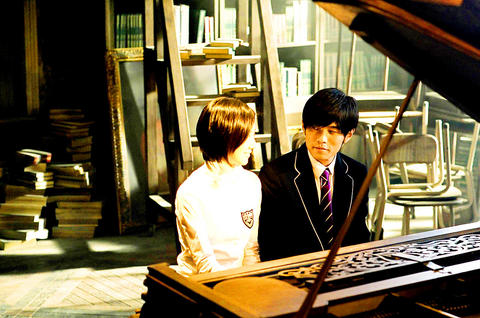
PHOTO: COURTESY OF DISTRIBUTOR
Amour-Legende (松鼠自殺事件) by emerging auteur Wu Mi-sen (吳米森) is possibly the most underrated film of the year as distributors shied away from the marketing nightmare - art house movie tricked up as a commercial flick. Featuring Japanese pop idol Yowusuke Kubozuka and Hong Kong beauty Rachel Ngan (顏穎思), the polyglot film shows many of Wu's trademarks along with a serious attempt to reach a larger audience. It's fragmented reality, blurred identities and dreamlike sequences make for a fascinating composition that reflects on the deceptiveness of relationships and the nature of both personal and national identity.
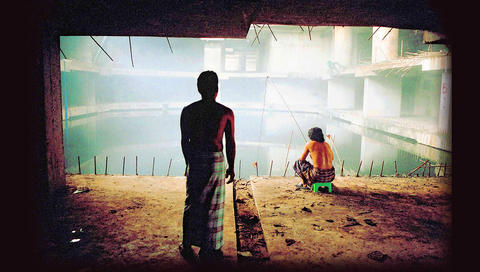
PHOTO: COURTESY OF DISTRIBUTOR
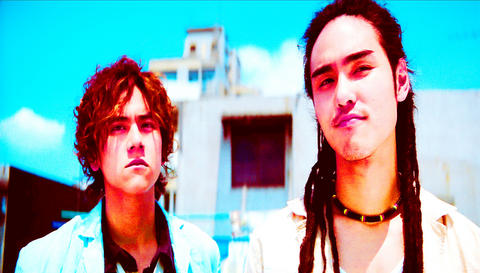
PHOTO: COURTESY OF DISTRIBUTOR

PHOTO: COURTESY OF DISTRIBUTOR

In late October of 1873 the government of Japan decided against sending a military expedition to Korea to force that nation to open trade relations. Across the government supporters of the expedition resigned immediately. The spectacle of revolt by disaffected samurai began to loom over Japanese politics. In January of 1874 disaffected samurai attacked a senior minister in Tokyo. A month later, a group of pro-Korea expedition and anti-foreign elements from Saga prefecture in Kyushu revolted, driven in part by high food prices stemming from poor harvests. Their leader, according to Edward Drea’s classic Japan’s Imperial Army, was a samurai

The following three paragraphs are just some of what the local Chinese-language press is reporting on breathlessly and following every twist and turn with the eagerness of a soap opera fan. For many English-language readers, it probably comes across as incomprehensibly opaque, so bear with me briefly dear reader: To the surprise of many, former pop singer and Democratic Progressive Party (DPP) ex-lawmaker Yu Tien (余天) of the Taiwan Normal Country Promotion Association (TNCPA) at the last minute dropped out of the running for committee chair of the DPP’s New Taipei City chapter, paving the way for DPP legislator Su
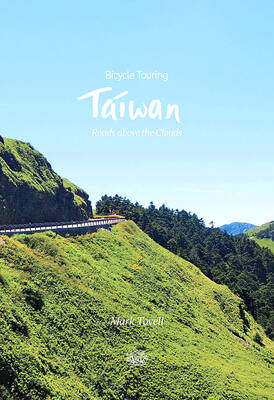
It’s hard to know where to begin with Mark Tovell’s Taiwan: Roads Above the Clouds. Having published a travelogue myself, as well as having contributed to several guidebooks, at first glance Tovell’s book appears to inhabit a middle ground — the kind of hard-to-sell nowheresville publishers detest. Leaf through the pages and you’ll find them suffuse with the purple prose best associated with travel literature: “When the sun is low on a warm, clear morning, and with the heat already rising, we stand at the riverside bike path leading south from Sanxia’s old cobble streets.” Hardly the stuff of your
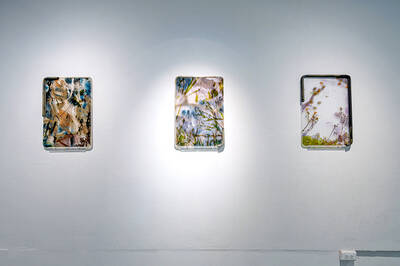
Located down a sideroad in old Wanhua District (萬華區), Waley Art (水谷藝術) has an established reputation for curating some of the more provocative indie art exhibitions in Taipei. And this month is no exception. Beyond the innocuous facade of a shophouse, the full three stories of the gallery space (including the basement) have been taken over by photographs, installation videos and abstract images courtesy of two creatives who hail from the opposite ends of the earth, Taiwan’s Hsu Yi-ting (許懿婷) and Germany’s Benjamin Janzen. “In 2019, I had an art residency in Europe,” Hsu says. “I met Benjamin in the lobby


 RSS
RSS