


It was at the top of a trail called Hanging Tree that the fear set in. And at the crest of a steep, mogul-filled and tree-strewn trail, it's all about the fear, isn't it? This was near the top of Aspen Mountain last winter, and at moments like these - surveying a no-nonsense double-black-diamond run - the mind will race.
Here was my central thought: Who names a trail Hanging Tree? OK, so that noose playfully dangling from a tree near the trail entrance might be a tip-off, but what exactly are they trying to tell me here?
For a large sector of the skiing public, the message is clear: Go away, you don't belong.
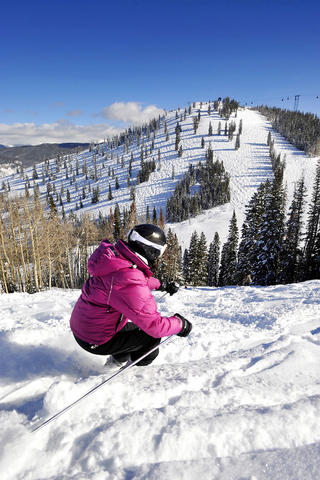
PHOTO: NY TIMES NEWS SERVICE
And people listen. It's not about one Aspen trail, it's about a disquieting reality at any major ski resort - 80 percent of the skiers use only 20 percent of the mountain. The blue-square groomers are packed, while the mogul and tree runs are empty. There are a few reasons for this, including the advent of terrain parks and halfpipes that have lured away a lot of young talent.
But there is a bigger factor. The baby boom generation, which created the American ski craze of the 1960s and 1970s, has grown averse to risk. Resorts ought to rename every intermediate cruising trail in the country the 401(k). Because the more you have invested in a retirement account, the more likely that's the trail you'll be on.
Joe Nevin, a 61-year-old Aspen ski instructor, knows the story. He's heard it over and over on Aspen's lifts, talking with middle-age skiers.
"It's kind of the forgotten society of skiing," he said. "They look in the ski magazines, and the stories and pictures are about cliff jumping. They don't want to fly in the air. They don't want to end up in physical therapy. And if they see somebody in the moguls, it's always some 20-year-old banging through the course with his knees in his face. They know that's not for them, either.
Five years ago, Nevin decided to do something with all the information he had acquired during those chairlift rides. He devised a pioneering instruction program aimed at those born between 1946 and 1964 called Bumps for Boomers. In three days of lessons, Nevin erases the fear and, without demanding young, quick reflexes or extraordinary agility, teaches his students to confidently ski black-diamond, even double-black-diamond, mogul runs.
And it works. Nevin's program, which costs US$840 for a three-day session, has turned hundreds of former boomer-groomers into mogul and glade skiers. It is now one of the most popular specialized instruction programs offered by the Aspen Skiing Company, with students flying in from around the country weekly from the middle of December through March. Reservations are required (www.bumpsforboomers.com).
"It's not a gimmick," said Rose Ries, a 51-year-old psychiatrist from Philadelphia who has taken the Bumps for Boomers course. "I was the classic devoted skier who, nonetheless, had no chance in the moguls. Now, tree and mogul runs are the only place I go. I don't even bother with groomers."
Nevin's program is one of several sprouting around the nation, like Mermer Blakeslee's Power Learn programs at Windham Mountain in New York (www.windhammountain.com) and the Prime Time classes at Breckenridge in Colorado (www.breckenridge.snow.com), which is aimed at those 50 and older. At nearby Vail Mountain (www.vail.snow.com), there are masters camps geared to adults. The programs are finding a following because they offer hope to a vast generation searching for something to rejuvenate their skiing. "There are a million kids' instruction programs, but they're not the only people we should be helping get better," said Nevin, a former Silicon Valley executive and longtime weekend ski instructor who settled in Aspen several years ago.
Perhaps to prove that his techniques are suitable for any age, Nevin only employs middle-age coaches, who work in groups no larger than four. The connection is obvious. The program also attracts a lot of couples.
"Typically, the husband calls, and after a lot hemming and hawing, says, 'I'm an expert skier but my wife isn't, so can we take the program together?'" Nevin said with a snicker.
Harvey Federman, 71, enrolled in Bumps for Boomers with his 59-year-old wife, Carol.
"We both got better, and it's going to extend how long we can keep skiing," said Federman, who lives near Boston. "I have so many friends who have just given up skiing because they're afraid to get hurt. We are more brittle and the trees are intimidating, but you can learn to slow down. You ski better, and it's fun, too."
Federman said he was recently skiing with his 46-year-old son when they came upon a massive mogul field.
"My son is a great skier, and he blazed down the trail, but after about 20 turns he had to stop," Federman said. "Using the technique Joe Nevin taught me, I just kept making my controlled turns and I went right past him until I stopped at the bottom.
"My son just looked at me and said, 'Wow.'"

Last week Joseph Nye, the well-known China scholar, wrote on the Australian Strategic Policy Institute’s website about how war over Taiwan might be averted. He noted that years ago he was on a team that met with then-president Chen Shui-bian (陳水扁), “whose previous ‘unofficial’ visit to the US had caused a crisis in which China fired missiles into the sea and the US deployed carriers off the coast of Taiwan.” Yes, that’s right, mighty Chen caused that crisis all by himself. Neither the US nor the People’s Republic of China (PRC) exercised any agency. Nye then nostalgically invoked the comical specter

Relations between Taiwan and the Czech Republic have flourished in recent years. However, not everyone is pleased about the growing friendship between the two countries. Last month, an incident involving a Chinese diplomat tailing the car of vice president-elect Hsiao Bi-khim (蕭美琴) in Prague, drew public attention to the People’s Republic of China’s (PRC) operations to undermine Taiwan overseas. The trip was not Hsiao’s first visit to the Central European country. It was meant to be low-key, a chance to meet with local academics and politicians, until her police escort noticed a car was tailing her through the Czech capital. The
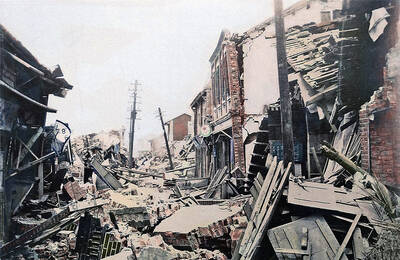
April 15 to April 21 Yang Kui (楊逵) was horrified as he drove past trucks, oxcarts and trolleys loaded with coffins on his way to Tuntzechiao (屯子腳), which he heard had been completely destroyed. The friend he came to check on was safe, but most residents were suffering in the town hit the hardest by the 7.1-magnitude Hsinchu-Taichung Earthquake on April 21, 1935. It remains the deadliest in Taiwan’s recorded history, claiming around 3,300 lives and injuring nearly 12,000. The disaster completely flattened roughly 18,000 houses and damaged countless more. The social activist and

Over the course of former President Ma Ying-jeou’s (馬英九) 11-day trip to China that included a meeting with Chinese Communist Party (CCP) leader Xi Jinping (習近平) a surprising number of people commented that the former president was now “irrelevant.” Upon reflection, it became apparent that these comments were coming from pro-Taiwan, pan-green supporters and they were expressing what they hoped was the case, rather than the reality. Ma’s ideology is so pro-China (read: deep blue) and controversial that many in his own Chinese Nationalist Party (KMT) hope he retires quickly, or at least refrains from speaking on some subjects. Regardless


 RSS
RSS