


No Spanish child would question that presents are an inseparable part of Christmas, but who should bring them, the Three Kings or Father Christmas?
The Spanish tradition of the Three Kings (Reyes Magos, literally “king-magicians”) is increasingly being challenged by the Anglo-Saxon and northern European Father Christmas.
Many Spaniards consider Father Christmas a commercial US invention, but he has an advantage over the Three Kings in that his earlier timetable allows children to enjoy their presents over the Christmas holidays.
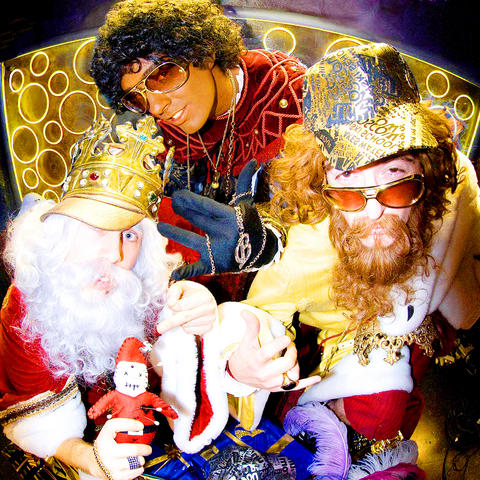
PHOTOS: DPA
Traditionally, Spaniards give Christmas presents on Jan. 6 after watching glittering processions of the Three Kings the previous evening.
Black Baltasar, white-bearded Melchor and red-haired Gaspar represent kings and astrologers who are believed to have come to pay their respects to the new-born Jesus, bringing him gifts.
Naughty children, however, are only given a black sweet called coal, according to the Spanish tradition.
The camel-riding kings have been part of the Spanish Christmas for centuries, and it is only in the 1950s that US soldiers stationed in Spain began popularizing Father Christmas, Papa Noel in Spanish.
The figure also known as Santa Claus is believed to be based on that of the 4th-century bishop Nicholas and on northern European folk traditions.
The white-bearded old man dressed in red rides across the sky in a sledge pulled by reindeer in a snowy landscape, something that hardly fits in with Spain's warmer climate.
The increasing popularity of Father Christmas has been accompanied by another import, the Christmas tree.
The real or more often plastic fir tree now competes with the traditional Spanish Nativity scenes comprising miniature statues showing the baby Jesus surrounded by Mary, Joseph, shepherds, kings and other Biblical characters.
Spain's Catholic Church initially criticized Father Christmas and the Christmas tree as Protestant intrusions.
Today, Spaniards no longer look down on Father Christmas for religious reasons, but as “an invention of Coca-Cola,” because of his use in advertising campaigns.
Father Christmas does, however, have an undeniable advantage over the Three Kings. He comes on Christmas Eve, Dec. 24, leaving children more time to enjoy their presents before school begins.
People dressed as Father Christmas can now be seen distributing leaflets on streets and in shopping centers, and many Spaniards hang Papa Noel dolls from their windows as a Christmas decoration, often alongside dolls representing the Three Kings.
“The kings are an example of multiracialism, while Father Christmas is a product of consumerism,” one participant wrote in an Internet discussion on the advantages and disadvantages of both traditions.
“Both are a part of the Christian tradition,” another countered.
“The magic of the kings is deep in my heart,” one commentator wrote, and the kings are now fighting back. A Madrid advertising agency launched an anti-Father Christmas campaign, with a Web site showing a Papa Noel voodoo doll “to give him what he deserves.”
“Who the hell are you?” three rapping kings wearing sunglasses and fancy hats sing to Father Christmas on a video clip, accusing him of “exploiting elves” at his gift factory. “You think you are riding high and your pyjamas were designed by Coca-Cola,” the song goes.
Most Spanish families, however, ignore the controversy. Nearly 60 percent of them gave presents only on Jan. 6, according to a poll done in the late 1990s, but Father Christmas has gained ground since then.
“The families of most my friends give gifts on both days,” a 15-year-old girl says.

In late October of 1873 the government of Japan decided against sending a military expedition to Korea to force that nation to open trade relations. Across the government supporters of the expedition resigned immediately. The spectacle of revolt by disaffected samurai began to loom over Japanese politics. In January of 1874 disaffected samurai attacked a senior minister in Tokyo. A month later, a group of pro-Korea expedition and anti-foreign elements from Saga prefecture in Kyushu revolted, driven in part by high food prices stemming from poor harvests. Their leader, according to Edward Drea’s classic Japan’s Imperial Army, was a samurai

The following three paragraphs are just some of what the local Chinese-language press is reporting on breathlessly and following every twist and turn with the eagerness of a soap opera fan. For many English-language readers, it probably comes across as incomprehensibly opaque, so bear with me briefly dear reader: To the surprise of many, former pop singer and Democratic Progressive Party (DPP) ex-lawmaker Yu Tien (余天) of the Taiwan Normal Country Promotion Association (TNCPA) at the last minute dropped out of the running for committee chair of the DPP’s New Taipei City chapter, paving the way for DPP legislator Su
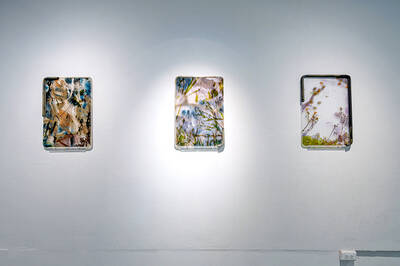
Located down a sideroad in old Wanhua District (萬華區), Waley Art (水谷藝術) has an established reputation for curating some of the more provocative indie art exhibitions in Taipei. And this month is no exception. Beyond the innocuous facade of a shophouse, the full three stories of the gallery space (including the basement) have been taken over by photographs, installation videos and abstract images courtesy of two creatives who hail from the opposite ends of the earth, Taiwan’s Hsu Yi-ting (許懿婷) and Germany’s Benjamin Janzen. “In 2019, I had an art residency in Europe,” Hsu says. “I met Benjamin in the lobby
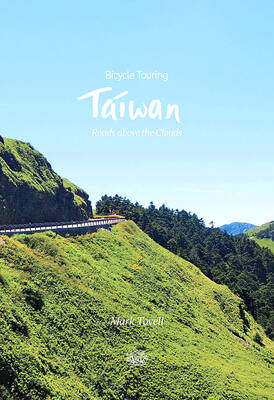
It’s hard to know where to begin with Mark Tovell’s Taiwan: Roads Above the Clouds. Having published a travelogue myself, as well as having contributed to several guidebooks, at first glance Tovell’s book appears to inhabit a middle ground — the kind of hard-to-sell nowheresville publishers detest. Leaf through the pages and you’ll find them suffuse with the purple prose best associated with travel literature: “When the sun is low on a warm, clear morning, and with the heat already rising, we stand at the riverside bike path leading south from Sanxia’s old cobble streets.” Hardly the stuff of your


 RSS
RSS