


Victor Chou is obsessed with the hotel industry. The veteran hotelier has seen Taiwan grow from attracting mainly businesspeople working in the IT industry into a tourist destination that expects to top five million visitors by 2008.
Along the way, Chou has played host to some of the world's most powerful people and famous celebrities, written a book and taken up a teaching post at a local university. Though he has to deal the rich and famous and grade papers, the crunch comes daily at 3am when he talks with his boss overseas.
"My chairman says to me, 'Victor, if you don't reach your target this year, you will be sent off to Moscow,'" he said in an interview with the Taipei Times.
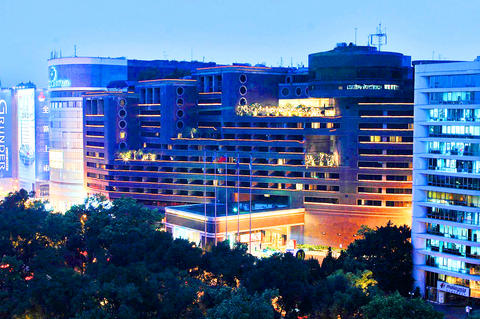
PHOTO: COURTESY OF SUNWORLD DYNASTY HOTEL
He isn't planning on leaving any time soon. Chou, like some of Taiwan's other most experienced hoteliers, helped create the country's hospitality industry. He was brought in last year by Sunrider Group chairman Chen Te-fu (陳得福) to turn around the fortunes of the 27-year-old Sunworld Dynasty Hotel (王朝大酒店), which is about to undergo a NT$2 billion renovation of its 738 guest rooms.
The multilingual Chou — he's fluent in English, Mandarin and Hoklo, and can get by in Japanese and Cantonese — has been general manager of some of Taiwan's top hotels including the Lai Lai Hotel (來來大飯店, now known as the Sheraton Hotel), Sherwood Hotel (西華飯店) and Ta Shee Resort (鴻禧大溪別館).
"Before I joined the hotel industry, Taiwan was not really a tourist spot. We didn't have many resources so we needed aggressive support and assistance from our neighbors, like Japan and Korea. And the US," Chou said.
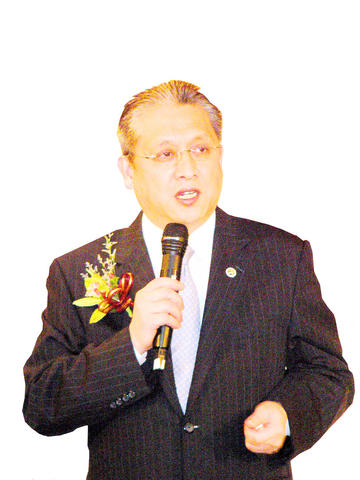
PHOTO: COURTESY OF SUNWORLD DYNASTY HOTEL
He sees 1976 as the year Taiwan's tourist industry got off the ground: "We didn't have enough hotel rooms to accommodate all the people coming to Taiwan."
Today, however, there aren't enough tourists or businesspeople to fill the rooms because the market is saturated with hotels.
Taiwan's tourism industry — and the island's infrastructure to accommodate it — developed from nothing to "30 five-star hotels," Chou said.

PHOTO: COURTESY OF SUNWORLD DYNASTY HOTEL
"The development and growth of hotels over the past 20 years shows that many people see Taiwan not only as a destination for doing business but also for leisure. In 1997, there were two million [people coming to Taiwan]. By 2006, there were 3.6 million people," he said. "There is tremendous growth."
Though the number of travelers visiting Taiwan has increased, the country still pales in comparison to Singapore and Hong Kong. Chou thinks the government's target of 5 million visitors by 2008 is unattainable.
He says the single biggest problem facing the tourism industry in Taiwan is the lack of international marketing.
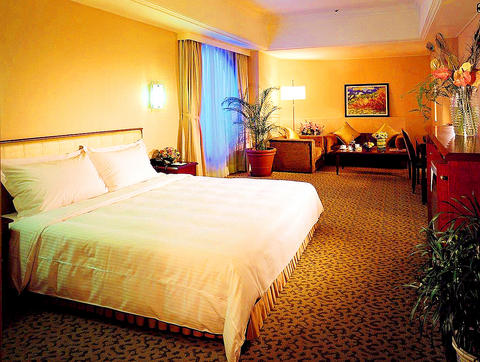
PHOTO: COURTESY OF SUNWORLD DYNASTY HOTEL
"When I was at the Sheraton, 3.5 percent of the total revenue was spent on marketing. But … this is more than the annual budget of the Tourism Bureau. So how does it promote Taiwan?" Chou said.
"We need to get the word out. [Taiwan] should follow the example of Malaysia and create an international advertising promotion program on CNN, like 'Malaysia Truly Asia.' [South] Korea also has its own ads that are seen throughout the world."
Advertising to an international audience, he says, is the only way Taiwan is going to be discovered by the world and that process needs to begin with the government.
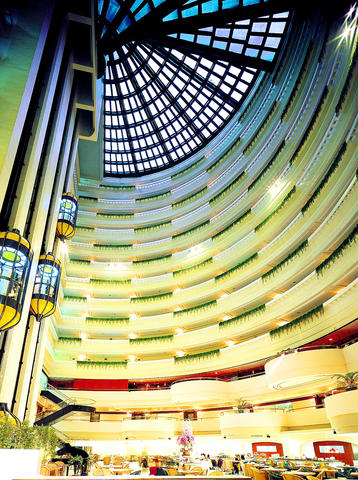
PHOTO: COURTESY OF SUNWORLD DYNASTY HOTEL
Chou places himself in the context of a number of scholars, bureaucrats and businessmen who studied abroad during the 1970s and 1980s, then returned to Taiwan to develop the island's tourism industry.
"Only since the 1980s have we started to promote Taiwan as a leisure destination," he said.
Though he's never run a hotel overseas, Chou travels extensively to keep abreast of the latest developments in the hotel industry. His hectic schedule — Chou, like most general managers, lives in the hotel that he runs — also meant he had little time for anything else. That changed, however, in 2000 when he underwent surgery for a stomach ailment.
"That was the very first time that I had nothing to do and I was in Taida (National Taiwan University) hospital. I had time to write a book." Describing the experience as cathartic, Chou took the chance to reflect on his life and accomplishments.
The fruit of his labor, Five Star Diploma (五星級文憑), chronicles the development of Taiwan's tourism industry. Sprinkled with anecdotes and information culled from his 30 years of experience in the hotel industry, the work includes chapters on the history of the industry and managing a hotel.
After the book was published, Chou was invited to teach an International Tourism course at Tamkang University, as part of its international business program.
While teachers in other disciplines lament the faltering abilities of their students, Chou only has praise for his: "In the past the students only listened to what their teachers told them to do. Now the teacher tells them to do something and the student thinks it's bullshit. They want their own space to create. My students are very good."
By many measures, the three-year English-only program, which includes a year of study in abroad, has been a success. Students from the first graduating class were all hired straight out of school.
Chou says the program's success is an example of how the tourism industry is catching up to international standards.
"Creativity. That's the key now, and I always tell my management, 'you always have to think about change and never stop learning new ideas,'" he said.

In late October of 1873 the government of Japan decided against sending a military expedition to Korea to force that nation to open trade relations. Across the government supporters of the expedition resigned immediately. The spectacle of revolt by disaffected samurai began to loom over Japanese politics. In January of 1874 disaffected samurai attacked a senior minister in Tokyo. A month later, a group of pro-Korea expedition and anti-foreign elements from Saga prefecture in Kyushu revolted, driven in part by high food prices stemming from poor harvests. Their leader, according to Edward Drea’s classic Japan’s Imperial Army, was a samurai
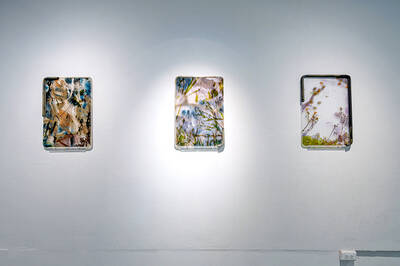
Located down a sideroad in old Wanhua District (萬華區), Waley Art (水谷藝術) has an established reputation for curating some of the more provocative indie art exhibitions in Taipei. And this month is no exception. Beyond the innocuous facade of a shophouse, the full three stories of the gallery space (including the basement) have been taken over by photographs, installation videos and abstract images courtesy of two creatives who hail from the opposite ends of the earth, Taiwan’s Hsu Yi-ting (許懿婷) and Germany’s Benjamin Janzen. “In 2019, I had an art residency in Europe,” Hsu says. “I met Benjamin in the lobby
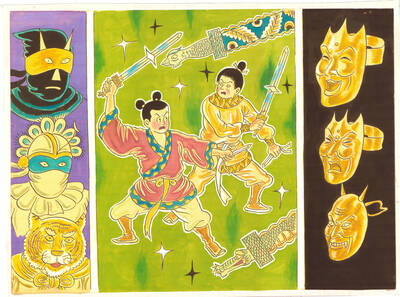
April 22 to April 28 The true identity of the mastermind behind the Demon Gang (魔鬼黨) was undoubtedly on the minds of countless schoolchildren in late 1958. In the days leading up to the big reveal, more than 10,000 guesses were sent to Ta Hwa Publishing Co (大華文化社) for a chance to win prizes. The smash success of the comic series Great Battle Against the Demon Gang (大戰魔鬼黨) came as a surprise to author Yeh Hung-chia (葉宏甲), who had long given up on his dream after being jailed for 10 months in 1947 over political cartoons. Protagonist

The following three paragraphs are just some of what the local Chinese-language press is reporting on breathlessly and following every twist and turn with the eagerness of a soap opera fan. For many English-language readers, it probably comes across as incomprehensibly opaque, so bear with me briefly dear reader: To the surprise of many, former pop singer and Democratic Progressive Party (DPP) ex-lawmaker Yu Tien (余天) of the Taiwan Normal Country Promotion Association (TNCPA) at the last minute dropped out of the running for committee chair of the DPP’s New Taipei City chapter, paving the way for DPP legislator Su


 RSS
RSS