


"If something tragic happened to my adopted daughter I'd be devastated, but I wouldn't die. If something happened to either of my two boys who I gave birth to, I feel I would die," says Tina Pattie. "I don't love my daughter any less, but it's a different kind of love. With my sons, my love is set in stone. It's that ‘die for you love' that would never change, no matter what. With Cheri, it's a love that develops and grows. It's more of a process than an absolute."
Ask most adopters whether they think their love for their children is any different than it would be if they had their own offspring, and you can generally expect a resounding no. Very likely, they'll be offended it even crossed your mind. But in families such as Tina's — where there are both biological and non-biological children — it's a question that is put to the test. It's a question that gets to the very heart of what it means to be a parent.
"I don't care how close you are to your adopted son or beloved stepdaughter, the love you have for your non-biological child isn't the same as the love you have for your own flesh and blood," wrote Rebecca Walker in her recent book, Baby Love. "Yes, I would do anything for my first [non-biological] son, within reason. But I would do anything at all for my second [biological] child without reason, without a doubt," added the estranged daughter of the prize-winning author Alice Walker.
Her comment has attracted much controversy, but Tina relates to it. She had always wanted three children, so when she was told it could jeopardize her health to have a third baby naturally, she persuaded her husband to adopt. Her preference was for a baby, but none was available and they were offered a little girl five weeks off her fourth birthday.
"I was totally and absolutely shocked to find that in the early years, I felt no love at all for her," recalls Tina. "It didn't even feel right to say she was my daughter. The word ‘daughter' describes a relationship, a connection — things we didn't have."
There was no one point at which Tina began to love Cheri, now 17. "It was a drip, drip, drip kind of process. Now, I love her a lot. I'm really proud of her and close to her, but it has taken time," she says.
PHOTO: AFP
Pttie has spent a lot of time "unpacking" the disparity in her feelings for her children. "I think there are several things going on. First, she wasn't a newborn baby, like my sons had been. There's nothing quite like a newborn baby. Second, when you get a stranger in your house, you're not going to love it straight away, you're just not.
Then there was the fact that Cheri was a hugely damaged and difficult child. Even now, I wonder that if she'd been sweet and easy instead of angry and violent whether it would have been different. Instead, I turned from a calm, patient mother into a monster. I'd never felt rage like that, ever. But even in the blackest moments, when there was no connection between us at all, there was never a question that I would give up."
Mary Cooper did adopt a newborn baby, but she too found it difficult to use the word "daughter" in the early days. "This was 37 years ago, when I was a psychiatric social worker and had my own three-year-old son. It was assumed I'd know it all, but I was not prepared for the difference between giving birth and adopting," she says. "You don't have nine months to prepare, you don't go through the birth and you don't breastfeed. I was completely a nurture not a nature person — I didn't think nature mattered — but I've changed my mind. I wasn't aware of the differences that I would feel or that Louise would feel as a result of us not sharing any genes. With my son, there was an instant bond. With Louise, there wasn't and every way you turned, it seemed she was different to us. If we had brown sugar, she wanted white. If I cooked something, she wanted (an instant microwave meal) ... . I don't love either of my children more than the other, but the nature of the relationship is poles apart."
Unfortunately, Louise did not interpret it in this way as she was growing up. "I felt like my brother was the golden boy and that I was the black sheep and I felt less loved than him because of it," she says. "In fact, it wasn't until I was 27 that I told anyone I was adopted. I was ashamed of it before then. But then I started thinking about finding my real mother, which I did, and somehow that journey made me realize that my parents didn't love me less, just differently. Now I speak to my mom every day on the phone. We're so different, it's unbelievable, but we both accept those differences now and we're very close."
With the benefit of hindsight, Louise realizes she didn't make it easy for her parents to love her. "Having decided I was the black sheep, I wound up ostracizing myself," she says.
Nancy Verrier, author and publisher of The Primal Wound: Understanding the Adopted Child, believes that all children who are separated from their mother suffer a trauma that will affect their bond with their new parents, regardless of the age at which they enter that new family. "I wouldn't say that I love my adopted daughter or my biological daughter differently — I would do just about anything for either of them — but I would definitely say the bond is different and I know now that is inevitable," she says. "An adopted child has had their bond with their mother broken once, so they're not going to let it happen again."
For many children, this manifests itself in testing-out behavior, she says. Even if this kind of child is adopted as a baby, they tend to keep a psychological distance. Because they never quite fold into the new mother when she cuddles them, the phenomenon has become known as the stiff-arm baby. At the other end of the spectrum is what's known as the Velcro baby. These children react to the fear of their new mother leaving by being very clingy.
If anyone had told Nancy when she brought home her three-day-old daughter that rearing an adopted child would be different from rearing a biological child, she says she would have laughed at them.
"I thought, ‘Of course it won't be different! What can a tiny baby know?' Now I know it's nonsense for anyone to suggest the bond can be the same. We are tuned in hormonally to what our natural children want. Psychologically, the mother and child are still at one for some time even when the umbilical cord is cut. Genes continue to play a major part in the relationship throughout life. The way you cock an eyebrow, how you stand or walk, gestures you make — all these are things that make children feel as if they belong. But because a lot of people don't expect adoption to be different, they can feel shock, hurt and resentment when their adopted child doesn't react to them in the way they'd like them to."
Some parents try to compensate for this loss. Bill Aldridge, who has three adopted and two natural children in their 20s and 30s, says, "There was always a sense for us that our adopted children required additional love to make up for the extra challenges they'd faced. I wouldn't say we loved them more, but our feelings for them were combined with an overriding desire to make everything all right. I think we were more overt with our love for them than we were with our own kids, certainly while they were growing up."
Bella Ibik, who grew up in a family of five birth children and four adopted children, says her parents also went out of their way to make the adopted ones feel special. "We were made to feel chosen, as opposed to the others who just came along — to the point that one of their biological children grew up with a bit of a chip on her shoulder," she says.
Bella, now 41, says she still feels surprised by how much her mother loves her, and still has a need from time to time to examine the differences in her mother's feelings for all her children. "Yesterday we commemorated the 23rd anniversary of my brother's death. He was one of her blood children and I often wondered whether she'd have preferred it had it not been one of her birth children. We talk about everything, so I asked her and she answered as honestly and diplomatically as she could. She said that no mother would ever wish death on any of her children, but that when I saw her cradling his head and talking to him when he was in his coffin — a childhood image I will never forget — she was thinking of it having grown inside her and she was thinking of giving birth to him."
Bella isn't convinced that whether her siblings were adopted or not is the be-all-and-end-all in the nature of their relationship with their mother, however: "Evie, her youngest, is her absolute golden child who can do no wrong. I'm sure that's because she came along just after my mother had been very ill and she sees her as her anchor in the storm. My point is that sometimes I think it's impossible to pull out adoption as being the only reason for a parent feeling differently towards her children. There are so many other variables."
Carol Burniston, a consultant clinical child psychologist, believes that the requirement for adopters to parent therapeutically gives a tiny minority of them a psychological get-out clause, which again affects the nature of their relationship with their children.
"I worked with one adoptive mother who was suffering from a problematic home life who said, ‘If it comes to it, I'll keep my children and let my marriage go.' You would expect a parent of a biological child to say that, but for an adopter there was something very powerful about it. With a small number of adopters, there is something going on in the back of their minds that if they can't bear it any longer, they will give these children up."
Indeed, an estimated one in five adoptions in the UK breaks down before the adoption order is granted. Conversely, of course, that means that 80 percent last the distance — at least until after then — and for Lisa Bentley, who adopted a troubled 14-year-old when she already had four birth children, there was never a moment when she thought about giving up.
"In fact, I'd say that the love I have for her is strong and powerful — more so in a way than for my birth children — because there's nothing taken-for-granted about it," she says. "It's come from getting through enormous battles and from an undying commitment," she says. Her bond with her natural children is fluid and easy; her relationship with her non-biological daughter is more intense and tested.
Angela Maddox believes that the relationship between parents and non-biological children has more chance of being positive if any birth children arrive later. "We adopted three boys, now aged 22, 20 and 19, and when we later had two birth children unexpectedly — now aged 16 and 11 — the feeling of almost knowing your child before it's born took me by surprise. But I think the fact that the boys were already in our family helped them feel more secure than if it was the other way round. They had us first."
Angela says that while her husband relates to Rebecca Walker's philosophy, she doesn't. "My love is endless for all my children. You can love any child as your own. There was the different feeling around the birth, but that's all."
A few parents even believe that giving birth is irrelevant in the bonding process. Unusually, Molly Morris — who has given birth to five children and adopted two — says, "I've never been able to make a distinction between children born to us and those we adopted. It's the nursing and handling, not the giving birth, that has given me the bond with my children. I'm not sure I really understand people that don't share that view."
Pam Hall disagrees. "There's something almost beyond words about the attachment you feel for your own baby. That's not to say you can't love another baby or child, but it's quite a different quality of love. I think parents who have given birth already are usually — although not always — better placed to work at a relationship with a non-biological child because they've been through that. They don't go through life longing for it," says Pam, who has two birth children and an adopted child in their late 30s.
Pam, who has worked with adoptive families as a psychiatric social worker and an analytical psychotherapist, explains that parents who have had birth children tend to have a different motivation for adopting than those who haven't. "They generally aren't starting the process of adoption from a position of infertility, looking for a substitute for their own baby."
That's not to say it's always an easy ride. "I've worked with adopters who have been racked with guilt that they didn't have the same feelings for their adopted child. But that's all the more reason that we should stop this pretence that adopting is the same as having your own children. I'm not suggesting anyone should outline every detail of that difference to their children. That would be dire. But they do need to own the feeling and be OK with it."
Lucy Hoole, a 25-year-old adoptee, agrees. "There is something quite taboo about suggesting that parents feel differently to non-biological children. But I'm OK with that difference, and see it as part of my life story that's made me who I am. I wish it would be talked about more openly."
Some names have been changed.

In late October of 1873 the government of Japan decided against sending a military expedition to Korea to force that nation to open trade relations. Across the government supporters of the expedition resigned immediately. The spectacle of revolt by disaffected samurai began to loom over Japanese politics. In January of 1874 disaffected samurai attacked a senior minister in Tokyo. A month later, a group of pro-Korea expedition and anti-foreign elements from Saga prefecture in Kyushu revolted, driven in part by high food prices stemming from poor harvests. Their leader, according to Edward Drea’s classic Japan’s Imperial Army, was a samurai

Approaching her mid-30s, Xiong Yidan reckons that most of her friends are on to their second or even third babies. But Xiong has more than a dozen. There is Lucky, the street dog from Bangkok who jumped into a taxi with her and never left. There is Sophie and Ben, sibling geese, who honk from morning to night. Boop and Pan, both goats, are romantically involved. Dumpling the hedgehog enjoys a belly rub from time to time. The list goes on. Xiong nurtures her brood from her 8,000 square meter farm in Chiang Dao, a mountainous district in northern Thailand’s

Located down a sideroad in old Wanhua District (萬華區), Waley Art (水谷藝術) has an established reputation for curating some of the more provocative indie art exhibitions in Taipei. And this month is no exception. Beyond the innocuous facade of a shophouse, the full three stories of the gallery space (including the basement) have been taken over by photographs, installation videos and abstract images courtesy of two creatives who hail from the opposite ends of the earth, Taiwan’s Hsu Yi-ting (許懿婷) and Germany’s Benjamin Janzen. “In 2019, I had an art residency in Europe,” Hsu says. “I met Benjamin in the lobby
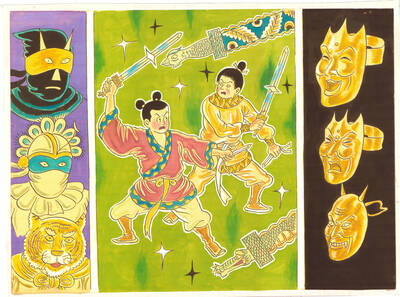
April 22 to April 28 The true identity of the mastermind behind the Demon Gang (魔鬼黨) was undoubtedly on the minds of countless schoolchildren in late 1958. In the days leading up to the big reveal, more than 10,000 guesses were sent to Ta Hwa Publishing Co (大華文化社) for a chance to win prizes. The smash success of the comic series Great Battle Against the Demon Gang (大戰魔鬼黨) came as a surprise to author Yeh Hung-chia (葉宏甲), who had long given up on his dream after being jailed for 10 months in 1947 over political cartoons. Protagonist


 RSS
RSS