


The Weekender reviewers got off to an early start with the Dance Forum production Blink at the Novel Hall last Wednesday. The two pieces on the program were completely different, but both allowed the company's dancers to shine.
Choreographer Lin Wen-chung (林文中) began constructing his piece, the 40-minute Evil Boy Trilogy, three years ago, and it reflects the care and thought that went into it. A simple set, the only decoration a series of ribbons criss-crossing above the stage, and minimalists costumes, kept the eye focused on the dancers. Group work was interspersed with a lovely solo and duets, while fast-paced segments gave way to more lyrical passages.
Toru Shimazaki's Run began with a pulsating, driving beat and a circle of dancers clad in bright ragbag costumes, setting a fast pace for the 20-minute work. The score was mesmerizing, as was Shimazaki's choreography, and it ended all too soon in a shower of glitter cascading from the flies above the stage. I was left wanting more, although I doubt the exhausted dancers felt the same way.
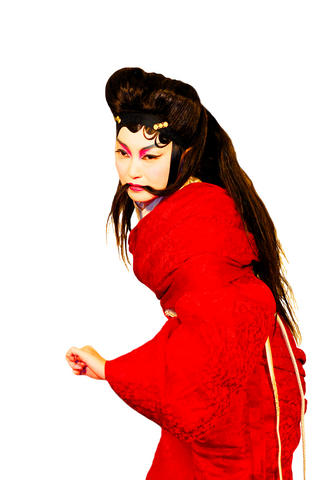
PHOTO: COURTESY OF CLI
U-Theatre's (優劇場) latest production, Mountain Dawn (入夜山嵐), is a quiet homage to their Laoquanshan (老泉山) home. While it is hard to think of a drumming group being quiet, this work is, probably because the drums took a supporting role to the gongs after the cheery all-drumming opening segment.
The second piece on the program was a beautiful duet by drumming master Huang Chih-chun (黃誌群) and Tu Chi-chao (杜啟造), who twirled back and forth to play on eight gongs hanging from a huge sculptured-tree stand.
The third piece used the two big gongs at the back of the stage. It seemed as if you could feel the reverberations of the gongs, not just hear them. In the fourth piece, five sculptured gong stands and five women took center stage and the women's slow rhythmic movements were almost hypnotic.
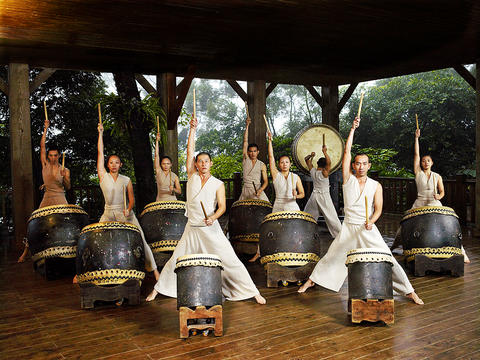
PHOTO: COURTESY OF U-THEATRE
One of U-Theatre's trademarks are the segues from one composition to the next. In Mountain Drum those movements were a combination of tai chi and meditative dance, including the finale, when the entire company was on-stage, moving slowly, quietly, raising and lowering their arms, softly lulling the audience into tranquility. It was so quiet all you could hear were the bugs chirping in the night air and the rustling of tree branches.
And then it was over, and you had to walk back down to the road, to the shuttle buses and cars, back to your life - when all you wanted to do was sit, watch and listen to U-Theatre for the rest of the night.
On Thursday, the premiere of Contemporary Legend Theater's (當代傳奇劇場, CLT) The Butterfly Dream (夢蝶) attracted a full house at the National Theater for one of the most highly anticipated theatrical events of the year. It brought together Wu Hsing-kuo (吳興國), the company's founder, with celebrated Kun opera star Qian Yi (錢熠) in what was billed as a radical re-interpretation of a classic work. Artistic fusions have always been CLT's forte, but The Butterfly Dream, with its vast ambitions to combine contemporary romanticism with classical Daoist philosophy and Confusion morality, failed to produce a really compelling theatrical event.
The work, which was also a highly personal composition by Wu's wife and CLT's long-time producer Lin Hsiu-wei (林秀偉), showed all the signs of being excessively self-indulgent, and the show, at over three-hours in length, was in need of a strong editorial hand to condense the promising material into a show of about two hours.
The Butterfly Dream suffered from a somewhat uneven script, and where harsh juxtapositions of the classical and the contemporary often worked reasonably well in the rough-and-ready 108 Heroes (水滸108), which CLT premiered earlier this year, they were jarring in a show that required greater elegance and unity of composition. There was also little need for the bombastic score, which strained to produce a dramatic tension that simply wasn't in the script.
Overall, for all the beauty and skill that was present in the performance - something that needs to be emphasized amidst this flurry of criticism - the show suffered almost fatally from a lack of formal rigor in composition and for a facile sentimentality that fatally undermined its philosophical pretensions.
CLT must be applauded for including more than adequate subtitles in English for this show, a trend that we can only hope other groups will emulate as an important means of giving Taiwan's theatrical products greater accessibility for an international audience.
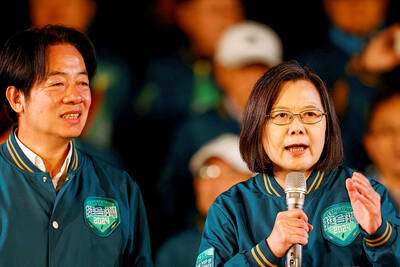
Last week Joseph Nye, the well-known China scholar, wrote on the Australian Strategic Policy Institute’s website about how war over Taiwan might be averted. He noted that years ago he was on a team that met with then-president Chen Shui-bian (陳水扁), “whose previous ‘unofficial’ visit to the US had caused a crisis in which China fired missiles into the sea and the US deployed carriers off the coast of Taiwan.” Yes, that’s right, mighty Chen caused that crisis all by himself. Neither the US nor the People’s Republic of China (PRC) exercised any agency. Nye then nostalgically invoked the comical specter
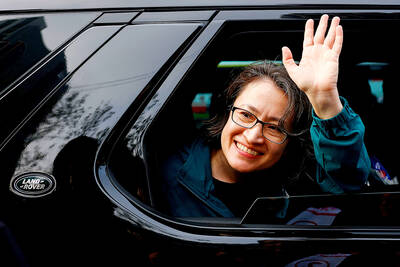
Relations between Taiwan and the Czech Republic have flourished in recent years. However, not everyone is pleased about the growing friendship between the two countries. Last month, an incident involving a Chinese diplomat tailing the car of vice president-elect Hsiao Bi-khim (蕭美琴) in Prague, drew public attention to the People’s Republic of China’s (PRC) operations to undermine Taiwan overseas. The trip was not Hsiao’s first visit to the Central European country. It was meant to be low-key, a chance to meet with local academics and politicians, until her police escort noticed a car was tailing her through the Czech capital. The
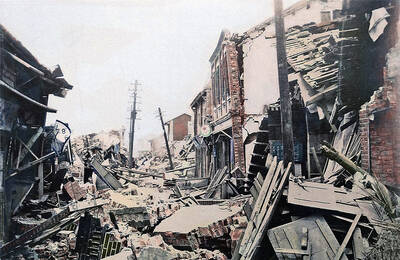
April 15 to April 21 Yang Kui (楊逵) was horrified as he drove past trucks, oxcarts and trolleys loaded with coffins on his way to Tuntzechiao (屯子腳), which he heard had been completely destroyed. The friend he came to check on was safe, but most residents were suffering in the town hit the hardest by the 7.1-magnitude Hsinchu-Taichung Earthquake on April 21, 1935. It remains the deadliest in Taiwan’s recorded history, claiming around 3,300 lives and injuring nearly 12,000. The disaster completely flattened roughly 18,000 houses and damaged countless more. The social activist and

Over the course of former President Ma Ying-jeou’s (馬英九) 11-day trip to China that included a meeting with Chinese Communist Party (CCP) leader Xi Jinping (習近平) a surprising number of people commented that the former president was now “irrelevant.” Upon reflection, it became apparent that these comments were coming from pro-Taiwan, pan-green supporters and they were expressing what they hoped was the case, rather than the reality. Ma’s ideology is so pro-China (read: deep blue) and controversial that many in his own Chinese Nationalist Party (KMT) hope he retires quickly, or at least refrains from speaking on some subjects. Regardless


 RSS
RSS