


 |
The 2007 Taipei Golden Horse Film Festival
Li Ya-mei, former head of the Golden Horse competitionPHOTO: TAIPEI TIMES PHOTOS: LIBERTY TIMES |
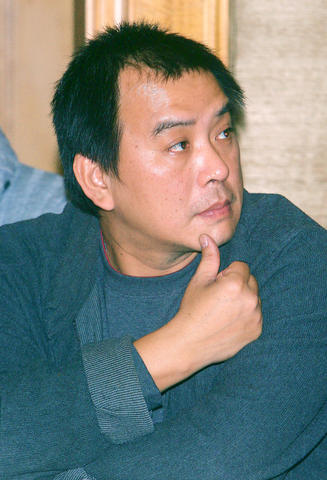
PHOTO: TAIPEI TIMES
Lust, Caution (色,戒) swept the 44th Golden Horse Awards (金馬獎) last weekend, putting many film professionals, critics and audiences in a festive mood. The raft of accolades may, however, also temper worries that Taiwanese cinema is being marginalized from the country's own competition, which has in recent years been dominated by works from China, Hong Kong and Singapore.
To many observers, internationalization of the Chinese-language equivalent of the Oscars seems to be inevitable if the awards are to maintain their competitiveness and be reinvented as a top notch event. Others feel that the Golden Horse, sponsored by the Government Information Office (新聞局), has drifted further away from the local film industry than it should.
PHOTO: TAIPEI TIMES
From foal to horse
The early days of the Taipei Golden Horse Film Festival (TGHFF, 台北金馬國際影展), which leads up to the awards ceremony, were politically slanted. Its inception in 1962 was, in large part, made in celebration of former president Chiang Kai-shek's (蔣介石) birthday, according to Angelika Wang (王耿瑜), who has headed both the competition and film festival and was a Golden Horse jury member for several years. It wasn't until 1990 that the TGHFF executive committee was established.
By the mid 1990s, the slumping local film industry, effects of globalization and impending handover of Hong Kong to China prompted the Golden Horse, previously reserved for films made in Taiwan and Hong Kong, to open its doors to all Chinese-language films. The decision was approved in a public hearing composed of local journalists, film professionals and scholars in 1997, said Li Ya-mei (李亞梅), who headed the competition for nine years.
The Chinese government granted co-productions permission to enter the contest around three years ago, but films wholly financed by Chinese capital are still barred. Candidate films are often withdrawn due to political intervention, Li said. The issue, however, came to prominence this year when organizers were "a bit too careless and let exclusively Chinese films in. Their withdrawals made headlines," Li said.
Jury committee expanded
Another controversy emerged when this year's jury committee was to include members from the trade unions, which have ceased to attract younger generations of filmmakers as the local industry continues to decline. Many trade union members retired from making movies decades ago and their understanding of cinema is often seen as outdated, if not completely obsolete.
"The union members' tastes are inevitably inclined to conservatism. I think it is part of the reason why this year's nominations were dominated by Chinese cinema rather than the genre films of Hong Kong," Li said.
To Peggy Chiao (焦雄屏), a former Golden Horse festival and awards chairwoman, however, opening the jury to the new members may be the price that must be paid to reinvigorate the unions. She believes participating in the event can help union members keep up with the international film environment and thus help the local industry.
Finding a stride
As the oldest and only Chinese-language cinema competition in Asia, the Golden Horse Awards have been a well-respected model for other similar film festivals such as the Hong Kong Film Awards and China's Golden Rooster Awards, both of which are limited to local works.
Yet, like the local enterprises striving to upgrade in the face of fast-growing competition from China, the film festival is said to be facing a survival crisis. Many in the industry feel it is only a matter of time until China sets up its own Chinese-language cinema awards, diverting attention from Taiwan's competition. The only way for the TGHFF to remain on top, Chiao said, is to further open it to films and filmmakers around the world and occupy that niche ahead of others.
"The vantage point is in China," Chiao said, "with its coveted market drawing capital, talent and resources … . Though our film industry has gone downhill, the Golden Horse Awards have remained competitive, so far. I think further reforms need to be made so that it will take a long while for China to catch up with us."
Fostering local talent
The plan sounds promising except that the local film industry, which is suffering from a serious talent drought as production levels have been too small to train and support technical personnel, would be excluded. From Chiao's point of view, though, these are problems beyond the festival's remit and it is unreasonable to expect the Golden Horse to solve them. As organizers, they feel they are responsible for the competitiveness of the festival, not of the industry.
To local directors like Chang Tso-chi (張作驥), the competition has become more of a yearly party that distances itself from local filmmakers. Another sore spot is that the TGHFF sometimes seems like a competition-driven business rather than a cultural undertaking.
"Awards are, after all, just awards," said Wang, "They are mere reflections on the film environment as a whole … . However, the most positive value of having the awards ceremony is, I believe, to foster a connection with local film environment."
Forging connections
Both Li and Wang agree that if the Golden Horse is to have constructive influences on the local film industry, the competition itself should not be seen as one night of glory, but as an occasion packed with activities through which local filmmakers could meet film workers from other countries.
The Taiwan Film and TV Project Promotion expo (台灣國際影視創投會), initiated in 2005 in conjunction with the festival, presents the opportunity for local filmmakers to meet investors, producers and distributors from around the world and to scout Chinese-language TV and film projects, Chiao said.
Though smaller in number and budget, the selected projects feature many local faces including up-and-coming filmmakers Lin Yu-hsien (林育賢) and Ho Wi-ding (何蔚庭) and veteran directors Chang Tso-chi and Cheng Wen-tang (鄭文堂).
Open to local filmmakers, the co-production meetings held by industry luminaries during the promotional fair also serve as venues for exchanges.
"TGHFF should become an event young filmmakers are willing to attend to get to know people, to be known and show their works. Everything can fall into place more easily when we accomplish this first step," Li said.
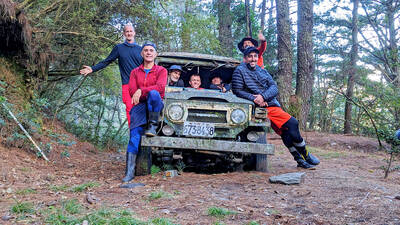
The year was 1991. A Toyota Land Cruiser set out on a 67km journey up the Junda Forest Road (郡大林道) toward an old loggers’ camp, at which point the hikers inside would get out and begin their ascent of Jade Mountain (玉山). Little did they know, they would be the last group of hikers to ever enjoy this shortcut into the mountains. An approaching typhoon soon wiped out the road behind them, trapping the vehicle on the mountain and forever changing the approach to Jade Mountain. THE CONTEMPORARY ROUTE Nowadays, the approach to Jade Mountain from the north side takes an

Relations between Taiwan and the Czech Republic have flourished in recent years. However, not everyone is pleased about the growing friendship between the two countries. Last month, an incident involving a Chinese diplomat tailing the car of vice president-elect Hsiao Bi-khim (蕭美琴) in Prague, drew public attention to the People’s Republic of China’s (PRC) operations to undermine Taiwan overseas. The trip was not Hsiao’s first visit to the Central European country. It was meant to be low-key, a chance to meet with local academics and politicians, until her police escort noticed a car was tailing her through the Czech capital. The

Last week Joseph Nye, the well-known China scholar, wrote on the Australian Strategic Policy Institute’s website about how war over Taiwan might be averted. He noted that years ago he was on a team that met with then-president Chen Shui-bian (陳水扁), “whose previous ‘unofficial’ visit to the US had caused a crisis in which China fired missiles into the sea and the US deployed carriers off the coast of Taiwan.” Yes, that’s right, mighty Chen caused that crisis all by himself. Neither the US nor the People’s Republic of China (PRC) exercised any agency. Nye then nostalgically invoked the comical specter
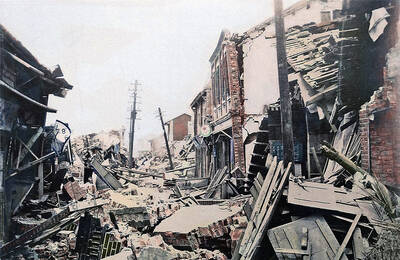
April 15 to April 21 Yang Kui (楊逵) was horrified as he drove past trucks, oxcarts and trolleys loaded with coffins on his way to Tuntzechiao (屯子腳), which he heard had been completely destroyed. The friend he came to check on was safe, but most residents were suffering in the town hit the hardest by the 7.1-magnitude Hsinchu-Taichung Earthquake on April 21, 1935. It remains the deadliest in Taiwan’s recorded history, claiming around 3,300 lives and injuring nearly 12,000. The disaster completely flattened roughly 18,000 houses and damaged countless more. The social activist and




 RSS
RSS